< Extracted from Paul the Persian, Aristotle’s Logic, edited and translated by Raham Asha, Paris, Ermān, 2004; Tehran, ParsiAnjoman, 2016. For more information click here. >
pārsīg
abar perì e͑rmēneías. hangirdīg
mardōm az hān ī agōbāg ped gōbāgīh abardar, ud harv cē nē dāned u-š tuvān dānistan ud kāmed dānistan ā-š ped rāh ī gōbāgīh dāned, cē abzār ī harvtis dānistan gōbāgīh ast, ud ēd rāy fradum gōbāgīh sazed dānistan.
§ bahrīhā ī gōbišn šaš hend: nām, vāxš, guhrīg-nām, kanārag-vāxš, abarnīsišn, bann.
1) nām vāng-ē ast ī, daxšagumandīhā, jud az zamān tis nišānēned, ud agar baxšīhed ēc nē nišānēnd, cōn «mardōm», «asp», «murvārīd». cē agar «muvārīd» baxšīhed ō «mur», «vā», «rīd», ēg ēc nē nišānēned, ēd rāy agar-z «mur» ka judāgīhā gufsed nišān ī tis ast, bē ka andar «murvārīd» nē nišān ī hān tis.
2) vāxš vāng-ē ast ī, daxšagumandīhā, kunāgīh ayāb krīyišn-ē abāg zamān nišānēned. kunāgīh cōn «burram», kirīyišn cōn «burrīhed».
nām ud vāxš ped do ēvēnag hend: ēk, vimandumand cōn «mardōm», «burred»; ud ēk abēvimand, cōn «nē-mardōm», «nē-burred».
3) guhrīgnām vāng-ē ast ī ped guhrīg ī nām gōbīhed, cōn «an», «tū», «ōy», «amāh», «ašmāh», «avēšān», «ēn», «hān».
4) kanāragvāxš ast vāng-ē ī abar vāxš vāxt ēsted, cōn «frihgōn», «ērdanīhā», «kāmagzīvišnīhā».
5) abarnīsišn (meyānjīg) vāng-ē ast ī abar gōbišn nīsād ēsted, cōn «pas», «pēš», «bē», «andar», «nē», «ōhāy» («ēvar»).
6) bann vāng-ē ast ī gōbišn-ē ō gōbišn-ē banned, cōn «cē» («ēd rāy cē»), «gahī», «agar», «anī» (: anī … anī) –daxšag.
ud az hāmōyēn bahrān ī gōbišn nām ud vāxš māyagvarīhādar, ud az ēn do nām abērdar.
§ ud ēd rāy dānāgān ast ī ka ō hāmōyēn bahrān ī gōbišn nām dahend. panz hend ēvēnagīhā ī nām abar tis gōbīhed: hamnāmīh, āgenīnnāmīh, vasnāmīh, judnāmīh, aznāmīh.
1) hamnām hend do ayāb vas tis ī ka-šān nām ēk, bē-šān cihr ī ped hān nām jud, cōn «tēzīh» [gufsed] ō menišn ud ō tēg ud ō kanārag ud ō raftārān.
2) āgenīnnām hend do ayāb vas tis ī ka-šān nām ēk u-šān-z cihr ī ped hān nām ēk, cōn «mardōm» [gufsed] ō man ud ō tō ud ō abārīg mardōmān.
3) vasnām ast ēk tis ī-š nām nē ēk, cōn «tēg», «šafšēr», «cilān».
4) judnām hend vas tis juttar ī-šān nām-iz juttar, cōn «zamīg», «āb», «xvar».
5) aznām ast nām-ē ī az anī nām baved, cōn az «durgarīh» «durgar», ud az «āhangarīh» «āhangar».
§ cahār tis:
1) nibēg (dibīrīh);
2) vāng;
3) parmānag;
4) tis ī-š abar parmānag baved.
nibēg nišānag ī tis ī andar vāng. ud vāng nišānag ī parmānag ī andar ruvān. ud harv parmānag az tis baved ud abar tis. ud nibēg ud vāng harvisp [mardōmān] rāy nē ham hend, bē parmānag ud tis ī-š abar parmāyīhed harvisp rāy ham hend. ēd rāy cē parmānag ud tis ī-š abar parmāyīhed cihragīhā hend, bē vāng ud nibēg daxšagumandīhā.
ast ī ka parmānag andar ruvān, ud nē rāst nē vaxr, cōn agar kas parmāyed tanīhā «asp»; ud ast ī ka rāst ayāb vaxr, cōn agar kas parmāyed kū «asp cahārbāy ast» ayāb «asp cahārbāy nēst». cē ka ped ēk bahr ī gōbišn judāg parmāyed ayāb gōbed, nē rāstīh baved nē vaxrīh; bē ka ped harv do, gāh-ē ēv abāg did ast, ayāb ēv az did jud. ēdōn, hō parmāng ī andar ruvān judāg ped vāng grift baved, cōn nām ayāb vāxš ī judāg ped vāng gōbīhed, parmānag ēvāzīg (judāg) nēst, bē ēvāz parmānag; nē-z nām ayāb vāxš ī judāg gōbīhed gōbišn, bē ēvāz nām ayāb vāxš.
§ gōbišn ped do ēvēnag baved: ēk, ped parmān, ud ōy dānišnīg; ud ēk, ped uzvān, ud ōy mārišnīg. ka parmānag ī andar ruvān abāg anī parmānag pesāxted, ēg ped hān gāh gōbišn dānišnīg baved, ud ast ī ka rāst ayāb vaxr, ud ast ī ka nē rāst ud nē vaxr, cē nē harv gōbišn rāst ayāb vaxr, cōn pasādar bē gōbem. ud ka ped vāng jumā nām ud vāxš gufsend, ēg ped hān gāh gōbišn mārišnīg baved, ud ast ī ka rāst ayāb vaxr, ud ast ī ka nē rāst ud nē vaxr, cōn hān ī ped parmān.
gōbišn vāng-ē ast ī, ped nihādag, tis nišānēned, ud agar baxšīhed, ēg-iz bahrīhā [tis] nišānēnend, cōn «mardōm uštānumand ast», ēd xvad nišānēnāg; ud agar baxšīhed, ēg-iz harv ēk az bahrān nišānēnāg, cōn hān ī nām («mardōm») ud hān ī vāxš («uštānumand ast»).
§ dah sardag gōbišn ī hend: xrōhišnīg, pursišnīg, framāyišnīg, peyvahišnīg, vizīrīg, vidimāsišnīg, sōgandīg, abarnihād, nihišnīg, gumānīg.
1) xrōhišnīg, cōn «ēdar āy!».
2) pursišnīg, cōn «az kū hē tū?».
3) framāyišnīg, cōn «šav az ēdar!».
4) peyvahišnīg, cōn «day ō man ē tis!».
5) vizīrīg, cōn «xvar tābāg ast».
5) vidimāsišnīg, cōn «cē tābāg xvar!».
7) sōgandīg, cōn «xvadāy dāned kū tābāg ast».
8) abarnihād, cōn «bē baved hān gyāg mēhan, ēdōn bavād!».
9) nihišnīg, cōn «agar xvar ast, tābāg ast».
10) gumānīg, cōn «kay būd ē tis?».
gōbišn ped panz [sardag-iz ēvāz] tuvān baxtan, xrōhišnīg ud pursišnīg ud framāyišnīg ud peyvahišnīg ud vizīrīg. cē gumānīg hān pursišnīg ast ī ō xvad pursed; vidimāsišnīg ēvāz ped «cē» frāy az vizīrīg, agar nē xvad vizīrīg; sōgandīg ped gugāyīh ī yazd frāy az vizīrīg, agar nē xvad-iz vizīrīg; abarnihād āškārag vizīrīg ast, bē ēvāz ped «ēvar» frāy az vizīrīg, agar nē xvad vizīrīg. pēdāg kū agar hān ī gumānīg andar pursišnīg, ud vidimāsišnīg ud sōgandīg ud abarnihād ud nihišnīg andar vizīrīg hend, ped ēn šōn, ōn cōn [azabar] guft ēsted, panz hend sardagīhā ī gōbišn.
§ rāstīh ud drōvīh (vaxrīh) ēvāz ped vizīr ast, cē ōy kē gōbed kū «xvar tābāg ast» ped vizīr rāst gōbed, ud ōy kē gōbed kū «xvar nēst tābāg» ped vizīr drōv drāyed. bē ōy kē ō kas xrōhed ayāb pursed ayāb framāyed ayāb peyvahed ped hān ī xrōhed ud pursed ud framāyed ud peyvahed nē rāst gōbed nē drōv drāyed. ud frazānagān rāy ēvāz abar ēd gōbišn vizīrīg āmāxšišn, ēd rāy cē kāmend dānistan abar harvtis rāstīh ud drōvīh, kū dā rāstīh gīrānd ud drōvīh hilānd. cē abārīg cahār gōbišn anī tis rāy būzend, bē gōbišn vizīrīg ēvāz dānišn rāy.
§ vizīr ast < … ka bahr-ē syāh ud kē gōbed kū «syāh ast» ud > bahr-ē nē syāh [ud kē] gōbed kū «nēst syāh», harv do rāst gōbend, ud nēst hamēstārīh pedisāy judbahrīh.
ud agar hān ī ēk gōbed «bahrīhā cahār hend», ud anī gōbed «cahār bahr nē hend», ud ēd kē gōbed kū [cahār] bahr hend hassār (hampediz) ašt gōbed, ud hō kē gōbed kū bahrīhā [cahār] nē hend hassār do gōbed, jumā rāst gōbend, ud pedisāy judhassārīh hambasānīh nēst.
ud agar hān ī ēk gōbed «rēdak mārīgušmār ast», ud anī gōbed «rēdak nēst mārīgušmār», ud ēd kē gōbed kū mārīgušmār ast ped nirōg gōbed, ud hō kē gōbed kū nēst mārīgušmār ped kunišn gōbed, harv do rāst gōbend ud nēst hambasānīh, pedisāy judtisīh.
ped ē ī ēd āšnāg kū hambasānīh gahī baved ka hān tis ī nīsem ud hān tis ī vāzam ham hān baved andar xustūgīh ud nigīrāyīh, ud nē ped hamnāmīh ud nē ped abāgnāmīh, ud nē ped anī ud anī zamān, ud nē ped anī ud anī bahr, ud nē ped anī ud anī hassārīh (handāzag), ud nē ped anī ud anī tis.
§ ēd cē gufted ēvāzīhā gufted cōn «Sōkrátēs», ayāb dahīgīhā ud nē ēvāzīhā; ud ēd nē vimandēnīd ē-š nēst parvann, ōn cōn «mardōm», āyāb vimandēnīd ē-š ast parvann, ōn cōn «harv mardōm». parvannīhā cahār hend: harv, ēv, ēc nē, nē harv. ud az imīn do ped xustūgīh hend, ud do ped nigīrāyīh, ōn cōn «harv mardōm mārīgušmār», «ēv mardōm mārīgušmār», «nē ēc mardōm mārīgušmār», «nē harv mardōm mārīgušmār».
§ māyagīhā ī-šān, ped cihr, gōbišn abar gōbīhed sē hend: acārīg, tuvānīg, nē-šāyedbūd.
1) acārīg ast ēd cē ast ud anī nē šāyed būdan, cōn «vehīh» ud «vattarīh», «do ud do cahār».
2) tuvānīg ast ēd tis ī ast ud anāy tuvān būdan, cōn kē raved nišīyed, ayāb hān tis ī nēst ud šāyed būdan, cōn kē nēst mārīgušmār ud ēd būdan šāyed.
3) nē-šāyedbūd gōbīhed hān ī nēst ud nē-z būdān tuvān, hān ī šagr xūg, ayāb mardōm ped cihr cahārbāy, ayāb do ud do dah.
§ pedīragēstišnīh ī abar tis ēvāzīg hamvār andar harv māyag ī ped cihr hambasānīh kuned, cē abar cihr ī hān ī acārīg hamvār xustūgīh rāst, ōn cōn «Sōkrátēs mardōm ast», ud hamvār nigīrāyīh drōv, ōn cōn «Sōkrátēs nēst mardōm»; ud abar cihr ī nē-šāyedbūd hamvār xustūgīh drōv, ōn cōn «Sōkrátēs xūk ast», ud hamvār nigīrāyīh rāst, ōn cōn «Sōkrátēs nēst xūk»; ud abar-z cihr ī tuvānīg ēk rāst ud anī drōv, ōn cōn «Sōkrátēs yazdīg ast», ud «Sōkrátēs nēst yazdīg».
pedīragēstišnīh ī abar tis hamāgīg ī-š nēst parvann abar cihr ī acārīg hambasānīh kuned, ud hamvār xustūgīh rāst, cōn «mardōm uštānumand ast», ud hamvār nigīrāyīh drōv, cōn «mardōm nēst uštānumand»; ud abar-z cihr ī nē-šāyedbūd hamvār hambasānīh kuned ud hamvār xustūgīh drōv, cōn «mardōm xar ast», ud hamvār nigīrāyīh rāst, cōn «mardōm nēst xar»; ud abar cihr ī tuvānīg tuvān kū harv do rāst bavend, cōn «mardōm raved», «mardōm nē raved», ud ēd ēvaz pedīragēstišnīh ast ud nē baved hambasānīh.
bē abar tis hamāgīg ud nē ēvāzīg ī-š ast parvann pedīragēstišnīh ped šaš ēvēnag baved ī nūn gōbem:
1) «harv mardōm ast», «ēc mardōm nēst»;
2) «harv mardōm ast», «mardōm-ē ast»;
3) «ēc mardōm nēst», «nē harv mardōm ast»;
4) «mardōm-ē ast», «nē harv mardōm ast»;
5) «harv mardōm ast», «nē harv mardōm ast»;
6) «mardōm-ē ast», «ēc mardōm nēst».
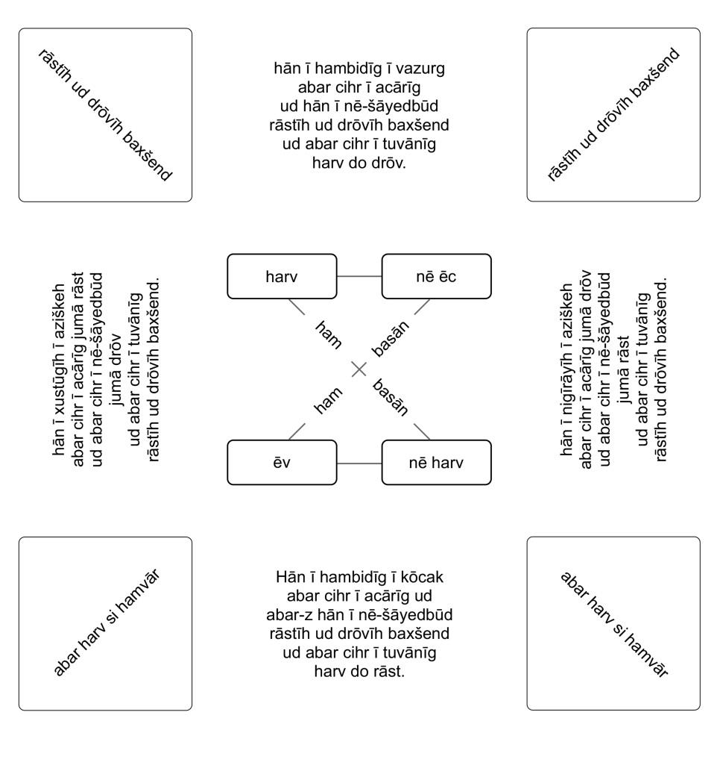
ud hān ī pedīragēstišnīh ī-š ast andar «harv» ud «nē ēc», hambidīg ī vazurg nāmīhed; ud hān ī-š ast andar «harv» ud «ēv» xustūgīh ī aziškeh xvand ēsted, ud hān ī-š ast andar «nē ēc» ud «nē harv» nigīrāyīh ī aziškeh nāmīhed; ud hān ī-š ast andar «ēv» ud «nē harv» hambidīg ī kōcak xvand ēsted; ud hān ī-š ast andar «harv» ud «nē harv» anī-z hān ī-š ast andar «ēv» ud «nē ēc» harv do az gōšagān ud hambasān nāmīhend.
ud hān ī hambidīg ī vazurg, abar cihr ī acārīg ud abar-z hān ī nē-šāyedbūd, rāstīh ud drōv baxšed; ud abar cihr ī tuvānīg nē baxšed, cē tuvān kū xustūgīh ud nigīrāyīh hangōn vaxr bavend, ōn cōn «harv mardōm drust» ud «ēc mardōm nē drust».
ud hān ī hambidīg ī kōcak, abar cihr ī acārīg ud cihr ī nē-šāyedbūd, rāstīh ud vaxrīh baxšed, ud abar cihr ī tuvānīg nē baxšed, cē tuvān kū harv do rāst bavend, ōn cōn «mardōm-ē drust» ud «nē harv mardōm drust».
ud hān ī xustūgīh ī aziškeh, abar cihr ī acārīg, hamvār hamis rāst; ud abar cihr ī nē-šāyedbūd hamvār āgenīn vaxr; ud abar cihr ī tuvānīg hamvār ēk rāst ud ēk vaxr, ōn cōn «harv mardōm mārīgušmār», «mardōm-ē mārīgušmār».
ud hān ī nigīrāyīh ī aziškeh, abar cihr ī acārīg, hamvār hamis vaxr; ud abar cihr ī nē-šāyedbūd, hamvār hamis rāst; ud abar cihr ī tuvānīg, hamvār rāst ud vaxr baxšed, ōn cōn «ēc mardōm nē mārīgušmār», «nē harv mardōm mārīgušmār».
ud harv do hambasānīh hamvār, abar harv māyag ī ped-cihr, rāstīh ud vaxrīh baxšend, ud ēk rāstīh pedīred ud ēk drōvīh. ud hān ī hambidīg ī vazurg hagriz hamis rāst nē baved, bē ast ī ka hamis vaxr; bē hān ī hambidīg ī vazurg hagriz hamis vaxr nē baved, bē ast ī ka hamis rāst; ud hān ī xustūgīh ī aziškeh ud nigīrāyīh ī aziškeh, ast ī ka āgenīn rāst, ud ast ī ka hamis vaxr, ud ast ī ka hamis rāstīh ud vaxrīh baxšend.
bē ēvāz avīn ī az gōšag hambasānīh kunend, cē hamvār rāstīh ud drōvīh baxšend. vahān ēd kū, hān ī hambidīgān ī vazurg ēvāz ped cōnīh pedīrag hend, ped ē ī ēk xustūgīh ud ēk nigīrāyīh, bē-š ped candīh nēst pedīragīh, cē jumā harvtis anī nīsed anī abdāzed; ud hān-z ī hambidīgān ī kōcak, hamgōnag, anī bahr-ē nīsed anī bahr-ē abdāzed. ud hān ī aziškehān, jumā ped cōnīh nē pedīrag, cē jumā xustūgīh ayāb nigīrāyīh, bē ēvāz ped candīh pedīrag hend, cē hamvār anī harvtis ud anī nē harv tis nīsed ayāb abdāzed. bē avīn kē az gōšag, harv do ham ped cōnīh ud ham ped candīh pedīrag hend, cē hamvār anī xustūgīh ud anī nigīrāyīh, anī hamāgīg ud anī nē hamāgīg.
ud nimūdār ēn ast:
§ ast ī ka andar xustūgīh ud hān ī nigīrāyīh nām ēk ast ud vāxš ēk, ud ast ī ka andar harv do nām do. ud agar-šān ēk nām ast pēšnihād sādag, ē gōbišn ī sādag; bē-šān agar do nām pēšnihād pesāxtag ast, ē gōbišn ī pesāxtag. bē az vāxš nē xustūgīh sāzend ud nē nigīrāyīh. harv ēk xustūgīh ō ēk nigīrāyīh pedīrag, ud harv ēk nigīrāyīh ō ēk xustūgīh.
§ andar gōbišn vizīrīg hamē ka «nē» abāg nām gōbīhed xustūgīh baved, ud ka abāg vāxš gufsed nigīrāyīh, cē hān gōbišn kē gōbed «Sōkrátēs mardōm ast» ā-š nigīrāyīh ēd kū «Sōkrátēs mardōm nēst», ud hān gōbišn kē gōbed kū «Sōkrátēs nē mardōm ast» xustūgīh, a-š nigīrāyīh ēd: «Sōkrátēs nē mardōm nēst». harv xustūgīh ī-š ast «nē» andar, nimāyed kū nigīrāyīh ast bē agar andar vāxš «nē» gōbed; ud harv nigīrāyīh ī-š ast do «nē», nimāyed kū xustūgīh ast, ud hāmgōnag andar vāxš «nē» gōbed.
andar nigīrāyīh ī-š ast parvann, hamvār «nē» abāg parvann gōbem, cōn «nē harv» ud «nē ēc».
§ ka andar vizīr do nām ast, hagriz nē gōbem parvann abāg hān nām kē vāxt ēsted, bē hamvār abāg hān nām gōbem kē nīsād ēsted, cē nē cōn šāyed ka gōbem kū «harv mardōm gyānvar ast», hamēdōn-z ka gōbem kū «mardōm harv gyānvar ast» ped rāst dārem, ped ē ī drōv.
§ ōn cōn sē hend bahrīhā ī zamān, hamgōnag-iz gōbišnīhā, ped ē ī harv gōbišn ped sē zamān baved, «Sōkrátēs ast», «Sōkrátēs būd», «Sōkrátēs baved».
§ harv hambasānīh hamvār rāstīh ud drōvīh baxšed, cōn [azabar] guft, bē nē hamvār ped ham gōnag, cē abar tis ī ast ud tis ī nē šāyed būdan ōn baxšed cōn amāh-iz dānem kadām rāst ud kadām drōv; bē abar cihr ī tuvānīg ud abar tis ī frāzdar bē baved nē hamvār ped ham gōnag baved ōn baxšed cōn amāh nē dānem kū agar xustūgīh rāst agar nigīrāyīh dā kū bē baved, cōn anī gōbed kū «fradāg vārān bē baved» ayāb «fradāg ardīg bē baved», ud anī gōbed kū «fradāg vārān nē baved» ayāb «fradāg ardīg nē baved».
sē hend bahrīhā ī cihr ī tuvānīg:
1) hān ī cōn ped vēšistīh baved u-š frāz aviš cihr;
2) hān ī kem ud dūrzamān baved u-š frāz aviš jahišn,
3) hān ī ped meyānagīh ī ast ī ka ēdōn ud ast ī ka ēdōn baved u-š frāz aviš kām ī amāh.
ud mardōmān abar ēn bahr [ī sidīgar] ēvāz ēk ō did pursend ud hampursagīh kunend ud uskārend. ast kē gōbed kū harv tis abāyedbūd ud baved, cē cihr ī tuvānīg andar abāyed, andar xvēš cihr, būdan ayāb nē būdan, cē andar abāyed fradāg vārān būdan ayāb nē būdan, ud an šavam ō Hindūgān ayāb nē šavam, bē amāh dā bē baved nē dānem. ud harv tis ped ōn cōn ast ped xvadīh ped dāštan, ud nē ōn cōn amāh dānem. bē agar harvtis abāyedbūd ud baved, ud ēc tis ped jahišn ud ped kām nē baved, ēg handarz ud hampursagīh ud kunišn ud pahrēzišn ud kirbakkarīh ud bazakkarīh ī mardōmān ud pādifrāh ud pādāšn ī dušox ud vahišt frāybūd, ud ēd andar avīn ī pessazag griftan, hān vaxr; ayāb nē harvtis abāyedbūd ud baved, bē-z ped jahišn ud ped kām baved.
§ hamē ka ēk nām ud ēk vāxš āgenīn guft bavend cahār hend pedīragēstišnīh: ēk abar tis ī ēvāzīg, ēk abar tis ī hamāgīg ī-š nēst parvann, ud do abar tis ī hamāgīg ī-š ast parvann. ud ēd cahār, abar sē māyag ī ped cihr, dvāzdah bavend. ud ēd dvāzdah, abar sē zamān, bavend sīh-u-šaš. did ka ēk nām ud ēk vāxš, bēš nām nē vimandēnīd, anī sīh-u-šaš pedīragēstišnīh bavend ped ham dastvar. ud āškārag kū pedīragēstišnīh sādag hamāg haftād-u-do. ud ped pēšnihād pesāxtag ī-š do nām andar ast, anāy pedīragēstišnīh sad-u-cahal-u-cahār. cē, ped ham dastvar ī azabar guft, ka nām hān ī nīsād est ud hān ī vāxted jumā vimandēnīd gufsend, cōn «Sōkrátēs uštānumand ast», «mardōm uštānumand ast», «harv mardōm uštānumand ast», «mardōm-ē uštānumand ast», bavend sīh-u-šaš; ud ka nām hān ī nīsād vimandēnīd ud hān ī vāxted nē vimandēnīd, bavend anī sīh-u-šaš; ud did ka hān ī nīsād nē vimandēnīd ast ud hān ī vāxted vimandēnīd, bavend anī sīh-u-šaš; ud did ka harv do nē vimandēnīd, bavend anī sīh-u-šaš; ud cahār bār sīh-u-šaš sad-u-cahal-u-cahār. ud pedīragēstišnīhā, hān ī sādag az hān ī pesāxtag hamis, bavend dvēst-u-šāzdah.
§ ēd cē azabar abarvāxš guft ēsted, cōn «frihgōn», «ērdanīhā», ēvēnag ī gōbišn ast, cē ka ašnavam kū gōbišn frihgōn guft ēsted ayāb ērdanīhā, dānam kū ped cē ēvēnag guft ēsted. ēvēnag ast cōnīh ī hān ī nīsādag tis gufted, cē hān ī gōbed kū «hān mard frihgōn viyāvared», ē nimāyed kū hān mard hān gōbišn cōn gobed. ēvēnagīhā cōn ēn vasyār hend, ud amāh rāy asāg, bē avīn ī abērdar abāyem sē hend: abāyedbūd, tuvānīg, nē-šāyedbūd. ēvēnagīhā ī gōbišnān az māyagīhā ī ped cihr ī-šān pēšnihād gufsed ped ē jud hend kū māyagīhā ī ped cihr andar xvadīh ī tis hend, cē harvtis ī abar anī tis gufsed ayāb-iš hamvār abāg ud acārīg, ayāb-iš nē hagriz abāg ud nē šāyedbūd, ayāb ast ī ka-š abāg ud ast ī ka-š nē abāg ud tuvānīg ast; ud ēd rāy [māyagīhā] ped cihr guft ēstend, cē andar tis hend, bē ēvēnagīhā ēvāz ped viyāvarišn ī gōbišn az bē ō nām ud vāxš abzūd ēstend. ud and cand ast ī ka māyag ī cihrīg ī gōbišn rāst, bē nē pedisāy ēvēnag, cōn ka gufsed kū «Sōkrátēs ērdanīhā viyāvared», ud agar ōy viyāvared ud pādixšāyīhā viyāvared, ēg ēd ī viyāvared rāst, bē ēd ī frihgōn viyāvared drōv. andar nigīrāyīh ī ēvēnag hamvār «nē» abāg ēvēnag guft baved, cē agar abāg nām ayāb abāg vāxš gufsed xustūgīh baved nē nigīrāyīh.
§ pedīragēstišnīh ī abāg ēvēnag ēdōn baved:
ēvēnag andar pēšnihād ī az ēk nām ud ēk vāxš guft ēsted ayāb andar hān ī az do nām ud ēk vāxš. nām ayāb vimandēnīd est ayāb nē vimandēnīd, cōn azabar guft. agar az ēk nām ud ēk vāxš baved, pedīragēstišnīh cahār, ēdōn: «tuvān kū Sōkrátēs raved», «nē tuvān kū Sōkrátēs raved», «tuvān kū nē Sōkrátēs raved», «nē tuvān kū nē Sōkrátēs raved», «tuvān kū Sōkrátēs nē raved», «nē tuvān kū Sōkrátēs nē raved», «tuvān kū nē Sōkrátēs nē raved», «nē tuvān kū nē Sōkrátēs nē raved». bē agar do nām ud ēk vāxš bavend, pedīragēstišnīh ašt, ēdōn: «tuvān kū Sōkrátēs fīlāsōfā raved», «nē tuvān kū Sōkrátēs fīlāsōfā raved», «tuvān kū nē Sōkrátēs fīlāsōfā raved», «nē tuvān kū nē Sōkrátēs fīlāsōfā raved», «tuvān kū Sōkrátēs nē fīlāsōfā raved», «nē tuvān kū Sōkrátēs nē fīlāsōfā raved», «tuvān kū nē Sōkrátēs nē fīlāsōfā raved», «nē tuvān kū nē Sōkrátēs nē fīlāsōfā raved», «tuvān kū Sōkrátēs fīlāsōfā nē raved», «nē tuvān kū Sōkrátēs fīlāsōfā nē raved», «tuvān kū nē Sōkrátēs fīlāsōfā nē raved», «nē tuvān kū nē Sōkrátēs fīlāsōfā nē raved», «tuvān kū Sōkrátēs nē fīlāsōfā nē raved», «nē tuvān kū Sōkrátēs nē fīlāsōfā nēraved», «tuvān kū nē Sōkrátēs nē fīlāsōfā nē raved», «nē tuvān kū nē Sōkrátēs nē fīlāsōfā nē raved». ud abar tis ī ēvāzīg pedīragēstišnīh āgenīn dvāzdah bavend, ud abar tis hamāgīg ī-š nēst parvann anī dvāzdah, ud abar tis hamāgīg ī-š ast parvann ī-š «harv» ud «nē harv» abāg gufsed anī dvāzdah, ud abar hān ī-š «ēv» ud «nē ēc» gufsed anī dvāzdah, hamis cahal-ud-ašt bavend. ud imīn, abar sē zamān, bavend sad-u-cahal-u-cahār. ud imīn, abar sē māyag ī ped cihr, cahārsad-u-sīh-u-do. ud ēvēnagīhā ī gōbišn, cōn guft ēsted, sē hend, ud abāg ēn sē ēvēnag bavend hazār ud dvēst ud navad-u-šaš pedīragēstišnīh. imīn kē bē az ēvēnag, sādag haftād-u-do, pesāxtag sad-u-cahal-u-cahār; āgenīn dvēst-u-šāzdah. hamāg pedīragēstišnīhā az dvēst-u-šāzdah hamis hazār ud panzsad ud dvāzdah. ud pēšnihād xustūgīh abāg nigīrāyīh, bavend sihazār ud vīst-u-cahār, cē hamāg pedīragēstišnīhā āgenīn hend. anī dastvar ī gōbišn ī-š rāstīh ud drōvīh baved nēst, ud harv abārīg gōbišn ī ped vizīr guft baved az ēd dastvar nēk dānist baved.
frazaft
English
A short explanation of Aristotle’s On Interpretation (Περὶ Ἑρμηνείας)
Man is better than irrational [animals] by the logic, and everything he does not know, and it can be known, and he is willing to know, he knows it by means of logic, for logic is the instrument of knowing everything, and for this reason one should first of all know Logic.
§ The parts of speech are six: noun, verb, pronoun, adverb, preposition, and conjunction (particle).
1) A noun is a [spoken] sound signifying something, by convention, without reference to time, and if it be divided signifies nothing, for example, “man”, “horse”, “pearl” (/margānītā/), for if margānītā is divided into “mar”, “gā”, “nītā”, then [each part of it] signifies nothing by itself, therefore albeit when “mar” is said separately is the sign of something, but when it occurs in margānītā, it is not the sign of that thing.
2) A verb is a [spoken] sound significant, by convention, some action or passion with reference to time; an action (the active) is, for example, “I cut”, a passion (the passive), for example, ‘is cut”.
Nouns and verbs are of two sorts: One definite, for example, “man”, “cuts” (“is cutting”), and one indefinite, “non-man”, “not-cuts”.
3) A pronoun is a [spoken] sound which is said instead of the name, for example, “I”, “you”, “he”, “we”, “you”, “they”, “this”, “that”.
4) An adverb is a [spoken] sound which is predicated of a verb, for example, “amicably”, “humbly”, “freely”.
5) A preposition is a [spoken] sound which is affixed on a statement, as is affixed “after”, “before”, “out [of]”, “within”, “no”, “yes”.
6) A conjunction is a [spoken] sound which links a statement to a statement, for example, “because”, “therefore”, “if”, “on the one hand” –particle.
Out of all these parts of speech, noun and verb are more proper, and out of these two [parts] noun is preeminent.
§ And then philosophers sometimes give names to the parts of speech. Five are the sorts of names which are said about something: homonymy (equivocation), synonymy, polyonomy, heteronymy, paronymy.
1) Two or many items are homonym when they have one name, [while] their nature [expressed] by that name is different, for example, “sharpness” is stated of the mind, the sword, the rim (or, the edge), and the walkers.
2) Two or many items are synonym when they have one name, and moreover their nature [expressed] by that name is one, for example, “man” is stated of me, you, and the rest of humanity.
3) One item is polyonym if its name be not one, for example, “sword”, “saber”, “dagger”.
4) Many different items are heteronym if their names also are different, for example, “earth”, “water”, and “sun”.
5) A noun is paronym (derivative) if it come from another noun, for example, “carpenter” from “carpentry”, “blacksmith” from “blacksmithing”.
§ There are [yet] four things [to be dealt with]:
1) Writings (graphic forms);
2) Voices (vocal forms);
3) Thoughts (mental forms);
4) Something on which is produced a thought.
Writings are signs (or, symbols) of the things which are in the voice. And voices are signs of the thoughts which are in the soul. And every thought comes from something and is produced on something. The writings and the voices (words) are not the same for all, while the thoughts and the things about which are thought are the same for all. This is because the thoughts and the things about which are thought are by nature, while the voices (words) and the writings are by institution (or, based on convention).
Thought is sometimes in the soul (mind), and it is neither true nor false, for example, if one just think of “horse”, and it is sometimes true or false, for example, if one think “Horse is quadruped”, or “Horse is not quadruped”, for when one thinks or speaks, by means of one part of speech separately, neither the truth comes out nor the falsity, however when with both [parts one thinks or speaks], sometimes they are with each other, or they are separated from one another. Likewise, a thought in the soul which is simply taken by a spoken sound (voice), like a noun or a verb which is simply said by a spoken sound, is not a singular thought but simply a thought (a single thought/ notion), nor the noun or the verb which is simply said is a speech but simply a noun or a verb (a single word).
§ A speech is created in two ways: One, through conception (thought) and it is intelligible (intellectual), and the other, through expression and it is sensible. When a thought (notion) which is in the soul is composed with another thought, then at that time an intelligible expression is created, and sometimes it is true or false, and sometimes neither true nor false, for not every expression [of the sentence] is [inevitably] true or false, as will be said later. And when by spoken sounds a noun and a verb altogether are said, then at that time a sensible expression is produced, and sometimes it is true or false, and sometimes neither true nor false, in the same way as through the conception.
A speech is a spoken sound which, by institution, signifies something, and if it be divided [into parts], then [each of] its parts also signify something, for example, “Man is animate”, this [speech] itself is significant; and if it is divided, then each of its parts also is significant, for example, the name (“man”) and the verb (“is animate”).
§ There are ten kinds of speech: vocative, interrogative, imperative, deprecative, declarative, admirative, adjurative, institutive, hypothetical, dubitative.
1) The vocative, for example, “Come here!”;
2) The interrogative, for example, “Where do you come from?”;
3) The imperative, for example, “Depart from here!”;
4) The deprecative (optative), for example, “Give me this thing”;
5) The declarative (enunciative), for example, “Sun is shining”;
6) The admirative (exclamatory), for example, “How shining the sun is!”;
7) The adjurative (jurative), for example, “By god (lit., ‘God knows’), it is shining”;
8) The institutive, for example, “That place will be (our) home, verily!”
9) The hypothetical, for example, “If the sun [be up], it is bright”;
10) The dubitative, for example, “When this thing happened”.
And it is also possible [for sentences] to be divided into five, the vocative, the interrogative, the imperative, the deprecative, and the enunciative. Because a dubitative [sentence] is an interrogative [sentence] by which one puts a question to oneself. An admirative [sentence], only by having “how” (“what”), is more than an enunciative, however it is an enunciative. An adjurative, by having [in addition] the testimony of the divinity, is more than an enunciative, however it is also an enunciative. An institutive is evidently an enunciative, only by having [in addition] “yea” (“verily”) it is more than an enunciative, however it is an enunciative. It is obvious that if the dubitative belong to the interrogative, and admirative, adjurative, institutive and hypothetical to the enunciative, thereby, as [I] also said [before], the species of sentence are five.
§ The enunciative [sentence] is alone susceptible of truth and falsity. Because the one who says “The sun is shining”, by an enunciative sentence he says the truth; and the one who says “The sun is not shining”, by an enunciative sentence he says the falsity. But the one who calls a person, or questions him, or orders him, or persuades him, due to this that he calls, questions, orders, or persuades says neither the truth nor the falsity. The philosophers only deal with the enunciative (or, declarative) sentence, because they seek to know about everything the truth and the falsity, in order to retain the truth and scrap the falsity. Because those four other sentences are useful for other subjects, while the enunciative sentence is alone [used] in science.
§ An enunciative sentence is <…> [When a part is black and one says “It is black”, and] when a part is not black and one says “It is not black”, both say the truth, and there is not a contradiction [here], because of the diversity (otherness) of part.
And if one say “There are four parts”, and the other say “There are not four parts”, and the one who says there are [four] parts says it in proportion to eight, and the one who says there are not [four] parts says it in proportion to two, both say the truth, and there is not a contradiction [here], on account of the diversity of proportions (comparisons).
And if one say “The child is a grammarian”, and the other say “The child is not a grammarian”, and the one who says he is a grammarian says in power (in potentia), and the one who says he is not a grammarian says in act (in actuality), both say the truth, and there is no contradiction, because of the diversity of things.
It is certain, then, that a contradiction occurs if what I put (subject) and what I assert (predicate) be the same in the affirmation and in the negation (denial), and not homonymously, nor synonymously, nor at one time and at another, nor in one part and in another, nor in one respect and in another, nor one thing and another.
§ What is said (the subject term) is said either singularly, like “Socrates”, or generally and not singularly, and this is either undetermined (indefinite in quantification), that is, without further determination, for example, “man”, or determined, that is with a determination, for example, every man. Determinations (or, quantifications) are four: “every” (or, “all”), “some[one]” (or, “one”), “none” (“no”, “not one”), “not every”. Of these, two occur in affirmation, and two in negation, for example, “Every man is a grammarian”, “Some man is a grammarian”, “No man is a grammarian”, “Not every man is a grammarian”.
§ The matters (material modalities) in which, by nature, the discourses are asserted are three in number: necessary, contingent, impossible.
1) The necessary is that which is and it is not possible for it to be otherwise, like “good”, “evil”, “Two plus two equals four”;
2) The contingent is that which is and it is possible for it to be otherwise, like one who is walking will sit down, or that which is not and it is possible for it to be, like one who is not a grammarian and it is possible for him to be;
3) That which is not and it is not even contingent for it to be is called impossible, [for example, it is not possible for] a lion to be a boar, or man be by nature quadruped, or two and two be ten.
§ The opposition pertaining to singular items always makes a contradiction in each one of the material modalities which are by nature, because in the case of the nature of the necessary (that is, in the necessary matter) the affirmation is always true, for example, “Socrates is a man”, and the negation is always false, for example, “Socrates is not a man”; and in the case of the nature of the impossible the affirmation is always false, for example, “Socrates is a boar”, and the negation is always true, for example, “Socrates is not a boar”; and yet in the case of the nature of the contingent one is true and the other false, for example, “Socrates is divine” and “Socrates is not divine”.
The opposition pertaining to universal items, without further determination, in the case of the nature of the necessary makes a contradiction, and the affirmation is always true, like “Man is animate”, and the negation is always false, like “Man is not animate”; and yet in the case of the nature of the impossible it yields a contradiction, and the affirmation is always false, like “Man is an ass”, and the negation is always true, like “Man is not an ass”; and in the case of the contingent both [affirmation and negation] can be true, like “Man is walking”, “Man is not walking”, and this only constitutes an opposition and cannot be a contradiction.
In the case of not singular but universal items with further determination, the opposition is made in six kinds, as follows:
1) “Every man is …” and “No man is …”;
2) “Every man is …” and “Some man is …”;
3) “No man is …” and “Not every man is …”;
4) “Some man is …” <and> “Not every man is …”;
5) “Every man is …” <and> “Not every man is …”;
6) “Some man is …” and “No man is …”.
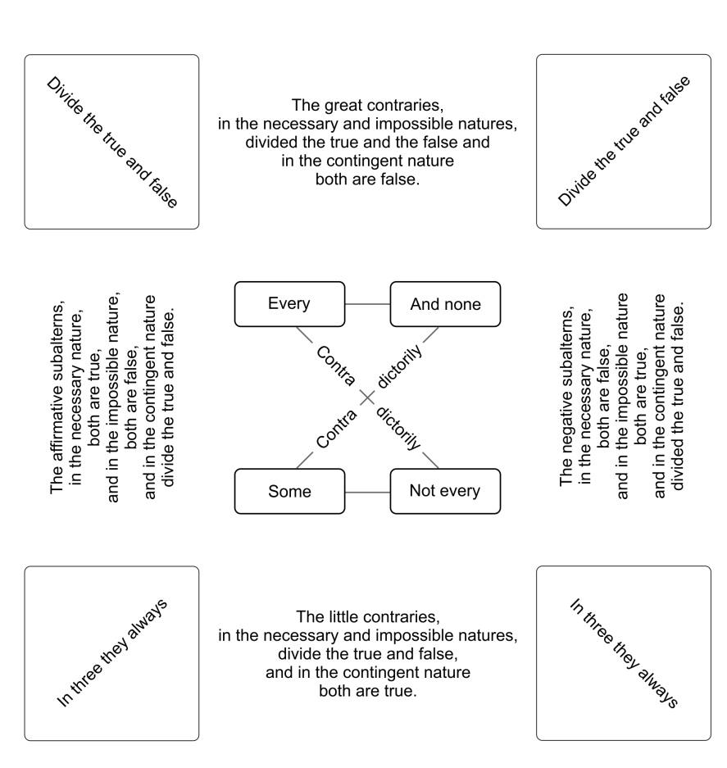
The opposition in which there is “every” and “none” is named [the opposition] of “great contraries”; and that in which there is “every” and “some” is called [the opposition of] “subaltern affirmations”; and that in which there is “none” and “not every” is named [the opposition of] “subaltern negations”; and that in which there is “some” and “not every” is called [the opposition] of “little contraries”; and that in which there is “every” and “not every”, and also that in which there is “some” and “non” both are named [the opposition] of “diagonal contradictions”.
The [opposition] of great contraries, in the case of the nature of the necessary, and also in the case of the [nature] of the impossible, divides the true and false; and in the case of the nature of the contingent it does not divide [the true and false], because it may be that the affirmation and the negation equally are false, for example, “Every man is healthy” and “No man is healthy”.
The [opposition] of little contraries, in the case of the nature of the necessary and the nature of the impossible [divides] the true and false; and in the case of the contingent it does not divide, because it may be that both are true, for example, “Some man is healthy”, “Not every man is healthy”.
And [concerning the opposition] of subaltern affirmations, in the case of the nature of the necessary, [the opposites] are always true together; and in the case of the nature of the impossible, [the opposites] are always false together; and in the case of the contingent, always one [affirmation] is true and the other false, for example, “Every man is a grammarian”, “Some man is a grammarian”.
And [concerning the opposition] of subaltern negations, in the case of the nature of the necessary, [the opposites] are always false together; and in the case of the impossible, [the opposites] are always true together; and in the case of the contingent, it always divides the true and false, for example, “No man is a grammarian”, “Not every man is a grammarian”.
The two contradictions [mentioned], in any material modality which is by nature, always divide the true and false, and one [proposition in each pair] receives the true and the other the false. As regards the great contrariety [the opposites] never become true together, but sometimes are false together. As regards the little contrariety (subcontrariety) [the opposites] never become false together, but sometimes they are true together. And as regards [the two] subalterities, [the pair of] affirmations and [the pair of] negations, sometimes [the opposites] are true together, and sometimes they are false together, and sometimes they divide the true and false together.
But only those which are diagonally [oppositions] make a contradiction, because they always divide the true and false. The reason for this is that, great contraries are only opposite by quality, on that account one is an affirmation, and the other a negation, while there is not opposition by quantity, because everything one of the two posits the other removes. And as for the little contraries also, in like manner, one part (one opposite) posits something and the other part removes something. And as for the two subaltern [oppositions], [the propositions] are not opposite by quality, because they both are either affirmations or negations, but they are only opposite by quantity, because always one posits or removes everything and the other posits or removes “not everything” (“something”). As for those which are opposite from the angles, both are always opposite together by quality and by quantity, because one [proposition] is always an affirmation and the other a negation, and the one is universal and the other “not universal” (“particular”).
Diagram:
§ Sometimes in the affirmation and the negation there is one noun as well as one verb, and sometimes in both there are two nouns. If [in them] there be one noun, the proposition is simple, that is it is a simple statement. But if there be two nouns, the proposition is complex, that is it is a compound statement. Without a verb is made neither an affirmation nor a negation. To every one affirmation is as opposite one negation, and to every negation one affirmation.
§ In an enunciative statement always when “not” (“non-”) is said with the noun an affirmation occurs, and when it is said with the verb a negation occurs, because [let us suppose] the statement that states, “Socrates is a man”, its negation is [then] this: “Socrates is not a man”; and the statement that states, “Socrates is non-man” is an affirmation, and its negation is “Socrates is not non-man”. Every affirmation in which there is “not” indicates that it is a negation only if it state “not” in the verb, and every negation in which there are two “not” indicates that it is an affirmation, and in like manner it states “not” in the verb.
In the negations which are with further determination, we always state “not” with further determination, such as “not every” and “not one” (“none”).
§ When in an enunciative [phrase] there are two nouns, we never state a further determination with that noun which is predicated (predicate), but we always state it with that noun which is posited (subject), for just because we can state “Every man is an animal”, does not mean we likewise state “Man is every animal”, since this is false.
§ As well as the parts of time are three, similarly statements also, for every statement is made according to the three times, such as “Socrates is”, “Socrates was”, “Socrates will be”.
§ Any contradiction whatsoever always divides the true and false, as has been said, but not always in the same way, because in the case of a thing which is (the necessary) and a thing which is not possible to be (the impossible), it so divides that we also know which is true and which false; but in the case of the contingent nature and a thing which will be in the future, it does not always occur in like manner, it so divides that we do not know if the affirmation is true or the negation, until it takes place, for example, one [proposition] says that “Tomorrow rain will appear or a battle will occur”, and the other says that “Tomorrow rain or a battle will not occur”.
The parts of the contingent nature are three:
1) That which occurs “for the most part” and nature is prior to it;
2) That which occurs “rarely and once in a not too frequent while” and accident (chance) is prior to it;
3) And that which is “intermediately”, that is, sometimes occurs in one way and sometimes occurs in the other way, and our will (choice) is prior to it.
It is only on this [third] part that men ask [the opinion of] each other and take counsel (deliberate) and discuss. There are some people who say that everything is of necessity and exists, because the contingent nature has, necessarily, in its nature to be or not to be, because it is necessary tomorrow to be rain or not to be, or I go to India or I do not go, but we do not know until [this or that] happens. One should give heed to everything as it is by itself, and not as we know it. But if everything is of necessity and exists, and nothing exists by accident nor by will, then the counsels, consultations, actions, [religious] services, the virtue and wickedness of men, the punishment and recompense of hell and kingdom (heaven) are superfluous, and this among those which are convenient to be taken, which is absurd; or not everything is of necessity and exists, but also there exist [things] by accident and by will.
§ When a noun and a verb are said together, then four oppositions are made: one according to that which is singular, and one according to that which is universal with no further determination, and two according to that which is universal with some further determination. These four [oppositions], according to the three material modalities which are by nature, become twelve. These twelve [oppositions], in three times [according to the past, present, and future] become thirty-six. Again when a noun and a verb [are said together], nevertheless the noun is indefinite, then following the same rule thirty-six other oppositions are made. It is obvious that all the oppositions of simple propositions become seventy-two. With the complex propositions in which there are two nouns, [the number of] other oppositions is one hundred forty-four, because following the same rule, as has been said above, when the noun which is posited (the subject term) and that which is predicated (the predicate term) both are said [as] definite, such as “Socrates is animate”, “Man is animate”, “Every man is animate”, “One man is animate”, [the oppositions] become thirty-six, and again when the noun posited is definite and that one predicated is indefinite, thirty-six other [oppositions] are made, and again when the subject term is indefinite and the predicate term definite, thirty-six other [oppositions] are made, and again when both [subject term and predicate term] are indefinite, thirty-six other [oppositions] are made. And four times thirty-six is one hundred forty-four. And the simple and complex [propositions] when taken together, [the number of] oppositions become two hundred sixteen.
§ What has been referred to above as “adverb”, such as “amicably”, “humbly”, is a mode of speech, because when I hear that a speech is said amicably or humbly, I know in which manner it is said. The mode (modal expression) is the quality in which something is said of the subject, because the [phrase] saying “that man speaks amicably” indicates how that man has pronounced the speech. The modes like these are numerous, and for us they are innumerable, but those which are especially discussed are three in number: necessary, contingent, impossible. The modes of speeches are different from material modalities which are by nature, according to which propositions are stated, in that the material modalities which are by nature are in the essence of a thing, because everything which is said about another thing, either it is always with it and [the proposition] is necessary, or it is never with it and [the proposition] is impossible, or it is sometimes with it and sometimes is not with it and [the proposition] is contingent. And on this account [the material modalities] are said by nature that they are inside a thing, but the modes only in the expression of speech are from outside added to the noun and the verb. And so often it happens that the natural matter of speech is true, but because of the mode [the speech] does not become [true], for example, when it is said that “Socrates speaks humbly”, because if he speak and he authoritatively speak, then this that he speaks is true, but [saying] that he speaks humbly is false. In the negation of a mode, “not” is always said with the mode, because if it be said with the noun or the verb, an affirmation is made and not a negation.
§ The opposition [of propositions] with modal expression is as follows:
The mode is either expressed in a proposition with one noun and one verb, or in that with two nouns and one verb. As mentioned above, the noun is either definite or indefinite. If it be made of one noun and one verb, then the oppositions that may occur are four in number, as follows: “It is contingent that Socrates walks”, “It is not contingent that Socrates walks”; “It is contingent that not-Socrates walks” “It is not contingent that not-Socrates walks”; “It is contingent that Socrates does not walk”, “It is not contingent that Socrates does not walk”; [“It is contingent that not-Socrates does not walk”,] “It is not contingent that not-Socrates does not walk”. But if it be made of two nouns and one verb, then eight oppositions may occur, as follows: “It is contingent that Socrates the philosopher walks”, “It is not contingent that Socrates the philosopher walks”; “It is contingent that not-Socrates the philosopher walks”, “It is not contingent that not-Socrates the philosopher walks”; “It is contingent that Socrates the not-philosopher walks”, “It is not contingent that Socrates the not-philosopher walks”; “It is contingent that not-Socrates the not-philosopher walks”, “It is contingent that not-Socrates the not-philosopher walks”; “It is contingent that Socrates the philosopher does not walk”, “It is not contingent that Socrates the philosopher does not walk”; “It is contingent that not-Socrates the philosopher does not walk”, “It is not contingent that not-Socrates the philosopher does not walk”; “It is contingent that Socrates the not-philosopher does not walk”, “It is not contingent that Socrates the not-philosopher does not walk”; “It is contingent that not-Socrates the not-philosopher does not walk”, “It is not contingent that not-Socrates the not-philosopher does not walk”. Likewise, as regards a singular [proposition] twelve oppositions may occur, and in the case of a universal without further determination twelve other oppositions, and in the case of a universal with further determination that is said “every” and “not every” twelve other oppositions, and in the case of [a universal with further determination] that is said “one” (“some”) and “not one” (“none”) twelve other oppositions, which together amount to forty-eight. And these in three times amount to one hundred forty-four, and these in three material modalities which are by nature amount to four hundred thirty-two. And the modes of speeches, as has been stated, are three in number, and with these three modes, [the oppositions] become one thousand two hundred ninety-six. Those which are without mode, simple [propositions make] seventy-two [oppositions] and complex ones one hundred forty-four, which together amount to two hundred sixteen. All the oppositions [mentioned] together with these two hundred sixteen amount to one thousand five hundred twelve. And affirmative propositions together with negative ones raise [the proposition-count] to three thousand twenty-four, because all the oppositions are taken into account. And there is no other rule for the speech in which there is the true and false, and every other speech which is said as enunciative is in fairness known according to this rule.
Col.
Completed the commentary of the book of [Aristotle], the Περὶ Ἑρμηνείας, written by Paul the Persian, and translated by Sevērā Sebōxt.
gōbišn abar gōbāgīh | A treatise on logic (Paul the Persian)-(GG)
Syriac text
 Made with Bullet