
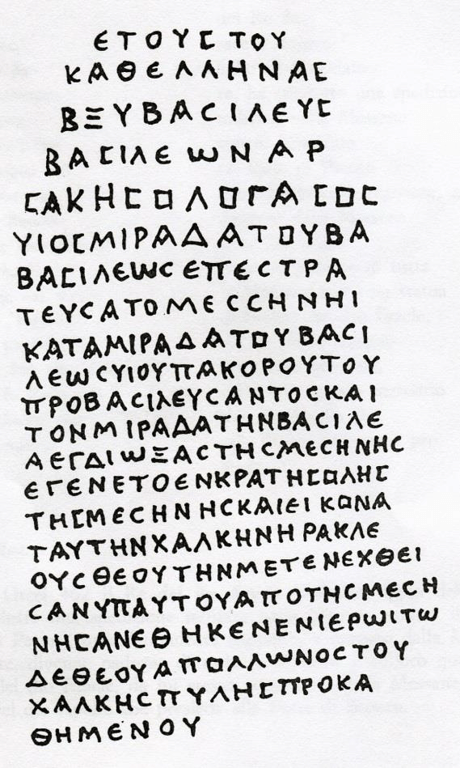
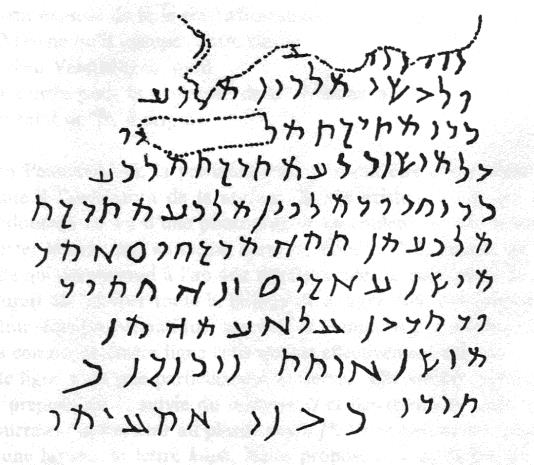
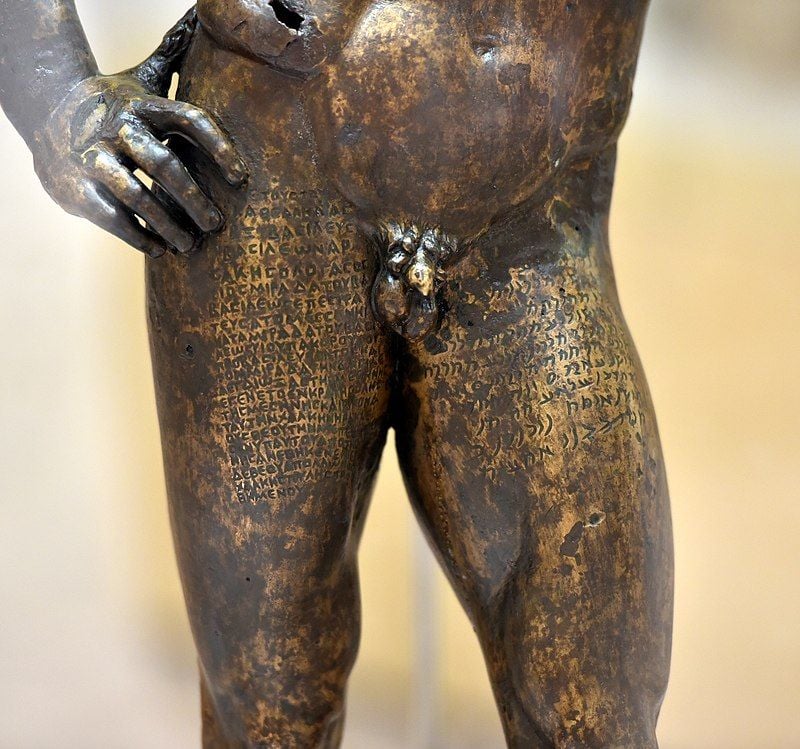
In the spring of 1984 a bronze statue of the standing hero (Gr. ῾Ηρακλέους, Parth. wrtrgn), with Greek and Parthian (Pahlavānīg) inscriptions incised on his thighs, was found by chance in the ruins of Seleucia on the Tigris. On the right thigh there is a complete Greek inscription comprising twenty two lines recording Vologeses carrying of the Statue of “Herakles” from Mesene to the temple of “Apollo” at Seleucia in the year 462 of the Greeks (≈ A.D. 150-151). On the left thigh there is a Parthian inscription the first lines of which are damaged and it records the same event thus: Vologeses transferred the statue of God Vṛθraγn (Av. vǝrǝθraγna) from Mēšan to the temple of Tīr (Av. tīra).
Greek (yōnāyīg)
1) ῎Ετους τοῦ
καθ᾽ ῞Ελληνας
βξύ βασιλεύς
βασιλέων ᾽Αρ-
σάκης ᾽Ολόγασος,
6) υἱὸς Μιραδάτου βα-
/βα/σιλέως, ἐπεστρα-
τεύσατο Μεσσήνηι
κατὰ Μιραδάτου βασι-
λέως υἱοῦ Πακόρου τοῦ
11) προβασιλεύσαντος καὶ,
τὸν Μιραδάτην βασιλέ-
α ἐγδιώξας τῆς Μεσήνης
ἐγένετο ἐνκρατὴς ὅλης
τῆς Μεσήνης καὶ εἰκόνα
16) ταύτην Χαλκῆν ῾Ηρακλέ-
ους θεοῦ, τὴν μετενχθεῖ-
σαν ὑπ᾽ ἀυτοῦ ἀπὸ τῆς Μεσή-
νης, ἀνέθηκεν ἐν ἱερῶι τῷ-
δε θεοῦ ᾽Απόλλωνος τοῦ
21) χαλκῆς πύλης προκα-
θημένου.
καθ᾽ ῞Ελληνας
βξύ βασιλεύς
βασιλέων ᾽Αρ-
σάκης ᾽Ολόγασος,
6) υἱὸς Μιραδάτου βα-
/βα/σιλέως, ἐπεστρα-
τεύσατο Μεσσήνηι
κατὰ Μιραδάτου βασι-
λέως υἱοῦ Πακόρου τοῦ
11) προβασιλεύσαντος καὶ,
τὸν Μιραδάτην βασιλέ-
α ἐγδιώξας τῆς Μεσήνης
ἐγένετο ἐνκρατὴς ὅλης
τῆς Μεσήνης καὶ εἰκόνα
16) ταύτην Χαλκῆν ῾Ηρακλέ-
ους θεοῦ, τὴν μετενχθεῖ-
σαν ὑπ᾽ ἀυτοῦ ἀπὸ τῆς Μεσή-
νης, ἀνέθηκεν ἐν ἱερῶι τῷ-
δε θεοῦ ᾽Απόλλωνος τοῦ
21) χαλκῆς πύλης προκα-
θημένου.
English
‘In the year 462 of the Greeks, king of kings Arsaces Vologeses, son of Mithridates, made war in Mesene against king Mithridates (of Mesene), son of Pacorus, who had reigned before him, and after having banished king Mithridates from Mesene he became master of the whole of Mesene, and this bronze image of the god Hercules, that he himself had carried from Mesene, he erected it in the temple of the god Apollo, who oversees the Door of Bronze.’
Parthian (pahlavānīg)
1) [ŠNT iii c xx xx xx xx x]
iiii iii (ʾ)[rš]k
wlgšy MLKYN M(L)Kʾ
BRY mtrdt M(L)[Kʾ ḤS]GY
ʿL myšn BRʾ mtrdt MLKʾ
6) BRY pgwr MLKYN MLKʾ mtrdt
MLKʾ MN TMH MRDPW • ḥmk
myšn ʾḤDW • ZNH ptkr
wrtrgn ʾLḤʾ MH MN
myšn ḤYTt nykndy B
11) tyry bgny ḤQʾ(Y)MW
iiii iii (ʾ)[rš]k
wlgšy MLKYN M(L)Kʾ
BRY mtrdt M(L)[Kʾ ḤS]GY
ʿL myšn BRʾ mtrdt MLKʾ
6) BRY pgwr MLKYN MLKʾ mtrdt
MLKʾ MN TMH MRDPW • ḥmk
myšn ʾḤDW • ZNH ptkr
wrtrgn ʾLḤʾ MH MN
myšn ḤYTt nykndy B
11) tyry bgny ḤQʾ(Y)MW
<sarδ 397 Aršag> Valaγš, šāhān šāh, puhr Mihrdād <šāh raft> ō Mēšān, ba Mihrdād šāh, puhr Pakur, šāhān šāh, Mihrdād šāh až ōδ stōβēnīd, hamag Mēšān grift. im padkar Varθraγn yazd cē až Mēšān ānīd nigand andar Tīr bγin avišt(ān)ād.
English
‘[In the year 397 (of the Parthians)] Aršak Valaγš, king of kings, son of king Mihrdād, went to Mēšān attacking king Mihrdād, son of Pakur. He defeated (and expelled) king Mihrdād from there, and he seized all Mēšān. This statue of the god Varθraγn (Varhrān), which he brought from Mēšān, he erects as a treasure in the temple of Tīr.’‘[In the year 397 (of the Parthians)] Aršak Valaγš, king of kings, son of king Mihrdād, went to Mēšān attacking king Mihrdād, son of Pakur. He defeated (and expelled) king Mihrdād from there, and he seized all Mēšān. This statue of the god Varθraγn (Varhrān), which he brought from Mēšān, he erects as a treasure in the temple of Tīr.’
 Made with Bullet