The Arebsun inscriptions in Royal Aramaic, engraved on two black stones (A-B), belong to the late Achaemenian period or the early Parthian period. These inscribed stones were discovered by Y. I. Smirnov in 1895, and are now in the Istanbul museum.
(For the bibliography of the editions and studies, see André Lemaire, “Les pierres et inscriptions d’Arebsun, nouvel examen”, Irano-Judaica V, Jerusalem, 2003: 138-64)
The inscriptions commemorate the marriage of BYL (Bêl) (Akk. Bēl (Aram. Baԑlā, OPers. bai̯rah) ≈ OPers. baga) with his sister in its two aspects: one, the marriage of the king with his sister, such as that of Vīštāspa with Hutaosā; the other, the symbolic marriage of the solar twin, Sun (Ahura Mazdā) and Dawn (Daēnā Māzdayasniš), reflected in the junction of Kingdom and Religion.
B1
1) [’hwr]mzd w-dynmzdysnš _
[mlk]t’ ’ḥth w-’ntth zy byl
kn ’mr ’nh ’ntt zy byl mlk’
’ḥr byl kn ’mr l-dynmzdysnš
’nt ’ḥty šgy’ ḥkym
6) w-špyr’ ’nt mn ’lhn
w-‘l zk ’nh šwyt lky
_ _ ’ntt zy l-
by _ _
‘Ahura Mazdā and Daēnā Māzdayasniš
The queen, the sister and wife of Bêl,
said thus: “I am the wife of Bêl, the king.”
Then Bēl said thus to Daēnā Māzdayasniš:
“Thou, my sister, art very wise,
And good art thou, (better) than the (other) Yazata;
And for this I have made thee worthy
(of being) the wife of
My heart.’
The queen, the sister and wife of Bêl,
said thus: “I am the wife of Bêl, the king.”
Then Bēl said thus to Daēnā Māzdayasniš:
“Thou, my sister, art very wise,
And good art thou, (better) than the (other) Yazata;
And for this I have made thee worthy
(of being) the wife of
My heart.’
According to M.N. Bogoliubov this text is a fragment of an Avesta prayer, written down in Aramaic script.
H. Reichelt rendered it into Pārsīg in 1901:
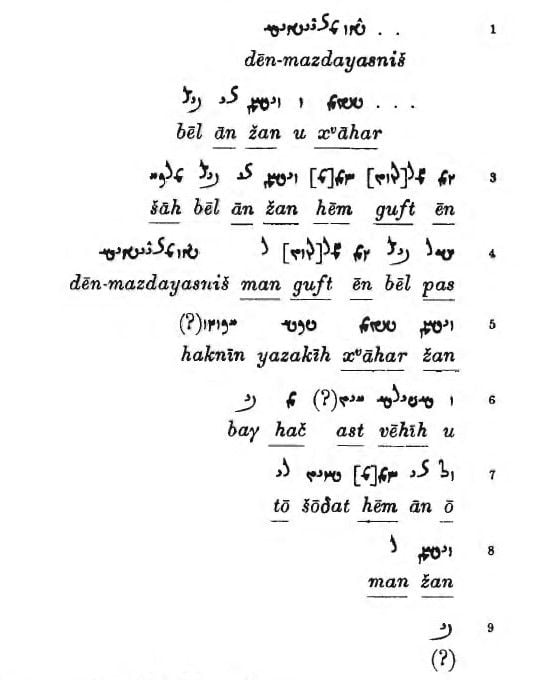
Here is another rendering in Pārsīg by Raham Asha:
Ohrmazd ud dēn mazdesn, bāmbišn, xvah ud zan ī Bay, guft kū: “an ham zan ī Bay šāh.”
pas Bay guft ō dēn mazdesn kū: “tū, xvah ī man, vas zīr hē, ud veh andar yazdān hē. ēd rāy cē-m arzān kird tū, zan ī hān ī man dil!”
 Made with Bullet