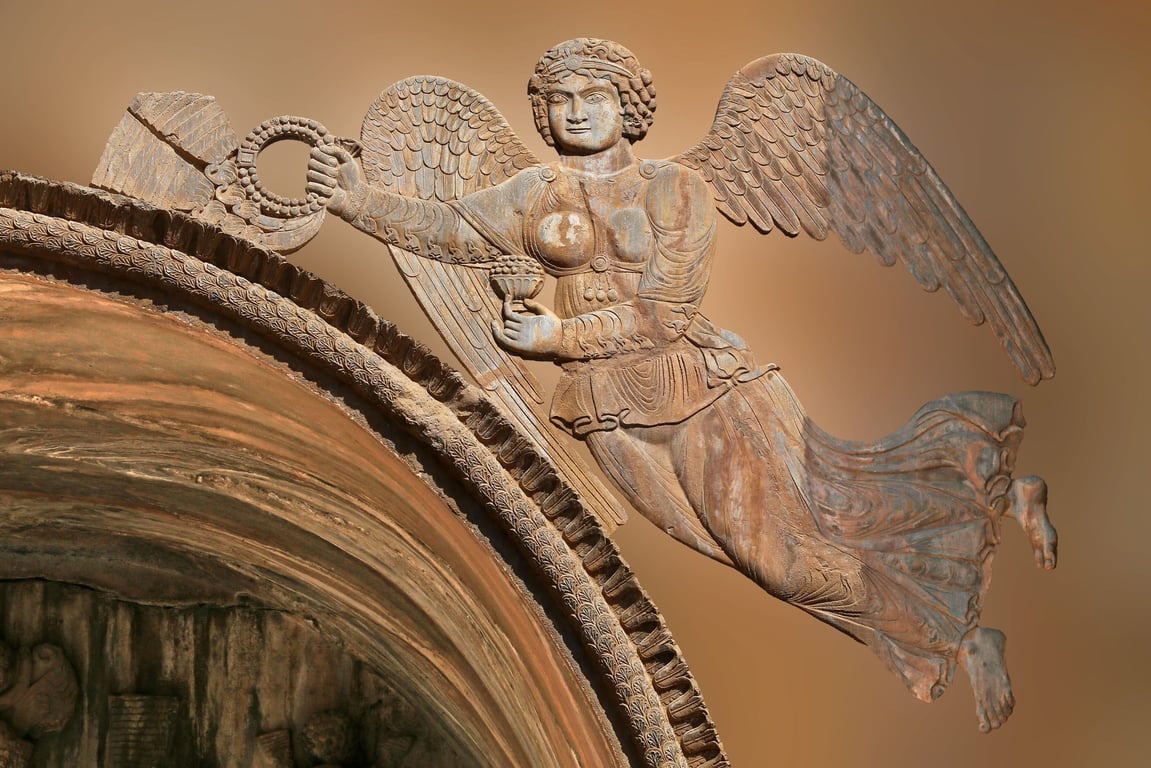
The extant book IV of the Dēnkird contains passages selected by Ādurfarrōbay son of Farroxzād from the book Ēvēn-nāmag ‘Book of Institutes’, an encyclopedia of various branches of knowledge compiled in the sixth century –precisely at the times of Xusrō Anōšervān (the text speaks of him thus: im bay ‘his present majesty’) –by some scribe(s) of the secretarial office of the Sasanians. Ibn Qutaiba, Ṯaʿālibi, and others have given a few information about it (كتاب الآيين ) and have translated some passages of it.
<Text edited and translated by R. Asha>
pārsīg
niyāyišn dēn mazdesn ī juddēv ī ohrmazddādestān.
cahārum az gōbišnīhā vizīd ī az veh-dēn-hamōg hufravard Ādurfarrōbay ī Farroxzādān ī hudēnān pēšubāy ō hamōg dar az Ēvēnnāmag vizin.
§ (M 409) hād. ēk. bunēšt-iz ī xvad-iz mānāg ast nē cimīg.
§ do. doīh ī naxvist andar ušīgān az dahišn bun ī ast fradum Vahman; bē-š bun az ebgad vahān ī ast dahišn cim. ud do ud abārīg bavandag-nigerišnīhā vēnīhed kū andar ēd xīr do ham-rāyēnišn ēd rāy ped and bar and bun nēstīh cē-š bun nām abāg nāmcišt az jud-ēkīh ud hambidīgīh āmad. az do hambidīg pesāzišn-ē rāst ī husāzag būd nē šāyed; ud pez kanārag tēz-sōgīhā brīd. ēd rāy ēdōn nē šāyed ī hān tēz-sōg ī do kust dāred ō bahrān baxšīhed. cē ēk ī ped ēkīh ōstīgān xvad abrīn. ēdōn az ham cim ka-z garded ped xvadīh āyed. ham ēk nē vinārīhed ceōn tis ī az cim. ud do-iz ēk ēk xvad cim nē, bē doīh az cim, ud ēn nimāyed abar bunēštagīh ud ōstīgānīh ud ēkīh ī ēk. ēkīh ud hambidīgīh ī donān nē “ēkīh ō ēkīh”, bē “ēk ō ēk”. abārīg ī andar maragīhā ped ham šōn. ud do-nāmīh (M 410) ēg baved ka ēk abāg ēk gōbīhed; enyā ēk ēk judāg ēk nām.
§ sē. sē bun nām az abzōn ī, andar ušīgān, ēk abar do; Ašavahišt ī dāred andar amehrspendān gyāg ī sidīgar, ped fradum “tarsagāhīh”. cē az āfurišn frāz, fradum dahišn andar dādār tarsagāhīh ī baved sidīgar. ceōn xvad ast dādār Ohrmazd fradum, didīgar Vahman ī ast fradum dahišn, sidīgar tarsagāh Ašavahišt ī bavīhist pediš Vahman tarsagāhīh az Ohrmazd, az Ohrmazd bavēnīdārīh. ud ham handāzag xvadāyīh peristišnīgīh ud bannagīh peristagīh, az bun dahišn ōrōn, ōstīgān ped cihr, ud bannagān peristagīh ō xēm ī xvadāyān handāzišn.
§ cahār. cahārum andar ušīgān xvadāyīh nāmīhist Šahrēver aparzūd ox ēvēnag, būd šāyistan az pahlum rāstkirdār tarsagāhīh Ašavahišt ī ast sidīgar ped bavišn ī az ōy ī didīgar Vahman ī ast fradum dām.
ayōxšust zēn driyušān abāg āmurzišn srāyišn.
u-š ped hamnāfīh abyuxt ox-kāmagīh ud dēn abzōnīg āštīh, āsn xrad ud gōšōsrūd xrad ī Vahman ham-zahagīg zahag, Ērmān-xvāyišnīh ud Sōk ī Ašavahišt hamnāfīg, ud ped hamnāfīh hamxāgīhā frāz-franāmišnīh oxīg xvadāyīh ud radīg dēn ō dāmān rāyēnīdārīh, ud ebgad ānāftārīh, ud hamāg-xvārīh mehēnīdārīh. ōh-iz ravāg-dēnīh ī yazdān andar gēhān, ravāg-xvadāyīh ī šāhān ped kāmag andar dāmān, u-šān ravāg-xvadāyīh ravāg-dēnīh ī ast (M 411) rāstīh peymān. ud xvadāyīh mādayān ped xvēš nērōg dēn vābarīgānīh, ud dēn mādayān ped xvadāyīh nērōg xvēš rāstīh. abēzagīh andar abēzagān gōbišnān ud gumēzagīh andar gumēzag gōbišnān harv do ēvēnag hambidīg kušišnīg, pedīrag hamēstārān tagīgīhā ravāg. hamgōnag ped gōbišn kunišn ēvēnag-ē ātaš mānāg abrōzišnīg ēsm ī hušk ud hān ī xvēd harv do ēvēnag ped sardīh ud huškīh, u-š snixr-vidāzišnīh, ceōn pedīrift ēsted. gēhānīgān abēzagīhā ud gumēzagīhā-z druz pediš hamē vānīhed ceōn … hām-spāsīh (?), ud pez andar gumēzagīh, ud pez škeftīh ēvēnag abāg hambidīgān kušišn. ēdōn-z dēn ud xvadāyīh hamē frāyistīhā huxvadāyīh pērōz, ud dēn ī rāst vābar ud kām ī yazdān andar gēhān ravāgīh, ud parvastagīh ī harv dānāgīh andar dēn mazdesn, drust-pettāyišnīh ī-š huxvadāyīh, ud hamnāfīh ī-šān āgenīn …, (ped??) hupānagīh ud ravāg-dahišnīh ī-šān ēk ō did rāy-iz dahyubedān dēn vābar, dēnīgān dahyubedīh amāvand dāštan, mazdesn-varzīhā abar toxšend dahyubedān dād ēvēn, u-šān ēvēn dēnīg.
Vištāsp šāh ka az kārezār ī abāg Arzāsp pardaxt būd ō sarxvadāyān abar pedīriftan ī dēn, frēstag ud nibēgīhā ī az vispdānāgīh pēsīd, mazdesn dēn, ped vas ēvēnag abzār ud frahang. ud būd ī hamōzegār frahād-uzvān muvmard abāg frestīd. Spitōg ud Arzāsp ud abārīg ī (M 412) az bē Xvanirah ped dēn-pursišnīh ō Frašōštar āmad hend, spurr-āgāhīhā visē kird.
Dārāy ī Dārāyān hamāg abestāg ud zand ceōn Zardušt az Ohrmazd pedīrift nibištag do pecēn ēk ped ganz ī šāhagān (šāhīgān) ud ēk ped diz ī nibišt dāštan framūd.
Valāš ī Aškānān abestāg ud zand ceōn abēzagīhā andar āmad ēstād hamōg-iz ī aziš harv cē az vizend ud āšuftagārīh ī Aleksander, ud ēvār ud rōb ī hrōmāyān andar Ērānšahr pargandagīhā cē nibištag ud cē uzvān-abespārišnīg ped dastvar mānd ēstād andar šahr ceōn frāz mad ēstād nigāh dāštan ō šahrīhā ayādgār kirdan framūd.
ōy bay Ardaxšēr šāhān šāh ī Pābagān ped rāst-dastvarīh ī Tōsar hān-z hamōg ī pargandag hamāg ō dar xvāst. Tōsar abar mad, hān ī ēk frāz pedīrift, ud abārīg az dastvar hišt. ud ēn-z framān dād kū: frāz ō amāh harv nigēzišn anī baved az dēn mazdesn, cē nūn-z āgāhīh ud dānišn aziš frōd nēst.
Šābuhr šāhān šāh ī Ardaxšērān nibēgīhā-z ī az dēn bē abar bizeškīh ud stargōbišnīh, ud cannišn, ud zamān ud gyāg, ud gōhr ud jahišn, ud bavišn ud vināhišn, ud jadagvihirīh, ud gōbāgīh, ud abārīg kirrōgīh ud abzār ī andar Hindūgān ud Hrōm abārīg-iz zamīgīhā pargandag būd abāz ō ham āvurd, ud abāg abestāg abāz handāxt, harv hān ī drust pecēn ō ganz ī šāhagān dādan (M 413) framūd, ud ēstēnīdan ī hamāg ērdast(ag)ān abar dēn mazdesn ō uskār kird.
Šābuhr šāhān šāh ī Ohrmazdān hamāg kišvarīgān ped pehikārišn abēvahānag kirdan hamāg gōbišn ō uskār ud vizōyišn āvurd. pas az bōxtan ī Ādurbād ped gōbišn ī pesāxt abāg hamāg avēšān jud-sardagān ud vase-ušmurdān-z ī jud-ristagān, ēn-z guft kū: «nūn ka-mān dēn ped stī bē dīd kas-iz agdēnīh bē nē hilem, u-š abar toxšāg toxšem.» ud hamgōnag kird.
im bay Husrō šāhān šāh ī Kavādān ceōn-š ahlemōgīh ud sāstārīh spurr-hamēstārīhā vānīd, ped pēdāgīh ī az dēn abar harv ahlemōgīh cahār pēšag āgāhīh ud uskārišn ī gugānīg vasīhā bē abzūd. ēn-z ped vehān-hanzamanīh guft kū:
«rāstīh ī dēn mazdesn bē dāned ušiyārān ped uskārišn ōstīgīhā tuvān [bē] ped stī dīdan. ud abardar abzōnīg ud pēš-xrad būdan, mādayān nē ped uskār bē ped abēzagīh ī menišn ud gōbišn ud kunišn ud veh-mēnōg-vāzišnīh mānsrīg-abēzagīhā-īzišnīh ī yazdān šāyed. u-mān Ohrmazd-mubed hān xvand xvānem kē mēnōg-vēnišnīh andar amāh pēdāgīhist. u-mān frašn-vizārīh mēnōg-vēnišnīh gētīg-handāzag-nimāyišnīhā-z harv do ēvēnag spurrīg azišān xvāst xvāhem. abāg-iz hān ī aziš āzādīh-kirdārīh ī yazdān vāspuhragānīhā abar ērān rāy Ērānšahr ped hamōg ī az dēn mazdesn frāz raft ī (M 414) pēšēnīgān hangad-dānāgīh-āmēzišnīh (hamōzišnīh??) ī ō-z hām-Xvanirah, hān ī āgāhān ped juttarīh pehikār nēst. aōn vasīhā abestāg-ēvāzīg ped abēzag-gōbišnīh nibēg peyrāyišnīg az mādayān ayādgārīh ud pādram-iz ēvēnag āvāzīg andar gōbišn āgāhēnišn dāšt ēsted. pas-iz hamāg xānīg ī dānāgīh ī dēn mazdesn ēd-iz rāy ī-mān šnāxt ēsted kū ka hamāg vīrumand-uskārišnīh ī bēgānag az dēn mazdesn nišān ō ēd gyāg rasend ped nōg-handēšišnīh-ud-uskārišnīh bēgānag az dēn mazdesn and dānišn ayāftan pēdāgēnīdan ō sūd-ud-vaxt-kārīh ī gētīgān āvurdan nē šāyend cand andar ušmurišn ī rad-ē ped vēš-vizōyišnīh ud vēš uskārdan vaxt. abardum xvāyišnīhā framāyem hāmis muvmardān ī vēnāg ērdar ud huxēmdar ud veh nōg nōg a-sūdagīhā abestāg ud zand uskārdan, ud ayābišn ī aziš ō dānāgīh ī gēhānīgān arzānīgīhā abzūdan. avēšān kē gētīgān ō šnāxtan ī dādār ud abdīh ī mēnōgān, ceōnīh ī dahišn az dādār fradum ayāftan nē šāyistan, ayāb hamāg ayāftan šāyistan, guft, ped kam dānišn varanīg. avešān kē pēdāgīh ī az dēn astīh ud pez hangōšīdag ast ī šnāxtan šāyistan guft ped uskārgar. ud hān kē rōšn nimūdan ped dānāgīh dēnāgāhīh dāštan. ud az hān ceōn harv dānāgīh bun dēn, ham ped nērōg ī mēnōgīg ud ham ped pēdāgēnīdārīh gētīgīg, hān ī kas (M 415) dānāgīhā guft ka-z-iš az kadām abestāg pēdāgīh hāmis nē dāšt, ēg-iz ped pēdāgīh ī az dēn hangārd kē xvēškārīh ped hamōg frāz ō vehān-zādagān burd.»
§ … (M 416)
§ dāmān-šān dastvar āgāh dēn-dānāgīh guft kū:
«ēk ēk dām xvēškārīh cē ud ceōn ō kār barišn ped āgāhīh ī az mānsrōgbarān ī dēn-āgāhān abērdar dānīhed.»
§ abar-šān akanāragīh ī zamān pēdāgīh ēk «baved-nē-šāyistan ī dahišn bē andar zamān» guft.
§ ud andar-šān sazišn ī kanārag-zamānīh abar vinārišn hamīh ī būd baved ud ēk ō did ēn-z pēdāgīh guft kū:
«harv būd baved, ud harv baved būd baved.»
§ hāvand-išān: gyāg abar ast ud nē-tis; bē gyāg ī tisān cand tisān, tis kanāragumand; ud gyāg-iz hamāg az tuhīgīh, ud tuhīgīh mānāg gyāgīg akanārag guft ped abastagīh ceōn ped zamān dādār astīh akanārag-zamānīhā. abar-z-išān «nēst-tis» guft ceōn būd baved.
§ (M 417) baxt-išān abar hān ī brihēnīdārīh ped kunišn, ud kunišn abar hān ī kirdārān, brīn-z andar mēnōgān gētīgīg xvad anāy vizīd kāmīhā guft. baxt abar hān ī az mēnōgān, kunišn abar hān ī az gētīgān.
§ handāzišn vēnišnīg andarvāyīgān dā-z ō rōšnān ī abardar ped candīh u-šān ōgrāyīh hān ī ham-nihādag, hān-z ī jud-nihādag, ulīh ud frōdīh ud abārīg kust-vardišnīh andar zamīg-peymānīh baved; u-š abzār cašm ud cōbīzag.
§ … (M 418)
§ nikōhīdārān ī peymān-gōbišnīh ī dād dēn ēn-z azišān pursīd kū: šāyed-būd kanāragumand ayāb nē? ud tuvān-dānāgīh and-cand šāyed-būd ayāb frāy? ud ēk ō did parvannāg ayāb nē? ud agar šāyed-būd nē kanāragumand, hān ī nē-šāyed-būd xvānend cē, ud cē vimand ī tuvān, cē hān ī šāyed-būd? kunišn hamāg andar zamān ayāb bē-z zamān? nivistag abēfrazām šāyed ayāb nē? ud hamāg ī kirīyed baved nūn ped dānāgīh parvastag ayāb nē? ud agar abāg bun (M 419) nērōkkunišnīh-iz ī akanārag-zamānīhā dēn dānišn gōbed, ud pas peyrāstag cē, peyrāstār kē, u-š tuvān cihrīkkunišnīh ped cē?
§ …
§ kē azadār andar-z vanīh ōy ī vānīdag, rāst-gōbišn andar-z grān-menišnīh, ud andar-z gursagīh ped pahlum-cinīh vizīn abar kird ēsted.
§ hutōhmagīh gōhr-gugāyīh pēdāgdar kuned kū spēdagārīh, ud pas-iz spēdagārān cimīkkunišnīh ī dahebedān rāy hamē abarmānīgīh grāmīg dāštan. kē-z abāz ō avēšān ī ped abestāg pēdāg tōhmag ušmurdan nē dānist ka abāz ō vindād-spēdagān pēdāg būd ped abarmānīgīh hangārdan.
§ ōy bay Ardašēr šāhān šāh ī Pābagān, parzūdagīh ī-š xvadāyīh az cand pid ud niyāg rāy, ped (M 420) dahebedīh kam-sazāgīh. ud dēn-āgāhān abar pēš-iz madan guftan-z ī dēnāgāhān aviš āgāh būd ī ōy bay hān ī … gēhān sūd abāz-ārāyišnīh ped xvarrah. ud ēn-z guft kū: «peyrāstag ī aōn vazurg pēš-iz az rasišn ī ōy ī xvarrahumand ud ōy-iz ī āvām frazānag-āgāhīh ud vahān ī toxšišn baved.» enyā hān ī a-peyrāst jastag pēš az madan nē ayābīhed.»
§ … (M 422)
§ hambidīgān-šān ceōn garmīh ud sardīh ud xvēdīh ud huškīh andar ēd tan āmēzišnīg pesāxtagīhā kārīg, ud pešān zīndagīh-iz vinirdan. ud vahān ī pettāyišnīgīh ī tanān az-iz mehmānīh ī vināhišngārān ceōn sardīh ud huškīh hān ī višōbišn mad, az-iz bavišngārān ceōn garmīh ud xvēdīh. ud harv cahār ped peymānīg hamrasišnīh vinārišn, ud ped frāybūd ud abēbūd višōbišn. u-š būd cim ēk astīh. juddahišnān-z nē hamāg ēk ō did pedīragīg hamēstārīg. ēdum hambidīgīhā kušīdārīh, bē (M423) jud jud hān ī ō xvēš vāspuhragān pedīrag hambidīg ceōn sard ō garm ud hušk ō xvēd nāmcištīg spuxtārīh, ud abāg hān ī kustagīg hamēstār rasišn hān-z ī nē spōzišnīg bē pādīrānkārīg andar āmixtagīh, ud hō ped ham-šōn huškīh abāg garmīh, sardīh abāg xvēdīh. ud hamdahišnīg husāzagīh ī garmīh abāg xvēdīh, ud sardīh abāg huškīh. ud bastīgīh ī-šān dušvizār az āgenīn ped hān bun āmēzišn huškīh abāg garmīh, ud sardīh abāg xvēdīh. nē aōn garmīh abāg sardīh, ud xvēdīh abāg-iz huškīh nazdīk pettūdan šāyistan; ud abāg-iz hamvārīhā kušīdan ī-šān nūn-z ēk ō did cand pettūgīh ud a-vardišnīg ēstād nē šāyistan. pez ham-cim tanān andar gumēzagīh. pas-iz ped ēd šōn hambidīgān āgenīn a-sāzišnīgīhā. ud andar-z ē tan mēšag kušīdārīhā kirdag ham-parvannīh. ud hān višōbišn hān ī az vināhišngārān, ped frāyīh az stōbēnīdārīh ī-š hān bavišngār ī pedīrag hambidīg, ud ped kamīh az hambannīhā bē kišīdan ī-š az hān bavišngār ī āmēg; hān ī az bavišngārān, ped kamīh az ānābišn ī xvad bār ī bavišngār ud ped frāyīh az abāgīh ī vināhišngār ī-š āmēg; ud andar stōbēnīdārīh ī-šān hamēstārān abāg ānābišn ī-šān hambidīgān pez bē kišīdārīh ī-šān juddahišnān ī āmēg, ud abārīg cand ēvēnag margīh ud višōbišn ī nē az ēd aōn vahān bavišn ī nē (M 424) az hambidīgān guft.
§ … (M 428)
§ nibēg-išān ī Tark xvānend ped drāyišn ī dēvān hangārd anastīh ud ped tis-iz ō mar nē gīrišnīh pēdāgīh ō gōbišn ī bērōn ham nibēg niyāz nē būd andar ham nibēg pēdāg kird.
§ hindūg-dibīrīh ped hamtāgīh ī vīsp-dibīrīh. ud nibēg ī Dīpavyākaraṇa xvānend ped hamtāgīh ī gōbišn ī hangām šnāsagān nē dānist.
§ g’lkwš’k / Gārgya?/ ī hindūg, Megistīg ī hrōmāy, ud abārīg ī az hān šōn abāg bun nibēg ī ped ganz ī šāhagān ōh handāxt, ud cē.
§ andar-šān virāyišn abāg ō cim-xvāstārān ī ham āgāhīh ōh nimūd.
§ nibēg-išān ī vīrumandān nōg ārāst. ē cē az bē-kišvar āvurd ā nigerīd ud ā vizust, frāz nē hišt, nigūnīh ud bēgānag-nāmīh rāy nē kam pedīrift. ud būd ka vaxšišn ī dānāgīh rāy vēš-iz stāyīd pez nām ī (M 429) bē-kišvarīg nibēgīhā nihād, nē vizūd.
ēk-išān nibēg ud mādayān ped bavandakkarīh ī harv āgāhīh ud dānišn ī andar nibēgīhā ud mādayānīhā pēdāg nē kird, bē-šān jud jud az bun nibēg ud mādayān ī xvēš xvāst. ud Hangirdīg xvānend nibēg-ē ī ped ganz ī šāhagān abar hamāg soxan.
§ andar-šān tan ī mardōmān cahār pēšag ī gēhān ped baxšišn: abar sar āsrōnīh, ud abar dast arsēštārīh, ud abar aškam vāstrōšīh, ud abar pāy hudoxšīh. ud azabar cahār pēšag abar gyān abar-z gyān ox-ud-xvadāyīh guft.
§ gōbišn-ē ayāb kirdag-ē ī ped do gyāg jast hān ī pas az hamōg hān ī pēšag abērdar hangārd.
§ ērān hamē peymān stāyed, frāybūd abēbūd nikōhed. ped Hrōm fīlāsōfā, ud ped Hindūgān dānāg, ud ped abārīg +gyāg šnāsag hān abērdar stāyīd kē gōbišn-nizūmānīh azišān pēdāgīhist, frazānagān ī Ērānšahr pesannīd ēstād.
§ … (M 431)
§ agar-t vurravīd hamuxtan ka-z kār ī frazānag nazdīk, ud ka juttar viyābānīhā ud gumān ayābišn ud xvāyišn šavē ō viyābāngarān ī vas-ēvēnag.
§ kē-m hamōzed?
dēn dastvar ī dānāg.
cē-m hamōzed?
sē pahlumīh, kū pahlum ēdar ud ānōh ud ped tan ī pasēn.
mizd cē xvāhed?
kirbag.
ceōn-um tuvān hamuxtan?
dastvar ī dēn gōbed.
kē-m frāz nayed?
xvad frāz šav!
ped kadām rāh?
ped Vahman-mehmānīh.
ped cē abzār mehmānēnam?
ped bavandag-menišnīh.
ped cē handōzam bavandagmenišnīh?
ped xrad ušiyārīhā-nigerīdārīh.
ašmā jār-ē vāzag do bē hamōz!
hangad sē kun ud hangad sē hil!
cē hilam, cē kunam?
hilam dušmat ud dušūxt ud dušvaršt, kunam humat ud hūxt ud huvaršt.
u-t ēd harv hamōg ī frārōn.
English
A hymn of praise to Daēnā Māzdayasni that is the Law of Ahura Mazdā against the Daēva.
The fourth [book], a selection from the Ēvēn-nāmag, in matters of doctrine, selected from the discourses of the tearcher of the good religion, the blissful Ādurfarrōbay son of Farroxzād, leader of those of the good religion.
§ One: One is the principle and also similar to itself, and has no rationale [except oneself].
§ Two: Two is dyad, the first among the Intelligences, from the origin of the creation, is first Vohu Manah. But its origin is because of Onslaught which is the reason of the [material] creation. Examining carefully two and the other [numbers greater than two], it will be seen that, in this matter “two” of the same direction cannot have the same number of origins as the number of its produces (or, parts?), because the name of “origin” in particular implies non-unity and contrariness. From two contraries there cannot be a fair and congruent composition, and even at the border they are cut (or, delimited) with a sharp edge. For this reason it is not possible that the [one] with a sharp edge which has two sides be divided into parts. Because one that is steadfast in unity is itself indivisible. For the same reason even if it turn it comes [back] to its essence. Likewise, one is not established like a thing which is due to a reason. And two is not one [anad] one, each one being its proper reason, but dyad (duality) is due to a reason; and this demonstrates the state of being origin, steadfastness and unity of one. The oneness and contrariness of the two do not mean that “unity [is added] to unity” but “one [is added] to one”. The other numbers are in the same manner. Then the name “two” implies that one is said together with one; otherwise each one taken separately is named one.
§ Three: The original name of three comes from the addition of one to two among the Intelligences. It is Aṣa Vahišta, as the first “Respect”, which holds the third place among the Aməṣa Spəṇta. Because from the [spiritual] creation onwards the first creature among [the creations of] the Creator is Respect, and it becomes the third: since the creator Ahura Mazdā himself is the first; the second is Vohu Manah, the first creature; and the third is the respectful Aṣa Vahišta which is generated by the respectfulness of Vohu Manah towards Ahura Mazdā, through the generation act of Ahura Mazdā. Similarly, the worthiness of the royal power to be served and the service of the servant status are truly established by nature from the original creation on, and the service of the subjects matches the character of the kings.
§ Four: The fourth [in rank] among the Intelligences is kingship (royal power) and is named Xšaθra Vairya; it is in the manner of a perfect “Lord” and could be generated through the best and righteous Respect, Aṣa Vahišta, that is the third through generation by the second [in rank], Vohu Manah, that is the first creation.
Ayō.xšusta, ‘(molten) metal’, the arms [of kinship]; the poor, with salvation and protection.
The “desire of the lord” is joined, by kinship, to the “peace of the holy religion” [as twin], [as] the innate wisdom [is joined to] the acquired wisdom [and both] are cognate (and) born of Vohu Manah, the desire for Airyaman and Saokā are closely related to Aṣa Vahišta; and [thus there will be] the advancement of the kingship according to ahu and the religion according to ratu, related by kinship and by friendship, for the guidance of the creatures, the driving away of Onslaught, and the exaltation of all-delightfulness. Thus also there will be the propagation of the Religion of the Yazata among the living beings (in the world) and the prevalence of the kingship of the kings [ruling] at will among the creatures. The prevalence of the kingship [of the kings] and the propagation of the religion [of the Yazata] imply truth and measure (or, the measure of truth). Kingship is chiefly [prevalent)] through its own force [and] the truth (trustworthiness) of the religion; and religion is chiefly [propagated] through the force of kingship and its own truth (righteousness). Purity in pure words (or, among those with pure words) and mixture in mixed words (or, among those with mixed verbiage) both of these two kinds of words are contrary and in conflict, and [the holy word] is swiftly propagated in the face of the contraries. In the same way as the word, the deed is like the fire which kindles both dry firewood and wet firewood, [fire is opposed to both properties] in coldness and dryness, and it melts snow, as it has been acknowledged. The deceit will be defeated by the worldlings in the state of purity and also in the state of mixture, like being in the same army in a battlefield, in the state of mixture and also in different kinds of difficulty that one has to strive with adversaries. So too [can be said of] Religion and Kingship, the good royal power will be victorious, the true and authentic religion and the will of the Yazata in the world will be current, and the comprisal of every knowledge in the good religion (Daēnā Māzdayasni), the sound endurance of good rule (Xšaθra), and the kinship of both of noble parentage, and for the good protection and prevalence of one [with the help of] the other, the kings hold the religion trustworthy, and the priests hold the kingship strong, the kings (lords of the land) will be diligent as a Mazdayasna in their practice of laws and ordinances, and their ordinances (laws) are religious.
Once king Vištāspa got through the war with Arəja.aspa, he sent to the chief rulers messengers and [also] the books of the good religion (Daēnā Māzdayasni) which were inscribed about all knowledge, concerning materials (or, ritual implements) and instruments of many kinds, to gain acceptance for the religion. And he sent with them some Magi who were teaching [priests] with bound tongue. Spiti, Ǝrəzrāspa and others from outside Xvaniraθa came to Frašaoštra to study the religion, and he (Vištāspa) despatched him (Frašaoštra) full of knowledge (Zand).
Dārayavahuš son of Dārayavahuš ordered that the whole Avesta and Zand as Zaraθuštra had received from Ahura Mazdā –two copies of the book (Avesta and Zand) – be preserved, one in the Royal Treasury, the other in the Fortress of Archives.
Valagš, descendant of Aršak, ordered that of the Avesta and Zand as assembled in purity, and also of the teaching as derived therefrom, everything that had survived the damage and turmoil of Alexander and the pillage and robbery of the Greeks, in a scattered state all over Ērānšahr (Persia), whether in written [form] or in oral transmission, as remained authoritative (as Canon), be preserved [exactly] as it had reached in the [Aryan] Land, and he ordered [the chiefs of] the land to make a record of it.
His (late) majesty king of kings Ardašēr son of Pābag on the true authority of Tōsar, summoned all those scattered teachings [to be brought] to the court. Tōsar acquitted himself well [in the undertaking]; he approved one, and left out of the canon the rest. He (that is, Ardašēr) issued this order also: “For us any other exposition will be according to the Daēnā Māzdayasni, since now there is no lack of information and knowledge in it.”
The king of kings Šābuhr son of Ardašēr collected again even the books out of the religion (i.e. other texts than the Avesta and Zand) concerning medicine, astrology, motion, time and space, substance and accident, (substantial change:) becoming and decay, accidental change, logic, and other arts and crafts, which were dispersed in India, Byzantium and also in other lands, and collated them together with the Avesta; a correct copy of all those (writings) he ordered to be deposited in the Royal Treasury. And he put forward for deliberation so that all the subordinates abide by the Daēnā Māzdayasni.
The king of kings Šābuhr son of Ohrmazd, to make, through disputation, all notables of the country without any pretext, brought all discourses for discussion and examination. After Ādurbād won the ordeal apropos of the discourses against all those sectarians of different sorts and also immense in number, he (the king) said: “Now that we have seen the Religion in person (as a real corpus), we shall no longer let anyone [to be] of evil religion, and we shall exercise greater zeal.” He did so accordingly.
His (present) majesty, the king of kings, Husrō son of Kavād, once he vanquished heresy and tyranny [that were] with complete opposition, he abundantly increased, through the revelation of the religion concerning all heresy, the detailed knowledge and deliberation of all the four estates. He said in the assembly of the good this also that:
“Know, O intelligent ones, that the truth of the Daēnā Māzdayasni can be seen concretely (in person) with confidence through deliberation. However, it is possible to become superior (and) holy and of foreknowledge basically not through deliberation, but through the purity of thought (heart), speech and action, the good spiritual movement, and the worship of the Yazata by the pure (/ sacred) formulas. And, verily, we shall call that (person) ‘High-priest of Ahura Mazdā’ (Ohrmazd-mubed) by whom has been made manifest to us the spiritual insight (or, the vision of the world of thought); and we definitely request of him the explanation of (difficult) questions and the vision of the world of thought, like a cosmorama, both these kinds in complete manner. Furthermore, thanks to the Yazata, especially for the Aryans, Ērānšahr advanced according to the teachings of the Daēnā Māzdyasni, that is, the perfect knowledge taught by the ancients to the whole of Xvaniraθa –those who are aware do not have a difference [of view] nor a dispute. So much has been preserved in the Avesta language through pure words, arranged in the Scripture from texts and memoranda, as well as in the didactic books in the vernacular. As the whole source of knowledge is the Daēnā Māzdayasni, for this reason also we have recognized that when all rational viewpoints stranger to the banner of Daēnā Māzdayasni, reach this place, through further reflection and deliberation, to show as much knowledge alien to the Daēnā Māzdayasni as is found cannot bring so much benefit and profit to earthlings as [may be] brought profit in the memorization [of the sacred texts] according to the rules (or, in the study of a Rad) through much investigation and deliberation. With utmost solicitude we decree that all Magian men who are clear-sighted, humble, of good personality and good, should deliberate the Avesta and Zand without negligence and even afresh, and should increase in a worthy manner the knowledge of worldlings [by] what is acquired therefrom. Those who say that earthlings cannot at all attain the knowledge of the Creator, the marvels of the spiritual existences, and the mode of the primeval creation proceeded from the creator, or else they can attain totally to that, are to be regarded as deficient in knowledge and irrational. Those who say that the revelation (or, appearance) out of the essence of the religion can be known through inference by analogy, should be held to be deliberators. And the one who is committed to clearly demonstrate [it], should be regarded as [an example of] wisdom and knowledge of religion. Since the origin of all knowledge is the religion, alike through its spiritual potency and alike through material manifestation, someone said wisely: Even when he had not anything of the revelation of the Avesta with himself, he still intended, through the revelation of the religion that he ought to present, through teaching, the duties to those who are born in the good (Aryan) community.”
§ …
§ [Regarding] the creatures the [spiritual] guide well-versed in the knowledge of the religion said:
“what is the duty (function) of the creatures one by one, and how it should be applied, is mostly known through the information of those who bear the sacred formulas, the well-versed in the religion.”
§ Concerning the infinity of Time, one revelation told by them (the wise, the guide) is this: “The [material] creation except in Time is impossible.”
§ And in the passing of finite time, concerning the working order (and) union of past and future they told this revelation too:
“Everything past becomes future, and everything future becomes past.”
§ Equally, [the guide said that]: Space applies to being and nothing; but the space of things is equal to [those] things, [and] things are finite. All Space is also from the Void, and the Void is said to be spatial [and] infinite through being unbounded (/ indefinite), just as the existence of the Creator [is said] to be infinite in time through Time. Concerning “nothing”, they said that it is like that which was will be (/ past becomes future).
§ Fate is said to concern the destining for action, and action concerns the agents; even the destiny which belongs to the world of life [for] a worldly being [should not act] but according to his own free choice. Fate concerns that which comes from the world of thought (/ the spiritual); action concerns that which comes from the world of life (/ the material).
§ The reckoning of visible airy beings up to the luminaries which are higher regarding [their] quantity, and their declination, those of the same position and also those of a different position, the upwardness (apogee), downwardness (perigee), and the circular motions to other sides, [all these subjects] are pertaining to Geometry. And its instruments are the eyes and a small stick.
§ …
§ ‘Those who criticize the moderate discourse of the Law and Religion ask them (those who bear the sacred formulas) this too: Is the possible [matter] finite or not? And is the power of knowledge coextensive with the possible [matter] or does it goe beyond it? Do they comprise each other or not? And if the possible [matter] is not finite, what is that which they call impossible, what is the definition of the contingent (probable) [matter], and what is the definition of the possible? Is all action within Time, or also outside Time? Is it possible for a thing begun to have no end? And is everything that is done comprised by knowledge now or not? And if you state that the knowledge of the religion is for an infinite time with the original potentiality of action, then what is well-prepared, and who is the well-preparer, and by what is his power of natural action?’
§ …
§ He who is non-violent even at the time of victory over one who is defeated, speaks the truth even at the time of fury, and is generous even at the time of hunger, has made a choice in the selection of the best.
§ A good seed manifests the evidence of stock more than a splendid deed; and afterwards those who do splendid things, because of the rational deeds of the rulers of the lands (the kings), their high-dignitary status (nobility) should be always held dear. Even he who cannot trace back his descent to those revealed in the Avesta, when he is known among the splendid ones, he must be considered in rank of high-dignitary.
§ His (late) Majesty Ardašēr, king of kings, son of Pābag, by reason of the deprival of kingship from his ancestors was less worthy in the position of the lord of the land. However those acquainted with Religion predicted his arrival, and even they were aware that His Majesty would re-organize the benefit of the [two] world[s] through [his] Fortune. It is said [in the Avesta] that: “A well-prepared, such a great one, even before [his] arrival, the Fortunate one, and also the Wise of the period, would be the cause of striving. Otherwise, an un-prepared accident before his arrival would not be perceived.”
§ …
§ They said: The contraries such as hotness, coldness, wetness, and dryness in the complexions of the body are in composition and effective, and through them there is the establishment of life. And the cause of the lasting of the bodies is even from the dwelling of the agents of corruption such as coldness and dryness through which comes destruction, and also from [the dwelling of] the agents of generation such as hotness and wetness. All four in moderate contact bring establishment, and through excess and deficiency destruction. And its reason was one existence. Different creatures are not all the opponents and adversaries of one another. Indeed the contraries strive [with each other], but each separately is contrary of its own opposite, for example cold especially repels hot, and dry wet; and the contact of one side with its contrary side does not cause repulsion, but hindrance in mixture, for example [the contact of] dryness with hotness, and [that of] coldness with wetness. Those of the same creation [are in concord, for example] the concord of hotness with wetness, and coldness with dryness. Those whose connection is difficult to be separated from each other, through the original mixtures, are: [the connection of] dryness with hotness, and [that of] coldness and wetness. Neither hotness can stay near coldness, nor also wetness near dryness, and with their constant strife of one toward the other, they can not stay in constancy and immutable. For the same reason also, the bodies in the state of mixture [can not endure]. Then, in this manner, the contraries are in incompatibility with each other; and in one body they are always in strife and encircle each other. The destruction results from the agents of corruption, in excess through defeating the agents of generation which are their direct contraries, and in deficiency by closely drawing it out from the agents of generation which are mixed with, from the agents of generation, in deficiency through the warding off of its own result as an agent of generation, and in excess through being with the agents of corruption which are mixed with; and in defeating their adversaries, and warding off their contraries, and through drawing different creations, and some other kinds of death and destruction which are not from causes such as these nor from the contraries.
§ …
§ The book called Tarka, includes the falsity of the (delirious) speech of the Deva, and the proof of not to take it at all into account, and what does not require the discourse outside the same book is shown in the same book.
§ They did not recognize the Indian script to be equal to the [Persian] All-writing, nor the book called Dīpavyākaraṇa equal to the treatises of the [Persian] savants of the time.
§ The Indian (Gārgya?), the Greek Μεγίστη, and other [writings] of that sort, were put, with the original books (i.e. the books in their original language), in the Royal Treasury, and so forth.
§ They were arranged [the books] in [the Royal Library] and presented [them for consulting] to the seekers of the reason and also to the [seekers of] knowledge.
§ The scholars prepared the books over again. Those [books] which had been brought from abroad were deliberated and examined, nor were they neglected or less received on account of their inferiority and foreign name. It happened that, for the growth of knowledge, they became even more praised, and even the foreign names were not left but attached to the books.
No single book or text was found which comprehended any information and knowledge in the books and texts, but [information and knowledge] were sought, one by one, from their own original books and texts. They call the book about all topics in the Royal Treasury the Hangirdīg (‘Compendium’).
§ They said regarding the body of man that: it is divided [in the likeness of] the world of life, between four professions (functions): the head corresponds to Priesthood; the hands to Warriorhood; the belly to Husbandry; and the feet to Artisanship. And above the four professions: the breathing soul corresponds to Lordship.
§ A discourse or an action which happens in one of these conditions is considered more [appropriate]: that of after education, and that of a profession.
§ The Aryans praise measure, and censure excess and deficiency. Of the philosophers of Byzantium, the sage (budha) of India, the savant of other places, those who showed skill in dialectics, were more praised, and the wise of the Aryan Kingdom (Persia) approved them.
§ …
§ If you start learning, either you are close to the action of the philosopher, or otherwise in the wandering state you shall find and seek doubt, and you shall go to the leading astray of any type.
§ Who will instruct me?
The wise guides of the religion.
What will they instruct me?
Three best things, that is, the best of here, that of there, and that in the Final (Future) Body.
What will they ask as reward?
Good works.
How can I get instruction?
The guides of the religion will tell [you].
Who will lead me forward?
Go yourself forward!
By what way?
Through [the way of] the lodging of Good Thought (Vohu Manah).
By which means [can] I lodge it?
By perfect-mindedness.
How can I hoard perfect-mindedness up?
By carefully observing through wisdom.
Teach [me] in short two Formulas!
Do completely three (things), give completely up three!
What [should] I give up, what [should] I do?
I give up evil thought, evil word, evil deed; I do good thought, good word, good deed.
These are all the righteous instructions for you.
Audio
 Made with Bullet