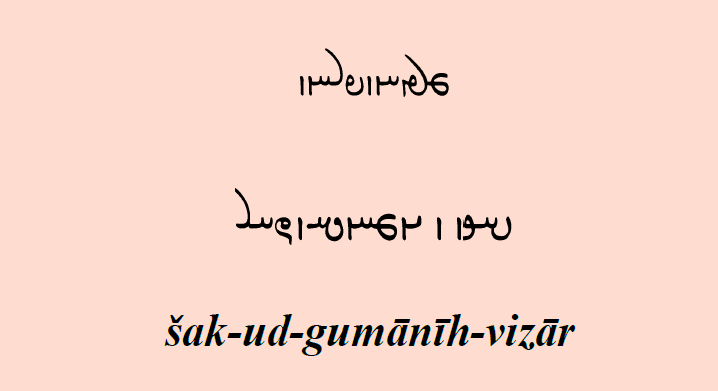
For a thematic introduction to šak-ud-gumānīh-vizār, see here:
The Text has been scrupulously edited, commented and translated by Raham Asha over decades. We here use the last version of his work, published in 2015, with some minor modifications: šak-ud-gumānīh-vizār: The Doubt-removing book of Mardānfarrokh, Introduced, translated, and edited by Raham Asha, Paris, Alain Mole, 2015. See here.
ped-bun
I
(1-2) nam Ohrmazd xvadāy ī mahist ud dānāg, [vispxvadāy, vispāgāh ud visptuvān, kē andar-z mēnōgān mēnōg.
(3) u-š, az xvadīh –ped ēkīh ōstīgān– āfrīd.
(4) u-š dād, ped xvēš anhambidīg zōr, abardar šaš amehrspend,] ud vispān yazdān ī mēnōgān gētīgān;
(5) ud haft gētīg daxšagān ī hend: mardōm, gōspend, ātaš, ayōxšust, zamīg, āb ud urvar.
(6) u-š dād mardōm ped sālārīh ī dāmān, ō kāmravāgīh.
(7) u-š frēstīd, āvām āvām, dēndānāgīh ī abēzagīh ud gumēzagīh, cihrīgīh ud kāmīgīh.
(8-9) ēdōn-z vīr, uš, xrad ud dānišn, bōy, fravahr, ī hend ruvān abzārān; ī hend āgāhīh-xvāstār ī ēn abzārān ī mēnōg panz, ī hend vēnišn, ašnavišn, hambōyišn, caxšišn, permāhišn, ped panz abzārān ī gētīg, ī hend cašm, gōš, vēnīg, dahan, dast, hamāg tan mārdārān.
(10) u-š, ped ēn abzārān abāgīh, mardōm dād ō rāyēnīdārīh ī dāmān.
(11-12) u-š dād dēn ī harvispāgāhīh ī mazdesn draxt humānāg, kē-š ēk stūnag, do baxšišn, sē azg, cahār sāg, panz rēšag.
(13) u-š ēk stūnag peymān;
(14) do baxšišn kunišn ud pahrēzišn;
(15) sē azg humat, hūxt ud huvaršt, ī ast humenišnīh, hugōbišnīh ud hukunišnīh;
(16-17) cahār sāg, cahār pēšagān ī dēn kē-š gēhān pediš virāyīhed, ī ast āsrōnīh, arsēštārīh, vāstryōšīh ud hudoxšīh;
(18) panz rēšag, panz pedān ī-šān dēnīg nām: mānbed, vīsped, zandbed, dahebed, zarduštrōdum.
(19) ud ēk sarān sar, ī ast šāhān šāh dahebed ī gēhān.
(20) u-š andar gēhān ī kōdak, pēdāgēnīd ped humānāgīh ī ēn cahār pēšagān ī gēhān:
(21) cōn abar sar āsrōnīh,
(22) abar dast arsēštārīh,
(23) abar eškamb vāstryōšīh,
(24) abar pāy hudoxšīh.
(25) ēdōn-z cahārān hunarān ī andar mardōm, ī ast xēm, hunar, xrad, toxšāgīh:
(26) abar xēm āsrōnīh, cōn mahist xvēškārīh ī āsrōnān xēm, ī šarm ud bīm rāy, vināh nē kunend.
(27) abar hunar arsēštārīh, ī ast vāspuhragāndar peyrāyišn ī arsēštārān hunar, ī vizārīhed «narīh ī az xvadīh».
(28) abar vāstryōšān xrad, ī ast xradīkkārīh varzīdan ī gēhān ud peyvastan ī ō frašegird.
(29) abar hudoxšān toxšāgīh, ī ast mahist ravāgēnīdārīh ī-šān pēšag.
(30) ēn harv ēvēnag vinārišn abar ēk stūnag, rāstīh ud peymān, pedīrag druz, u-š abzārān ī hambidīg hend.
(31-32) ēn ī-m ušmurd vasēvēnagīhā, vassardagīhā, cōn vasdēnīh, vasvurravišnīh ī andar āvām kē hamāg ēk abāg did hambasān, hambidīg, škastār ud kastār hend, abāg hambasānīh ud škastārīh ud zadārīh ī-šān ēk ō did, pas-iz ēvkirdagīhā, ped ēvzōrīh, pedīrag ēk rāstīh stēzend.
(33) rāstīh xvadīh ēk zōr, ī ōstīgān ped ēkīh, ī rāstīh.
(34) drōv vasēvēnag, ō vas brahm hambasān šāyist būdan hamāgīh az ēk bun ī drōzanīh ast.
(35) hān man ī Mardānfarrox ī Ohrmazddādān ham, ēn pesāzišn kird. cōn man dīd andar āvām vassardagīh vasdēnīh, vasuskārišnīh ī kēšān.
(36) ā-m andar ham aburnāy-dādīh hamvār taftīgmenišnīhā xvāstār, vizustār ī rāstīh būd ham.
(37) im cim rāy ō-z vas kišvar ud zrehvimand franaft ham.
(38) u-m ēn hangirdīg gōbišnān ī aziš ast pursišn ī rāstīhkāmagān, u-š az nibēg ud āyādgār ī pēšēnīg dānāgān rāstān dastvarān, ud nāmcišt hān ī hufravard Ādarpādyāvandān, cīd ud vizīd, ud ō ēn āyādgār «šak-ud-gumānīh-vizār» nām nihād.
(39) cōn ped gumānvizārīh ī nōghamōzagān abēr abāyišnīg ast abar bē dānistan ī rāstīh, ud vābarīgānīh ud rāstīh ī veh dēn, ud andarg škōh judpehikārān.
(40-41) u-m nē dānāgān ud abzārumandān, bē frahangīgān ud nōgabzārān rāy kird ud ārāst; kū dā vasān abar abdīh ud vābarīgānīh ī veh dēn ī pōryōdkēšīg gōbišn abēgumāndar bēnd.
(42-43) az-iz vizīdag dānāgān xvāhišnīg ham kū, kē nigerīdan xvāhed, mā ō nihangmāyagīh ī guftār ud pesāxtār, bē ō vazurgīh ud rāstīh ud vābarīgānīh ud vimandgōbišnīh ī pēšēnīg dānāgān ē nigered.
(44) cē an kē pesāxtār ham, nē pāyag ī hamōzgārīh, bē hān ī hamōzišnīgīh dāram.
(45) u-m rādmenišnīhā gōbišn az hān ī dēndānišnīh ō-z nōghamōzagān baxtan cimīg sahist.
(46) cē kē az andak dānišn ī-š ast ō arzānīgān baxšed, pedīrišnīgdar kū, kē vas dāned, (bē) arzānīgān aziš asūdīh ud anayyārīh.
(47) cōn avēšān vizīrēnīd pēšēnīg dānāgān
(48) kū rādīh sē ēvēnag: menišnīg, gōbišnīg ud kunišnīg.
(49) menišnīg rādīh hān kē kadār-z-ē hamgōhrān rāy nēkīh abāyistan ōn cōn xvēš rāy.
(50) rādīh ī ped gōbišn hān kē az harv frārōn dānišn ud āgāhīh ī-š mad ēsted ō arzānīgān hamōzed.
(51-52) cōn hān ī dānāg-ē guft kū: «kāmam kū, dānam vispāgāhīh ī sūdbar, ud hamōzam ō frayādān, ud ayābam bar ī abāyišnīg.»
(53) rādīh ī ped kunišn hān kē az nēkīh ī-š mad ēsted kadār-z-ē ō arzānīgān nēkīh.
(54-55) didīgar, āyādēnīdārīh ī vehān ped bōxtruvānīh. im cim rāy, man ārāst kū-m dā dānāgān ped xvēš xvābarīh ud hucašmnigerišnīh, ped anōšervānīh āyādēned.
(56) cē guft ēsted kū: kē visp dām ī veh, hucašmīhā, nigered, cašm ī ōy cašm ī xvaršēd ast.
(57) cē xvaršēd ō visp dām, hucašmīhā, nigerīdār ud brāzēnīdār.
Prelude
I
(1-2) Homage to Ahura Mazdā, the lord, the most great and wise, universal sovereign, omniscient and omnipotent, Who is the <holy> spirit among the spirits.
(3) From His selfhood (or, essence) that is One, steadfast in [His] unity, He spiritually created.
(4) And, through His unrivalled power, He created the six supreme Amǝṣa spǝṇta (holy Immortals), and all the Yazata of the world of thought and of the world of life,
(5) and the seven material signs (or, creations), namely the (primordial) Man, Holy Cow, Fire, Metal, Earth, Water and Plant.
(6) He created man as master of the creatures in fulfilment of His will.
(7) He likewise sent, age after age, through his beneficence and mercifulness, to His creatures the Scientia divina of purity and mixture, naturalness and willingness;
(8-9) and likewise the wit, intelligence, wisdom and knowledge, consciousness and fravahr-soul which are the organs of the soul that are seeking information of these five immaterial organs –i.e., sight, hearing, smell, taste and touch– by the five material organs –i.e., eye, ear, nose, mouth and hand–, the whole bodily senses.
(10) And [simultaneously] together with these organs, He created man for the guidance of the creatures.
(11-12) He created the Mazdayasnian religion of omniscience like a tree, with one trunk, two boughs, three branches, four stems and five roots.
(13) The one trunk is measure;
(14) the two boughs are action and protection;
(15) the three branches are humata, hūxta, huvaršta, that is, good thought, good word, and good deed;
(16-17) the four stems are the four classes of the Religion by which the world is well-ordered, that is, priesthood, warriorship, husbandry and artisanship;
(18) the five roots are the five lords whose scriptural names are house-lord, village-lord, district-lord, country-lord and pontiff.
(19) And [there is] one master of masters, that is, the king of kings, the lord of this world.
(20) He made manifest the microcosm that is man in the likeness of these four classes of the world:
(21) The head corresponds to priesthood;
(22) The hand to warriorship;
(23) The belly to husbandry;
(24) And the feet to artisanship.
(25) So too the four virtues (/qualities) that are in man i.e. temper (or, character), skill, wisdom and diligence:
(26) Priesthood corresponds to temper, for temper is the most proper function of the priests, that they do not commit sin on account of shame and fear.
(27) Warriorship corresponds to skill, for the most proper embellishment of the warriors is skill which is explained “manliness by itself”.
(28) Husbandry corresponds to wisdom, for the wise action is the cultivation of the world and the linking with the eschatological renovation [of the existence].
(29) Artisanship corresponds to diligence, for diligence is the greatest propagation of their class.
(30) All these diverse establishments are upon one trunk, truth-and-measure, opposed to its rival, lie and its organs.
(31-32) I noticed this, multifariously and of many kinds, that many religions and beliefs in the world that all are discordant, rival, breaker and enemy one as regards the other, in spite of their discord, breaking and hostility to one another, they combat however, in alliance and with united force, against the sole truth.
(33) The essence of truth is one force, steadfast in unity, which is Truth.
(34) The lie is manifold, which may be in numerous adverse forms, but all these are from one base, that is Lie.
(35) I, who am Mardānfarrox son of Ohrmazddād, provided this composition. For, I observed in the world (in this period), numerous kinds and many religious views and many discussions of the sects.
(36) From childhood on I have always been fervent-heartedly a suitor and researcher of truth.
(37)That is why I have travelled in many lands and seashores.
(38) And I have collected and selected these summarised discourses, some of which are questions of those who seek after the truth and some are from the writings and memoranda of the ancient sages, true priests, especially those of the blessed “Ādarpādyāvandān”, And I have appointed to this memorandum the title Šak-ud-gumānīh-vizār, “Doubt -and-doubtfulness-removing”;
(39) Because it is verily requisite for removing the doubts of neophytes about the knowledge of the truth and the trustworthiness and truthfulness of the good religion, in contrast with the miserable opponents.
(40-41) I have composed and arranged it not for the wise and expert, but for the students and novices, so that many of them may acquire more certainty regarding the wonder and the trustworthiness of the good religion and the discourses of the old teaching.
(42-43) As regards distinguished sages, I ask of those wishing to consider it, not to consider the little knowledge of the narrator and composer, but the greatness, the truthfulness, and the trustworthiness of the logical discourses of ancient sages.
(44) For I, who am the composer, belong not to the rank of the teachers, but to the rank of the students.
(45) And it seemed to me justified to bestow, liberal-heartedly, a theological treatise on neophytes.
(46) Because he who bestows the little knowledge that he has on those who are worthy is more acceptable than he who knows much, but from whom those who are worthy do not receive benefit or help.
(47) The previous sages stated that:
(48) Liberality is of three kinds, of thought, of word and of deed.
(49) Liberality of thought: to desire good for whoever is alike, just like for him.
(50) Liberality of word: to teach to those who are worthy all the righteous knowledge and information acquainted by him.
(51-52) As a certain sage said that: “I want to acquaint all advantageous knowledge and teach it to those who help (the other), and acquire a desirable profit”.
(53) Liberality of deed: [to bestow] the good that he has acquired something on those who are worthy.
(54-55) Furthermore, [I have composed it, so that] those who are good may remember me, saying “may his soul be saved”. For this reason, I have arranged it, so that the sages, through their beneficence and kind observation may remember me, saying “may his soul be immortal (and happy)”.
(56) Since it is said that: “He who observes all the good creature with good eyes, his eye is [like] the eye of the sun”.
(57) For the sun, indeed, observes and illuminates all creatures with a benevolent eye.
darag ī fradum
II
(1) darag ī fradum:
(2) abar pursišn ēcand ī hamēpērōzgar, Mihrayyār ī Muḥammadān, az Spāhān, vehmenišnīhā, nē halagxvāhišnīhā pursīd, pāsox:
(3) hān ī pursīd kū: «Ahrmen cē rāy ō rōšnīh vizāyed, ud cōn šāyist būd ka-š nē hamgōhr, ka amā hamē vēnem kū harv cē nē hamgōhr, az judgōhr ōn pahrēzed cōn āb az ātaš?»
(4) pāsox ēn kū: Ahrmen vizāyišn ī-š ō rōšnīh xvad vahān judgōhrīh;
(5) ud zadārkāmagīh ī-š hamēšagīhā ped gōhr būdan rāy ō judgōhr-š zadār.
(6) vizūdagīh, vizāyišn harv cōn baved bē az judgōhrīh ud judgōhrān enyā nē baved.
(7) cē hamgōhrān, ēk ō did, hamkāmagīh ud hamsāzagīh baved, nē vizāyišn ud vizūdagīh.
(8) ud judgōhrān, hamēstārgōhrīh rāy, harv cōn ō ham rasend, ēk ō did zadār ud vizūdār bend.
(9) hamgōhrān, hamsāzagīh ud hamgōhrīh rāy, ka ō ham rasend zīvīhend, kārīgīhend ud hamayyār hend.
(10) višōbišn ud judīh ud anhamīh ī judgōhrān,
(11) ōn cōn garmīh sardīh, kē hamēstārgōhrīh rāy, hamēšaggōhrīhā, ēk ō did, zadār ud vizūdār, kuxšāg ud višōbāg hend.
(12) cē harv višōbišn az sardīh ud huškīh ud garmīh ud xvēdīh ristagān;
(13) ud ēk ō did zadārīh ud vizūdārīh ud hamēstārīh.
(14) cē višōbišn ī tanān az hamēšakkuxšišnīh ī garmīh ud sardīh, huškīh ud xvēdīh.
(15) az kuxšišn ī avēšān, ēk ō did, tanān višōbīhend ud agārīhend.
(16) āb ud ātaš, xvadgōhrīhā, ēc vizūdārīh nē pēdāg;
(17) bē sardīh ī brādrodīg ō xvēdīh ī āb gumixt ēsted, hamēstār ī garmīh ī ātaš;
(18) ud huškīh ī brādrodīg ō garmīh ī ātaš gumixt ēsted, hamēstārīhā ō xvēdīh ī āb vizūdār.
III
(1-3) ud hān ī pursīd kū: «cim dādār Ohrmazd, Ahrmen az vad kirdan ud vad xvāstan abāz nē dāred, ka tuvān-kirdār ast? ka gōbem kū nē tuvānkirdār, pas nē bavandag, abādyāvand-iz ast.»
(4-5) pāsox ēn kū: Ahrmen vadkunišnīh az vadgōhrīh ud vadkāmagīh ī-š hamēšag ped druz.
(6) dādār Ohrmazd visptuvānīh, hān ī abar visp šāyed būdan sāmānumand.
(7) hān ī-š nē šāyed būdan, tuvān atuvān abar nē gōbīhed.
(8) kē gōbed, nē andar vimand ī soxanšnāsīh.
(9-10) cē, ka guft kū «nē šāyed būdan», did gōbed kū «yazd pediš tuvānīg», ā-š az vimand ī nē-šāyed-būdan burd; cē pas nē nē-šāyed, bē šāyed būdan.
(11-15) cōn-š tuvān sāmānumand, ōn-z aziš kām. cē frazānag; ud kām ī frazānag harv ō hān ī šāyed būdan; u-š kām ō hān ī nē-šāyed nē videred; cē harv hān kāmed ī šāyed ud sazed būdan.
(16-17) agar gōbem kū «dādār Ohrmazd Ahrmen az vattarīh ī-š hamēšag gōhrīg abāz dāštan tuvān», ā gōhr ī dēvīg ō yazdīg, ud hān ī yazdīg ō dēvīg vardēnīdan šāyed;
(18-21) ud tār rōšn, ud rōšn tār kirdan šāyed. gōhr, ped xvadīh, vaštan, gōhr-nē-šnāsān gōbend, kē vizīhišn ī gōhr andar kunišn ud jadišn anešnās; ud gurg xrafstar ped nēkīh hangārend.
(22-23) cōn anāgīh ud vad ī az mardōm ud gōspend, nē xvēšgōhrīhā, bē az vināhišn, frēbišn, vībišn ud viyābānīh ī druz, az ham vattarīh ī abārīg druz, cōn kēn (/xēn) ud xēšm ud varan, ī gumixtag ō mardōm.
(24) cōn xvardan ī dārūg ī taxl ī zahr-gumixtag, nē nēkīh-pardazišnīh, bē spuxtan ī dard ud vēmārīh ī az bē-gōhr rāy.
(25-28) cōn soxan ī rāst ud drō, ī ka, ast ī ka ped soxan-ē ī drō, ahlō mard az vas anāgīh bōxted, ud ped hān ī rāst ēraxted. frāyist, hān nēkīh nē az drōgōbišnīh, bē az spuxtan ī zadārīh ud vattarīh ī gumixtag ō vattarān, hān-z anāgīh nē az rāstgōbišnīh, bē az vattarīh ī gumixtag ō vattarān.
(29-31) az-iz hān ī ka hamēstārān ēk ēk xvēš hambidīg spuxtan cihrēnīd ēstend, harv ēk hān ī xvēš hamēstār abāz dāštan ādōg hend. cōn rōšnīh tārīkīh, hubōyīh dušgennīh, kirbag bazag, hudānāgīh dušdānāgīh.
(32-37) hān nē ādōg rōšnīh dušgennīh, ud nē hubōyīh tārīkīh abāz dāštan. bē jud jud hān ī xvēš hamēstār abāz dāštan cihrēnīd ēstend. hān-z ī gōbend kū:
«ped šab ī tārīk ahlō mard az šagr ud gurgān ud sagān ud duzān bōxted, ped rōz ī rōšn andar dast-išān grav baved»;
hān nē ped nēkīh ī az tārīkīh, nē-z ped anāgīh ī az rōšnīh dāštan sazed. cē rōšnīh ped spuxtan ī tārīkīh dād ēsted, nē ped abāz dāštan ī šagr, gurg ud xrafstarān, abārīg vas ī ped ēn šōn.
(38-39) dagrandīh rāy ō hangirdīg handāxt. ašmā pērōzgarān nēkīh šnāxtārīh ōn kū az dēn vas ayābed.
IV
(1-3) ud hān ī pursīd kū: «ka hamē vēnem kū hamāg tis az spihr ud stāragān hamē baved, ud ēn spihr kē dād pas ham hān ast ī vurravišnīgān gōbend kū nēk ud vad ōy dād.
(4-5) agar Ahrmen dād, ēn abd tis kār ōy cōn tuvān būd dādan? cē rāy ka ast stārag kē-šān nēkīh abāgīh aziš hamē baxšīhed.
(6) agar Ohrmazd ud Ahrmen ped hampursagīh dād, pas ōn pēdāg kū Ohrmazd ped vināh ud vad ī az spihr hamē baved, abāg Ahrmen hamvināh hambāy».
(7-8) pāsox ēn kū: spihr gyāg ī bayān ī nēkīh-baxtārān kē-šān harv nēkīh-baxtārīh aziš hamē baxšend rāstīhā.
(9-10) ud haftān starkirbān perigān ī azēr avēšān dvārend, appurdārān ī judbaxtārān, kē-šān dēnīg nām gayōgān.
(11) dādār Ohrmazd, nizūmānagīhā, frazānagīhā, ārāstārīh ī ēn dām dahišn, peyvastārīh ī ō frašegird rāy.
(12) cōn Gennāg-Mēnōg andarōn asmān pēcīd, ōy druz, dušdānāgīhā, zūrmihōxtīhā, abāg vas sardag bazagān, druzān ī tamtōmagān ō rōšnīh parvast ud gumixt kū «ēn dām dahišn ī Ohrmazd anast kunam, ayāb ō xvēš šāyam kirdan».
(13) avēšān rōšnān abardum ī vehīgān, harvispāgāhīh rāy, ō hān ī druz halakkārīh ud zūrmihōxtīh āgāh būd;
(14-15) ēn-z kū-š ēn nērōg kē-š ēn halakkārīh ud vizendgārīh aziš uzīhed cē sāmānag, ōn kū-š az nūn ēc nērōg ī ped abāz-ārāstārīh ī az bavandag-mārdārīh ī bann ud dard ud pēcīdagīh ī andarōn asmān nē baved.
(16-17) ā-š frazānagīhā, cōn-š ōy druz ō rōšnān parvast ud pēcīd, ēgiš hamāg zōrān abzārān ī-šān bazagān druzān ī vas sardag jud jud ped xvēš kāmišngarīh nē hištan rāy, ast ī ō stī ī rōšnān gumixtag, cōn druzīg zahr ī xrafstarīg kē cahār zahagān ī ohrmazdīg peymuxt dārend.
(18) cē agar ēn druzīg zahr ī xrafstarīg ō cahār zahagān ī tanēgirdīg ī ohrmazdīg, ī ast āb ud ātaš ud gil ud vād, pēcīd nē ēstēnd, hamcōn ō asmān mēnōgīg mad hēnd.
(19-20) agar ped mēnōgīh ud atanīh būd hēnd, ā dām ī Ohrmazd pahrixtan, rastan az hān ī avēšān zahr ī dēvīg nē šāyist hē; ud andar gravīgīh ud nihaxt ōn gumixt hād ī mardōm, abārīg dām, vinārišn, barišn, abzāyišn, vaxšišn nē šāyist hād.
(21) ōn-z avēšān abāxtarān rōšnīh peymuxt dārend cōn druzīg zahr ī xrafstarān andar stī ī rōšnān.
(22-23) hān-z rāy az mār-sardag ī zahr-vidāz, az abārīg dadān xrafstarān, vasān sūdīg tis astīh pēdāg, ōn-z az abāxtarān hamgumēzišnīh ī azērbrāhīh ī rōšnān rāy, nēkīh azišān pēdāgīhed.
(24-27) hangōšīdag ī ēn abāxtarān nēkīh ī avēšān hamē baxšend, ōn cōn gayōgān, rāhdārān ī andar kārevān ī vāzāragānān rāh brīnend, vasān tis ī māyagīg apparend, nē ō xvēškārān ud arzānīgān, bē ō vināhgārān, axvēškārān, jahigān, rūspīgān, anarzānīgān baxšend ud dahend.
(28-30) ēn-z kū: ēn kirbakkarīh, ī starhangārān az avēšān abāxtarān hangārend ud gōbend, hān cim rāy ka-šān cōnīh ī bayān, ī nēkīhbaxtārīh, ud hān-z ī panz stārag ī ohrmazdīg, ī ast mēx ī bālistīg ī handāzišnīg, Haftōiring mazdadād, Vanand, Sadvēs, Tištar stārag, andar gayōgān, anāgīh-baxtārān nē vizīd ēstend, ud hān panz abāxtar, ī ped starkirbīh, azēr avēšān dvārend, ud rōšnīh peymuxt dārend, ī ast Kēvān ud Ohrmazd ud Vahrām ud Anāhid ud Tīr.
(31-32) cōn stārag ī bālistīg mēx pedīrag kēvān;
(33) haftōiring mazddād pedīrag Ohrmazd;
(34) vanand ī xrafstar zadār pedīrag vahrām;
(35) star ī Sadvēs pedīrag Ānāhid;
(36) Tištar stārag pedīrag Tīr ī abāxtarīg.
(37-38) nēkīh ī az avēšān gayōgān gōbend az hān panz stārag ī ohrmazdīg, cōn vēš-nērōgīh, kamvizūdārīh, pērōzīh ayābend.
(39-40) ud ēn panz abāxtar, dādār Ohrmazd, xvēš-kamagīhā nē hištan rāy, harv ēk ped do zīg ō Mihr ud Māh bast ēstend; u-šān frāzravišnīh ud abāz-ravišnīh az ham cim.
(41-42) ast kē-š drahnāy ī zīg drāzdar cōn Kēvān ud Ohrmazd; ud ast ī kehdar cōn Tīr ud Anāhid.
(43-44) harv ka ō abdum ī zīg šavend, ped pas abāz āhanzend. u-šān xvēš-kāmagīhā raftan nē hilend, kū dām nē vināhānd.
(46) ud hān do druz ī meh-ōz, ī hend Mihr ud Māh ī abāxtarīg, hamēstārīhā, azēr brāh ī do rōšnān ravend.
(47-49) anī hān-z ī xvānīhed Mūšperīg, ī ast stārag gayōg, azēr brāh ī Mihr bast ast; ud ka az bann dūr baved, ped hān axtar ī-š andar jahed, ped kust ī hān kē hān axtar xvēškārīh, vizend ud anāgīh kuned, dā did abāz bannag ud gravīg ī Mihr baved.
(50-51) soxan ī pediš barend ēn ast: ardīg ī abarīgān andar star pāyag.
(52-54) azēr ī avēšān ardīg ī tištar ud spenzaγr dēv, ud ātaš ī vāzišt ud abōš dēv, abārīg veh mēnōgān ī abāg tamīgān, ped vārāngirdārīh ud sūdbaxtārīh ī ō dāmān.
(55) azēr ī avēšān mardōm ud gōspend ud xrafstar ud mar ud abārīg dām ī veh ud vattar.
(56–59) cē jadišn abāg mardōm gumixt ēsted, ī ast āz ud varan ud kēn ud xēšm ud būšyāsp, ud xrad ud xēm ud hunar ud dānišn ud uš ud vīr, cōn juxt ī veh ud juxt ī vattar gōbīhed ī vahān hend ī kirbag ud vināh.
(60-62) ēn hamāg nēkīh ī dām frāyist az dādār ī dām kē ast xvad bizešk ud drustbed, pānāg, dāštār ud parvarāg ud pahristār ud būzāg ī xvēšān dāmān; u-š ō xvēšān dāmān cār ī az anāgīh bōxtan, ud abzār ī az bazagīh pahrixtan, bavandagīhā dād ud hamuxt ēsted.
(63-66) u-š hangōšīdag ōn cōn bāv xvadāy, ud bōyestānbān ī dānāg kē-š dad ud murv ī vināhgār ud zadār ped tabāhēnīdan ī bar ī draxtān ō bāv kāmend vizūdan, ud ōy bāvbān ī dānāg, pedisāy kamranzīh ī xvēš abāz dāštan ī hān dad ī vināhgār az xvēš bāv rāy, abzār ī ped griftan šāyed ī hān dad ārāyed, cōn talag ud dām ud cīnag ī parrendag kū ka dad cīnag vēned, u-š ruzdagīhā kāmed raftan, ped anāgāhīh ī talag ud dām andar-iš gravīhed.
(67) ēn āšnāg kū dad ka ō dām ōfted, nē abarvēzīh ī dām, bē hān ī dām ārāstār.
(68-69) ped hān dad andar dām gravīhed ī mērag, bāv xvadāy ī dām ārāstār, ped dānāgīh, āgāh kū hān dad nērōg dā cē sāmānag ud cand zamān.
(70) hān dad, nērōg ud zōr ī-š andar tan ped kuxšīdārīh agārīhed, ud rebīhed, cand-iš tuvān ped dām kandan ud talag škastan ud tabāhēnīdan, kuxšīdan.
(71-72) ud ka-š abavandag-nērōgīh rāy, nērōg ī kuxšāg uzīhed, agārīhed, pas hān bāvbān ī dānāg, ped xvēš kāmaghanzāmīh, bar xvēš, dānāgīhā hān dad az dām bērōn abganed, xastgōhrīhā, agār-nērōgīhā. xvēš dām ud talag abāz-ārāstārīhā, avizendīhā, abāz ō ganz abespāred.
(73) ōy-iz mānāg ast dādār Ohrmazd ī dahišnān bōxtār, ud dām ārāstār, ud vad bunēštag agārēnīdār, ud bāv ī xvēš az vizūdār pādār.
(74) dad ī vināhgār, ī bāv tabāhēnīdār, ōy guzastag Ahrmen ī dām avištāftār, pedyāragēnīdār ī dām ī veh. asmān kē-š veh dahišnān andar mehmān hend, kē-š Gennāg Mēnōg ud vihūdagān hāmis andar gravīg hend, ōy talag ud dām ī dad ī vināhgār az xvēš kāmišngarīh agārēnīdār.
(78-80) zamān ī ped kuxšīdārīh ī Ahrmen, u-š zōrān, abzārān, dagrand ī ped kuxšīdārīh ī dad andar talag ud dām agārīhed ī-š nērōg. abāz dādār, ī dāmān bōxtan ī-š az pedyārag, jāyēdānag nēkravišnīh vinārdan, abāz-ārāstan ī ōy bāv xvadāy ī dānāg xvēš dām ud talag.
(81-82) enyā, kamnērōgīh ud abēhangīh ī ōy druz andar kuxšišn ī-š ō rōšnān az-iz ēn pēdāg ka cōn-š, zūrmihōxtīhā, menīd kū:
«ēn asmān ud zamīg, ud hān ī Ohrmazd dām, anast kunam, ayāb az xvēš gōhr vardēnam, ō xvēšīh baram»;
(83-85) ēg-iz, abāg druz-nērōgīh ud zadārkāmagīh ud hamēšakkuxšišnīh, ī az tuvān-sāmān ēc rāy, ud kuxšišn ī dēvān, ast ēn zamīg ud asmān ud ēn dām, ī az andak ō vas āzāyišnīg, cōn pēdāg, amaragān-z pediš xustōgīh.
(86) cē agar, andar ēn kuxšišn, ēc abarvēzīh frāyist būd hē, az andak ō vas madan ašāyist hē.
(87) agar-z zāyišn ī gētīg frāyist pediš margīh-rasišnīh pēdāg, ēg-iz vēnīhed kū hān margīh nē astīh bavandag-agārīh, bē vihēz ī az gyāg ō gyāg, az kār ō kār.
(88) cē cōn hāmōyēn dahišnān bavišn az cahār zahagān, ī-šān gētīg tan, abāz ō cahār zahagān gumēzīhistan ōy vēnābdāg pēdāg.
(89) mēnōgān, ī tan rāyēnāg, gyān hāmis abzārān, ō ruvān gumēzīhend; ēvcihrīh rāy nē višōbīhend.
(91-92) ud ruvān az hān ī xvēš kunišn āmārīhend. u-š ganzvar kē-š kirbag ud bazag aviš abespārd, ānōh frāz rasend ped kuxšīdārīh.
(93-94) ud ka ganzvar ī kirbag meh-ōz, ā-š ped abarvēzīh, az hamemāl dast, būzed, ō meh-gāhīh ud rōšnān ī hāmxvašīh ahrāmed; ud jāyēdān nēkravišnīhā frayādīhed.
(95-96) ud ka-š ganzvar ī bazag meh-ōz, ā-š ped abarvēzīh, az ayyār dast, kašīhed, ō gyāg ī pāzišn ud šōyišn, ud vēmārestān ī sardgar, abespārīhed;
(97-98) u-š ānōh-iz hān xvazārag kirbag ī-š gētīgīhā varzīd nē agārīhed, cē-š, im cim rāy, hān šōyišn ud pāzišn ud pādifrāh, vināh-sāmānīhā, nē adādīhā.
(99-100) cē-š pādifrāhēnīdan pādār, ud abdum, xvābar dādār ī dām abaxšāyīdār, ēc dām ī veh andar dastgravīgīh ī dušmen nē hiled;
(101) ud hān-z ī vināhgār jumā hān ī ahlavān, ped vizārdārīh ī vināh, az yōšdāhrgarān dast, būzed, ō nēkravišnīh ī jāyēdānag zāmēned.
(102) hangird ēn kū: dādār, bizešk ud drustbed, ud dāštār, parvardār ud pānāg, būzāg ī dāmān, nē vēmārgar ud dardēnīdār ud pādifrāhgar ī xvēš dām.
(103) ud ast ī gōvizārdar azēr nibišt abāg do bunēštag vinārdārīh, andarg nēst-yazd-gōbān ud ēkīh-uskārān.
(104-105) cōn-itān framūd ud xvāst, peyrāst ēsted. hucašmīhā framāyed nigerīdan! cē cōn-imān azabar nibišt, nē pāyag ī hamōzgārīh, bē hān ī hamōzišnīgīh dāram.
(106-107) ēn-z dēnīhā hamōz, ī-m ped nihang xrad, az nibēg ī Ādarpādyāvandān ayāft, ēdar nišānēnīd. u-š hamōzagān andar dēnkird nibēg ī agrī frazānag Ādurfarrōbay ī Farroxzādān, ī hudēnān pēšobāy būd, az dēn dānāgīh vizārd, ī ast hazār-darag.
(108) hān-z ī-tān abar akanāragīh ud kanāragumandīh pursīd, azēr nibišt-am. ped yazdān kām.
First Chapter
II
(1) Chapter one:
(2) On some questions that the ever-successful Mihrayyār son of Muḥammad from Spāhān, put forward not out of absurd curiosity, but with good intentions, and the answer thereto.
(3) As for that which he asked: “Why did Aṇgra Mainyu (harmful spirit) harm the Light and how was that possible? Since it is so that he is not of the same substance, and we always observe that a thing avoids that which is not of the same substance as itself, as the water does the fire?”
(4) The answer is this: The Angra Mainyu's harm to the Light is precisely because of their difference of substances.
(5) It is by reason of his desire of hostility which is a constant aspect of his substance that he is hostile to all that is of a different substance.
(6) Harmedness and harm, of whatever kind may they be do not take place except from difference of substance and those of different substances.
(7) For between those of the same substance there is consensus and concord, and not mutual harm and harmedness.
(8) Those of different substances, because of their substantial contrariness, every time they meet one another, become hostile and harmful to each other.
(9) While those of the same substance, because of their concord, and their community of substance, when they meet one another, become lively and efficient and assist each other.
(10) The disturbance and discord and disunion of those of different substances are
(11) just as heat and cold which, on account of their substantial opposition, are mutually hostile, harmful, striving and disturbing, through their perpetual substance.
(12) Because every disturbance comes from the natural properties of coldness and dryness, heat and moisture,
(13) there are hostility, harmfulness and opposition of one another.
(14) For the disturbance of bodies comes from the perpetual combat of heat and cold, dryness and moisture.
(15) Bodies become disturbed and disabled, owing to their combat, one with the other.
(16) Of water and fire, as regards their substance, no harm whatever does appear.
(17) But the cold that is closely related to the moisture, is mingled with the moisture of water, and is an opponent of the heat in fire;
(18) and the dryness that is related to the heat, is mingled with the heat of fire is opponently harmful to the moisture in water.
III
(1-3) As for that which he asked: “Why did Ahura Mazdā the creator not prevent Aṇgra Mainyu from doing and wanting evil, when He is able to do so? For if we say He is not able, that would mean that He is not perfect, and even He is feeble”.
(4-5) The answer is this: The evil actions of Angra Mainyu come from the evil substance and evil will, which are always his, as the Lie.
(6) The omnipotence of Ahura Mazdā the creator is limited to all that which is possible.
(7) The question of knowing whether or not one is able or unable to do that which is not possible does not make sense.
(8) Whoever says so, is not within the limits of rational discourse.
(9-10) For he who says first “it is impossible”, and next “God is able to do it”, then by that removes its impossibility, because now it is not impossible but possible.
(11-15) As His ability is limited, so is His will. For He is wise; and the will of the wise is [confined] to that which is possible, and his will does not encroach on what is impossible; because he only wills all that which is possible and contingent.
(16-17) If we say that “Ahura Mazdā the creator is able to prevent Angra Mainyu from the evil which is his constant substance”, then we might as well say that it is possible to change the demonic substance into the divine, and the divine to the demonic;
(18-21) and that it is possible to make darkness light and light darkness. Those who speak of the changing of a substance from its essence [into another] are not physicists i.e. those who cannot discern substance in action and accidents, and count wolf (and) monster as beneficent.
(22-23) Since the calamity and evil which arise from man and cattle are not substantially their own, but are owing to the corruption, deception, delusion of the Lie, and owing to the evil of other demons such as Revenge (or, Crime), Wrath and Lust which are mingled with man.
(24) Just as taking a bitter medicine, which is mingled with poison, is not for the maintaining of well-being, but for the removal of the pain and sickness which are owing to an extraneous substance.
(25-28) [Another] example: a true statement and a false statement. Sometimes, a righteous man is saved from much calamity by a false statement and is condemned by a true statement. That benefit does not come, mostly, from the lying, but from the removal of the hostility and evil which are mingled with the evil ones, and that calamity is not from the veracity, but from the evil which is mingled with the evil ones.
(29-31) Considering that the opponents have been constituted in order to repel each one its own contrary, each one is [only] capable to keep away that which is its own opponent, such as light darkness, fragrance stench, good-deed evil-doing, erudition ignorance.
(32-37) The light is not capable to keep away stench, nor the fragrance darkness, but they have been constituted in order to keep away each of them its own opponent. As for that which they say:
“In the dark night a righteous man is saved from he lion, wolves, dogs and robbers, while in the light day he is captured by them”;
It is not proper to consider that as a benefit owing to darkness, nor yet as a calamity owing to light. Because light is created to repel darkness, not to keep away the lion, wolf and monsters and many others alike.
(38-39) On account of tediousness, I contented myself to explain succinctly. You, the successful, may your appreciation of benefit be such that you may obtain much from Religion.
IV
(1-3) And as for that which he asked: “We always observe that everything is generated from the celestial sphere and stars, then He who created this sphere is the same that, the Believer claim that ‘He created Good and Evil’.
(4-5) If Angra Mainyu created, how was he able to create these wonderful things? For there are stars by which, and with accordance with them, benefit is bestowed.
(6) If Ahura Mazdā and Angra Mainyu created in consultation with each other, then so it is obvious that, Ahura Mazdā is an accomplice and partner, with Angra Mainyu, in the sin and evil which arise from the celestial sphere”.
(7-8) The answer is this: The celestial sphere is the place of gods (= luminaries) who bestow benefits, and every bestowal of benefits by them is done always justly.
(9-10) The seven planets are star-form witches who roam about beneath them (luminaries), rob and distribute amiss, whose scriptural name is Robber.
(11) Ahura Mazdā the creator prepared, skilfully and sagaciously, these creatures, with the idea of conveying them to the eschatological Renovation.
(12) When the Harmful Spirit winded in the sky, that demon, ignorantly and hypocritically, together with the various sinful demons, who are those of a gloomy seed, encircled the Light and mingled with it, expecting that: “I either will annihilate the creatures of Ahura Mazdā, or may take possession of them”.
(13) The luminarie, the supreme among the good, were aware, thanks to their omniscience, of the absurd action and hypocrisy of that Demon;
(14-15) and of this too that, to what extent is this power of his, from which the absurd action and harmfulness come out, so that, henceforth, no power remains for his restoration from the complete perception of bondage and pain, and winding inside the sky.
(16-17) When this Demon encircled and winded round the Light , then [Ahura Mazdā], sagaciously, for the purpose of not allowing the forces and organs [of the Demon], that is, the whole sinful demons, to fulfil their proper will, some of these demons are mingled with the realm of the luminaries, such as the demonic poison pertaining to monsters which is clad with the four divine elements.
(18) For if this demonic poison pertaining to monsters had not been winded in the four divine corporeal elements, that is water and fire and clay (/earth) and wind, then they would have come to the immaterial sky.
(19-20) If they had attained to immateriality and incorporeality, then it would have not been possible for the creatures of Ahura Mazdā protect and escape from the demonic poison of theirs, and it would be so mingled [with the creature] in the pledge and detention that the establishing and bearing, increase and growth of mankind would not be possible.
(21) Likewise also the planets are clad with light, as the demonic poison of the monsters in the realm of the luminaries.
(22-23) On account of that, too, the existence of a certain advantage is manifest from the serpent species that are poison-melting, and from the other wild animals and monsters, so also some benefit is manifested from the planets, on account of their commingling below the radius of the luminaries.
(24-27) By analogy, these planets that bestow benefit, are like the brigands and highwaymen who cut off the way of the caravan of merchants, steal many important things, and bestow and give them, not to the dutiful and worthy, but to the sinner, undutiful, harlot, prostitute and unworthy.
(28-30) The benevolence which astrologers attribute and state (that they come) from the planets, is for this reason that, they have not discriminated the quality of the gods (/luminaries) who bestow benefit, and that of the five divine (/Ahuric) fixed stars –which are the Highest Peg which is a measuring-mark (= Polaris), the star Haptō.iriṇga established by Mazdā (= Ursa Maior), Vanant, Satavaēsa and Tištrya – from the quality of the robbers (= the wandering celestial bodies) who distribute calamity, and that of the five planets which roam about beneath them, in the form of stars, and are clad with light, that is Saturn, Jupiter, Mars, Venus and Mercury.
(31-32) For, opposed to the Highest Peg is Saturn;
(33) opposed to Haptō.iringa established by Mazdā is Jupiter;
(34) Opposed toVanant the-smiter-of-monsters is Mars;
(35) opposed to the star Satavaēsa is Venus;
(36) and opposed to the star Tištrya is the planetary Mercury.
(37-38) The benefit which [the astrologers] claim comes from those robbers (planetary bodies), comes in fact from those five divine stars, as they obtain much strength, little damage and victory.
(39-40) The creator Ahura Mazdā in order not to abandon these five planets to their own will, bound each of them to the sun and moon with two ropes, hence their progression and retrogression.
(41-42) The length of the rope of some is longer, such as Saturn and Jupiter, and that of some others is shorter, such as Mercury and Venus.
(43-44) Whenever they go to the end of the rope then they are pulled back, they are not permitted to go according to their own will, so that they may not damage the creatures.
(46) Those two demons who are greater in strength, that is the planetary sun and moon, move in opposition below the radius of the two luminaries (Sun and Moon).
(47-49) Another star<-form> robber that is called Mūšperīg, is likewise bound below the radius of the sun. When she gets far from bond, and enters into a zodiacal constellation, she commits damage and calamity to the quarter which is the proper function of that constellation, until it becomes again subject and pledged of the sun.
(50-51) The reason given [by the sages] is this: The battle of the superior beings occurs in the star station.
(52-54) Beneath them, there is the battle of Tištrya against the demon Speṇjaγri, of the fire Vāziš a (the cloud-fire) against the demon Apaoša, and of other good Spirits against gloomy ones, for the making of rain and allotment of profit to the creatures.
(55) Below them, that of man and cattle [against] monsters and felons, and of other good creatures against bad ones.
(56-59) Because, accidents are mingled with man, that is: Greed, Lust, Revenge, Wrath and Sleepness, Wisdom, Character, Virtue, Science, Recollection and Wit, as the yoking together with good and the yoking together with evil are called, which are the causes of good deed and sin.
(60-62) All the benefits of the creatures come, mostly, from the creator of the creatures, who is Himself the healer and physician, the guardian and keeper and nourisher and protector and saviour of His own creatures. He has given to His creatures and taught them all the means of being delivered from calamity, and the instruments of abstaining from crime.
(63-66) He is like a wise garden-owner and gardener that pernicious destructive beasts and birds are intent on damaging the garden by spoiling the fruit of the trees, and the wise gardener, for the sake of diminishing his trouble and keeping those pernicious beasts out of his garden, prepares instruments whereby to be able to capture those beasts, like traps, net and bird-grains, so that when the beast sees the bait, and wishes, greedily, to catch it, is captured therein, not knowing of the trap or net.
(67) It is obvious that, if the beast falls into the net, this event is not the triumph of the net, but that of the arranger of the net.
(68-69) The beast is captured in the net because the master, garden-owner and arranger of the net knows, sagaciously, that to what extent the beast is strong and for how long.
(70) The bodily strength and force of that beast are exhausted by striving [in the net], and it becomes infirm in endeavouring, as much as it is able, to destroy the net and rend and demolish the trap.
(71-72) Since its strength is not sufficient, when its power of striving is gone out and it becomes powerless, then the wise gardener, taking successfully possession of his fruits, throws wisely the wounded and powerless beast out of the net, and consigns his net and trap, rearranged and undamaged, back to his storehouse.
(73) Similar to Ahura Mazdā the creator, the saviour of creations and (re-)arranger of creatures, who makes the principle of Evil disabled, is the gardener who protects his garden from the injurer.
(74) The pernicious beast which ruins the garden is similar to Angra Mainyu the accursed who oppresses the creatures and is adverse to the good creation. The trap and net which make disabled the pernicious beast to fulfill its wish are similar to the sky in which good creations dwell, and in which the Harmful Spirit and his abortions are captured.
(78-80) The time of Angra Mainyu and his forces and instruments, for the combat, is similar to the duration of the beast, for the striving in the trap and net, so that its power is exhausted. The salvation of the creatures from adversity, and the establishment of the eternal beatitude, are similar to the rearrangement of the net and trap by that owner of the garden.
(81-82) Moreover, the lack of strength and want of courage of the Demon, in his strife against the luminaries, is manifest from this too: When he thought hypocritically thus:
“Either I will annihilate this sky and earth the creatures of Ahura Mazdā, or I will change their substance and take possession of them”.
(83-85) Then, in spite of his fiendish strength, desire of hostility, and perpetual combat, as far as possible and in spite of the strife of the devils, there exist the earth and sky and the creatures that are increasing from few to many, as is manifest, and all acknowledge it.
(86) For, if in this combat there had not been any triumph, it would have been impossible to come from few to many.
(87) If it is manifest that the death occurs after the worldly birth, however that death may not be the complete cease of existence, but rather is the movement from place to place, or from act to act.
(88) For, it is obvious and manifest that, since the generation of all these creations is from the four elements which [constitute] their material body, they are to be mixed again with the four elements.
(89) The Spirits which are all the instruments of the breathing soul and agents within the body, are mingled with the soul, and on account of being of one nature, they do not be disturbed.
(91-92) The soul will be reckoned for its own deeds. The treasurers unto whom are deposited its good and evil deeds arrive for a test.
(93-94) If the treasurer of the good deeds is greater in strength, then it is, triumphantly, saved from the hands of the adversity, and it ascends to the great seat and all-blissful luminaries, and it is delighted eternally in beatitude.
(95-96) And if the treasurer of the evil deeds is greater in strength, then it is, triumphantly, dragged from the hands of the helper, and it is entrusted to the cleaning-and-washing place, that is, the purifying hospital.
(97-98) There, even those feeble good deeds practised in the material world, are not ineffectual to it. For this reason, the washing and cleaning and punishment are proportionate to the sin, and not arbitrarily.
(99-100) For, [these good deeds practised in the world] protect it from the [arbitrary] infliction of its punishment. Finally, the beneficent creator, who is the forgiver of the creatures, does not leave any good creature in captivity in the hands of the enemy.
(101) He saves both, the righteous and even the sinful, through atonement for sin, from the hands of the purifiers, and leads them to the eternal beatitude.
(102) In brief: The creator is the healer and physician, the keeper and nourisher and guardian and saviour of the creature, and not the one who inflicts disease and pain, and punishes his own creatures.
(103) This has been more extensively written below [in the chapters] on the proof of Two Principles and against the atheists and monists.
(104-105) I prepared [this chapter] as you (Mihrayyār) commanded and requested. May you consider it with kind regards. Because, as I have written above, I belong not to the rank of the teachers, but to the rank of the students.
(106-107) I have presented here, these religious teachings which I found, despite my little wisdom, from the books of “Ādarpādyāvandān”, and his teachings are extant in he book Dēnkird of the excellent wise Ādurfarrōbay son of Farroxzād, who was the Leader-of-Mazdayasnians, and explained out of the knowledge of the religion, [and this book Dēnkird] contains a thousand chapters.
(108) As for the unlimitedness and limitedness that you asked, I will write, God willing, below.
darag ī didīgar
V
- anī darag andarg ī nēstyazdgōbān, ud abar astīh ī yazd u-š hambidīg.
(2) astīh ī yazd u-š hambidīg xradpedīrišnīg dānišn ud gōbāgīh vimandsoxanīhā.
(3) hangird ēn ē framāyed dānistan kū: abardum, fradum ud avizīrišnīgdum dānišn yazd šnāxtan ast.
(4) kē-š ēn dānišn nē pēšobāy ī dānišnān, ā-š abārīg dānišn afrayād.
(5) yazd šnāxtan ped uš ī avinast, ud vīr ī tēz (ud ayābāg) ud xrad ī vizināg šāyed.
(6) cē yazd šnāxtan nē ēn and vas kū dāned kū, yazd ast.
(7-8) cē kē vahmān tis ped astīh āgāh, u-š az cōnīh anāgāh, ēn kū hān tis veh ayāb vattar, hudānāg ayāb dušdānāg, anōš ayāb zahr, sard ud afsurd ayāb garm ud vidāzāg, hušk ud hōšēnāg ayāb xvēd ud namēnāg, ud ka-š az cōnīh anāgāh, ēgiš ast ēvāz dānistan asūd;
(9) cē stāyišn ud nikōhišn ī kas ud tis nē ped astīh, bē ped cōnīh šāyed kirdan.
(10-11) ēn-z ē framāyed dānistan kū: dānistan ī tis ped sē ēvēnag:
ped acār-dānišnīh;
ayāb hangōšīdag-dānišnīh;
ayāb ped šāyed ud sazed būdan.
(12) acārdānišnīh ōn cōn:
ēk bār ēk ēk,
do bār do cahār.
(13-14) cē andar vimand ī acārīgīh-iz nē šāyed guftan kū: būd, baved zamān-ē ayāb gyāg-ē kū do bār do panz ayāb sē gōbīhed.
(15-17) hangōšīdagdānišnīh hān kē az pēdāgīg tis, hān ī nē pēdāg pēdāgīhed. ud az vēnābdāg tis avēnābdāg tis, ped hangōšīdag ī dastabarnihād āvared ō handēmānīh ī vēnišn ī xrad, ped spurrīgmānāgīh, humānāgīh, ud humānāgbahrīh.
(18) spurrīgmānāg ōn cōn mardōm ī Pārs ō mardōm ī anī šahr.
(19) ud humānāg ōn cōn panīr ō spēdag ī xāyag.
(20-26) ud humānāgbahr ōn cōn panīr ō gac. cē ēn az vimand ī humānāgbahr. cōn panīr ō gac ēvāz ped spēdīh mānāg; spēdag ī xāyag ped spēdīh ud xvarišn-iz. ud ast-iz kē humānāg humānāgdar, ud humānāgbahr humānāgbahrdar gōbīhed. hān ī spurrīghumānāgdar abar nē gōbīhed. cē spurrīg spurrīgdar nē baved.
az ēn ēvēnag gugān vas, dagrandīh rāy, frāz hišt.
(27-30) az vēnābdāg tis avēnābdāg nimūdan ōn cōn az kirdag ud dāštag tis kē kirdār ud dāštār nē handēmān, ud az nibištag tis kē-š nibištār nē pēdāg, pēdāgīhed kirdār ī hān kirdag, ud dāštār ī hān dāštag, ud nibištār ī hān nibištag acārīg, cōn-š nimūd tis ī pēdāg ud vēnābdāg hān ī abēdāg ud avēnābdāg.
(31) hān ī andar šāyed ud sazed būdan āgāhīh vurravišnīg.
(32-33) cōn kē gōbed kū: «-m dīd mard-ē kē-š šagr-ē, ayāb šagr-ē kē-š mard-ē bē ōzad», ud ēn hān ī andar šāyed ud sazed būdan vimand šāyed drōv.
(34) bē ka hān āgāhīh mard gōbed kē ped rāstīh husrav, ud ped vizurdīh uzmūdag, ā andar rāstīh ud astīh vimand.
(35) agar mard gōbed kē ped drōzanīh dusrav, ud ped avizurdīh uzmūdag, ā andar vimand ī drōvīh ud anastīh.
(36) anī ēvēnag ī az ēn bērōn vimand ī acārīg nē būd ud nē šāyed.
(37-45) cōn kē gōbed kū: «gēhān ped nihānīgīh andar andarōn xāyag-ē burdan šāyed»; ayāb: «pīl-ē andar sūrāg-ē ī sōzan vidurdan šayed, ōn ka ēk-iz nē meh baved ud nē keh»; ayāb: «gōhr tis ī nē-bun»; ud «kuxšišn ī nē kanāragumandīhā»; ud «astag tis ī nē zamānumand ud gyāgumand», ayāb «gyāgumand nē kanāragumand»; ud «jumbišn vihēzag ī tuhīg»; ud abārīg ī az ēn šōn guftan ud handēšīdan zīfān ud drōv ud nē šāyed.
(46-50) ēnyā astīh ī āfurāg yazd, jud az hān ī cihrmārišnīh ud anī gugāyīh, ped acārīg ud hangōšīdagīg dānišn, pēš vēnišn ī xrad ōn vēnābdāg cōn az bahrumandīh ud kirdagīh ud pesāxtagīh ī az vas ēvēnag judsān tis, kirdagīh ī gēhān ud mardōm kē-šān bahrān abzārān ī aziš, cōn tan, gyān, zahagān kē aziš pesāxt ud kird ēstend; ī ast: ātaš ud āb ud vād ud zamīg, ī jud jud ped xvēš kār rāyēnišn ōn cihrēnīd ud vāspuhragānēnīd ēstend kū, ātaš ped xvēšcihrīh ud vāspuhragānīh kār ōn kū-š kār ī āb, vād, zamīg nē ādōg rāyēnīdan.
(51) ēdōn-z āb ped xvēšcihrīh ud vāspuhragānīh kār ōn cōn kū-š kār ī vād, ātaš, zamīg nē [ādōg].
(52) ēdōn-z vād kār ī ātaš, āb, zamīg nē.
(53) ēdōn-z zamīg kār ī avēšān rāyēnīdan nē ādōg.
(54-56) bē jud jud ped hān ī xvēš kār cōn vāspuhragānēnīd ud cihrēnīd ēstend, az ōy ī cihrēnīdār ud pesāxtār ud vāspuhragēnīdār frazānagīhā ud nizūmānagīhā, cōn ō hān kār abāyišnīg, pesazag pesāxt, virāst, cihrēnīd ud vāspuhragānēnīd.
(57-59) ōn-z mardōm ud abārīg dām kē zahagumand ī ēn zahagān, kē-šān pesāxtagīh ī ast ud pit ud pay ud rag ud pōst jud jud, ēk ō did abyuxtagīh āgenīn vēnābdāg.
(60-62) ēdōn-z vāspuhragānīh ud cihrēnīdagīh ī hannāmān ī andarōnīg, cōn jagar, spul, šuš, gurdag, ud zahr pōšišn, abārīg abzārān kē harv ēk azišān xvēškārīh-ē pēdāg, avišān pādemār cihrēnīd ud vāspuhragānēnīd ēstend ped hān ī-šān xvēš kār.
(63-64) ēdōn-z cašm, gōš, vēnīg, uzvān, dahan, dandān, dast, pāy, abārīg abzārān ī bērōnīg kē-šān jud jud xvēškārīh cihrēnīdagīh vēnābdāg pediš pēdāg; ōn ka ēk az avēšān hannāmān agār, hān ī did ped kār ī ōy ī did kē-š aviš nē cihrēnīd ēsted nē šāyed.
(65-67) ud ka ēvāz ō pesāxtagīhā ī ēk az hannāmān ī tan nigerīhed kū cōn abd frazānagīh pesāxt ēsted:
cōn cašm ī az vas ēvēnag judnām ud judgār, cōn mijag ud padk, spēdag ud xāyag, syāhag ud tēdag.
(68-73) ōn kū spēdag pay ast; syāhag āb, ī ped rag ī pay ōn ēstādag kū-š vardišn ī cašm az kust ō kust pediš baved; tēdag xvad vēnāgīh ast cōn vēnāgīh ī andar āb; syāhag ped rag ī spēdag ēsted cōn ēstišn ī āb ped rag ī pay; ud tēdag andar syāhag cōn vēnāgīh ī tis andar rōšn āb, ud dīdan ī kālbod andar āyēnag ī rōšn.
(74-76) ud spēdag ī gabrīhā vināristan ped hān cim kū xāk gard ī az andarvāy ka ō cašm rased pediš nē ōftād, ō dumb ī cašm vardād, ud vēnišn ī cašm mā tabāhēnād.
(77-79) ēdōn cōn varg ī gōš xvahr pesāxt ped hān cim kū, xāk gard, parrvarān xrafstar, rāstīhā, pediš andar nē šavād, ud xvad nam ud guzd ī gōš, ud zahr ī xrafstarān.
(80-81) ēdōn pēdāg ka ō abzārān ī gyān ud ruvān nigerīhed, cōn hambōyišn ud ašnavišn ud vēnišn ud caxšišn ud permāhišn ī āgāhegar ī gyānumandān;
(82) ēdōn-z xrad, ī «harv rad» vizārīhed, vizingar;
(83) ud dānišn ī ayābāg;
(84) ud vīr ī xvāstār abespārdār;
(85) ud uš ī ganzvar nigāhdār;
(86) ud bōy ī xvād vēnāgīh ī ruvān;
(87) fravaš ī xvad cihr ī dāštār ī tan;
(88) ud ox ī abēzag;
(89-91) ud abārīg mēnōgān ī tan dāštār kē-šān jud jud kār ud xvēškārīh ped hān ēvēnag cihrēnīd ēstend, ped xvēškārīh cōn vāspuhragānēnīd cihrēnīd ēstend ped xvēš kār bavandag hend, ped hān ī nē cihrēnīd ēstend nē šāyend.
(92) ud gugān ī jud jud andar dēngird nibēg ī cōn agrī frazānag az dēnāgāhīh vizārd, ēdar dagrandīh rāy frāz hišt.
(93-95) kē-š kāmag kū abdīh ī dēn mazdesn ud pōryōdkēšīg gōbišn bē dānistan, ped hān an-angōšīdag nibēg pediš nigered, abdīh ud rāstīh ī dēn abardar ē dāned.
VI
(1-4) ud anī viyābānīgīh ī avēšān nēstyazdgōbān, kē-šān dahrīg xvānend, kē az arg ī dēnīg ud ranz ī ped kirbag varzīdan vaxt ēstend, ud drāyišn ī abēvimand vasīhā drāyend.
(5-6) ēn ē nigered kū: ēn gēhān abāg vasēvēnag vardišn ud ārāyišn ī-š hannāmān abzārān, ud pedyāragīh ī ēk ō did, ud gumēzišn ī-š ēk ped did, akanārag zamān bunēštag hangārend.
(7) ud ēn-z kū nē kirbag mizd, ud nē vināh pādifrāh, ud nē vahišt ud dušox, ud nē rāyēnīdār ī kirbag ud bazag ast.
(8) ēn-z kū: tis ēvāz gētīg ast, ud mēnōgīg nēst.
(9-10) cōn man azabar nibišt ud nišānēnīd kū:
kirdag bē az kirdār, ud vizīdag bē az vizīdār būdan ōn nē šāyed cōn nibištag bē az nibištār virāstan, mān bē az rāz dēsāg.
(11) hāmōyēn kirdag tis bē az kunāg būdan nē šāyed.
(12-14) ud ēn gētīg az gumēzišn ī zōrān hambidīgān, ōn vasān xīrān judcihrān, judgōnān, judbōyān, juddaxšagān, judsardagān ōn pesāxt ud vizīd ud kird ēsted cōn man azabar abar tan guft kū:
az vas tis ī cōn ast ud pay ud pit ud rag ud pōst ud xūn ud vād ud viš ud rīm ud dast ud pāy ud sar ud škam(b) ud abārīg hannāmān andarōnīg ud bērōnīg pesāxt ud kird ēsted.
(15-16) andar davistan ī vas ēvēnag tis ī judgōhr ī judzōr rāy hamēšag-nē-kirdag, ayāb bē-az-kirdār būdan, nē šāyistan ēvar.
(17-18) ud ham ēvēnag, abārīg dām, urvar, draxt, ud āb ud ātaš ud zamīg ud vād, u-šān rāyēnišn ī nē xvad ō xvēš kām, ud nē rāyēnīdār hend, bē-šān rāyēnīdār ud dēsāg ud kunāg ast;
(19) ud acār kē-šān az rāyēnišn ō rāyēnišn, ud az sān ō sān, ud az hangām ō hangām vardēnāg, rāyēnāg, nē cōn kām ud abāyist ī kirdagān, bē cōn hān ī rāyēnāg ud kunāg.
(20) ēdōn-z, vardišn ī sālān, māhān, rōzān, zamānān, ī daxšagumandīg, vardišn ī spihr ud stārag ī pesāxtag, ud Xvaršēd ud Māh ī vinārdag ī anhaspīnravišn ī cihrīgvardišn.
(21) ēn-z nimūdārīh kū harv cihrīg cannišnān az cihrēnīdār-ē kē-š ōy cihrīg cannišn cihrēnīd.
(22-23) az abārīg juttarīh ud judrāyēnišnīh ī andar gētīg, az gētīg ped zamān zamān, hangām hangām, šāyed dānistan kū, ēn gētīg nē abērāyēnīdār.
(24) ayāb-iš rāyēnīdār nē yazd ī cimīkkunišn ī akanāragzōr ud asāmānvarz? ōy-iz ī ka gēhān frāyumandīh ud zarmānīh ud marg ēdōn vēnābdāg kū ham mardōm ud gōspend, ud ham cihrān ud draxtān az juvānīh ō pērīh, az pērīh ō margīh madan cihrīg.
(25) az pērīh abāz ō juvānīh, az margīh abāz ō zīndagīh madan kas-iz nē vēnīhed, ud guftan nē tuvān.
(26-28) nē-z ēn menīdan, guftan, vurravistan sazed kū: pādāšn ī kirbag, ud pādifrāh ī bazag nēst; nē-z cihr ī hamāg dāmān ayābišnīh ī dādār, ud murnzēnīdār mārdārīh.
(29) ēn-z kū-šān grāmīgīh ī nivāzišn dōsttar kū xvārīh ī dušnām, vattarīh.
(30-31) cē-šān nēkīh ī pediš kunend spāsdār, ud ka must vēnend garzīdār bend.
(32) az-iz ēn baxt ud jahišn bē az mēnōgān mēnōgīg būdan nē šāyed.
(33-34) ēdōn-z ped cihr ī harv šuyišnumandān, ped harv avištāb ud vidang āyaftxvāhišnīh, umēddārišnīh, ō abardarnigerišnīh, abar mardōmān, bē abar dadān ud murvān ud cahārbāyān pēdāgīg.
(35-37) ēn-z ī sofistāgīh gōbend kū: tisān ēk-iz ōstīgānīh nēst, cē hamāg taxl hend.
(38-39) cē kē gōbed kū «angubēn taxl» ud «angubēn šīrēn», harv do rāst, cē taxl ō viš-abzūdān, šīrēn ō abārīgān.
(40-41) ud «nān xvaš» ud «nān axvaš» harv do rāst, cē xvaš ō gursagān, axvaš ō sagrān.
(42) abārīg vas ped ēn šōn.
(43-45) ā ēn gōbīhed ped pāsox ī avēšān drāyišn hangirdīg:
cōn-šān guft dānāgān kū: ēn-z soxan ī ašmā sofistāgān abar taxlenīh ī harv tis ham taxl ast, u-š rāstīh nēst.
(46-48) abārīg vas andarg ī avēšān guft ast. u-mān ēn kū nišānēnīd, pedisāy šnāxtārīh ī ašmā pērōzgarān kū az dēn vas ayābed.
Second Chapter
V
- Another chapter: Against the atheists, and about the existence of the God and His rival.
(2) The existence of the God and His rival is a judicious statement according to the science and logic acceptable by wisdom.
(3) In brief, you should know this that: the supreme, a priori and most inevitable science is Scientia divina (theology).
(4) He, of whom this science is not the leader of science, is helpless by other sciences.
(5) Knowing the god is possible through undefiled intelligence, “swift” memory and analytic reason.
(6) Because, for knowing the god it is not sufficient to know that the god exists.
(7-8) Whoever is aware of the existence of such a thing, and is unaware of its qualities – such as that thing is good or bad, erudite or ignorant, antidote or poison, cold and frozen or hot and melting, dry and parching or moist and damp–, his only knowledge of its existence is vain.
(9) For, it is possible to praise or blame someone or some thing, not through its existence, but through its qualities.
(10-11) You should know this too that: There are three modes of knowing anything:
Knowledge by necessity;
Knowledge by syllogism and analogy;
[and Knowledge] by possibility and convenience.
(12) Necessary knowledge is such as:
1 × 1 = 1,
2 × 2 = 4.
(13-14) For, within the limits of necessity, it is not possible to say that: there was, or there will be a time or a place where twice two are said to be five or three.
(15-17) Knowledge by syllogism is that by which is manifested from anything manifest something non-manifest, and convinced by analogy the vision of wisdom, out of anything obvious something obscure, that is through complete comparison, or resemblance, or partial comparison.
(18) Complete comparison is such as that of a man of Persis to a man of another province.
(19) Resemblance is such as that of cheese to the white of an egg.
(20-26) Partial comparison is such as that of cheese to plaster. For this comes from the definition of partial similitude. Because cheese is similar to plaster only in whiteness, but it is similar to the white of an egg in whiteness and also as food. Sometimes a resembling is said more resembling, and a partially similar more partially similar. But that which is more-complete-similar is never spoken about, because complete does not become more complete.
About this kind, details are enough; and on account of tediousness, [more details] are left aside.
(27-30) To show a thing obscure from a thing obvious is such as: from a thing made and kept whose maker and keeper is not present, and from a thing written whose writer is not manifest, are necessarily manifested a maker of that which is made, a keeper of that which is kept, and a writer of that which is written, so that those which are manifest and obvious show those of non-manifest and obscure.
(31) Information of that which is within the possible and contingent is something believable.
(32-33) For, one who says that “I saw a man who slew a lion, or lion who slew a man”, this may be false within the limits of possibility and contingency.
(34) If a man who is renowned for truth and tested in verity announces that information, then it is within the limits of truth and reality.
(35) But if a man announces it, who is notorious for falsehood and tested in non-verity, then it is within the limits of falsehood and unreality.
(36) Another mode, outside these [three modes of knowing], is within the limits of necessarily-non-existent and or impossible.
(37-45) For example, to state: “it is possible to beat the world hidden into an egg”, or “it is possible that an elephant passes into an eye of a needle, so that none of them become greater nor smaller”, or “substance is something without origin” and “[the time of] combat is not limited”, and “there is some existing thing which is not temporal nor localised”, or “it is localised but not limited (by time)”, and “movement is the displacement of the void” [these statements] and others alike, are false and untrue and not worthy to think and say.
(46-50) Moreover, the existence of the God who is (spiritual) creator, apart from perception and other evidences, and through the necessary and analogical sciences, is as much obvious before the vision of wisdom as: from the partition, constitution and composition of the things which are of many different kinds [is manifested] the constitution of the world and man from those things which are the parts and organs [of the world and man], such as body and [breathing] soul, and the elements from which [body] is composed and constituted; that is, fire, water, wind and earth, each of them is so appointed nature and made proper for its own management that, the operation of fire by its own nature and property, is so that [the fire] is not capable of managing the operations of water and wind and earth.
(51) So also the operation of water, through its own nature and property, is so that it is not [capable of managing] the operation of wind and fire and earth.
(52) So also wind is not [capable of managing] the operations of fire and water and earth.
(53) So also earth is not capable to manage the operations of these [others].
(54-56) But each of them is made, for its own operation proper and natural, by Him who, sagaciously and skilfully, appoints nature, composes and makes proper, according as He composed, arranged, appointed nature and made proper to that operation which is requisite and suitable.
(57-59) So, as to man and the other creatures who are embodied of these elements, and composed of bone, flesh, sinew, veins and skin, their junction to each other is obvious.
(60-62) So also the property and natural disposition of the internal organs, such as the liver, spleen, lungs, kidneys, gall-bladder, and other organs for every one of which a function is manifest. They are made natural and proper for their functions, according to the [natural] edict.
(63-64) So also is the function of the eye, ear, nose, tongue, mouth, hand, foot and other external organs, whose natural appointments are obvious and manifest, inasmuch as if one of these organs is disabled, the other does not deserve for the operation of that [organ], for which it is not appointed.
(65-67) Let us examine the composition of only one of the organs of the body to see how it is wonderful and sagaciously composed:
So the eye in many ways has different names and different functions, such as the eyelash, the eyelid, the white, the eyeball, the black and the pupil of the eye.
(68-73) As the white is sinew, the black is water, and in the veins of sinew is disposed in such a way that it permits the turning of the eye, from one side to the other, the pupil is itself the vision, like a vision (or, reflection) in the water, the black stands in the veins of the white just as the standing of water in the veins of sinew, and the pupil inside the black is like the reflection of a thing in the limpid water, and the seeing of a shape in a clear mirror.
(74-76) The white in the hollow is so disposed for the reason that when a particle of dust from the air arrives at the eye, shall not fall in it, but shall deflect towards the outer corner of the eye, and shall not spoil the sight of the eye.
(77-79) Likewise, the auricles are crooked for the reason that the dust and winged noxious insects shall not directly enter therein, not even the moisture and discharge of the ear, nor the venom of insects.
(80-81) It is manifest that, when the organs of breath [of life] and soul are observed, such as the smell, hearing, sight, taste and touch which are informers of living beings;
(82) as also the wisdom, interpreted as ‘every judge’, which is discriminator;
(83) the knowledge which is acquiring;
(84) the wit (faculty of intellectual awareness and perception) which is seeker and deliverer;
(85) the intelligence which is treasurer and keeper;
(86) the consciousness which is itself the faculty of vision of the soul;
(87) the Fravahr-nature which is itself a maintainer of the body;
(88) the Ahu which is pure;
(89-91) and the other immaterial agents that are maintaining the body, which are constituted, in that manner, for their special operation and function; they are perfect in their own operation, as to function such as they are specialised and constituted for, as to that [operation] for which they are not constituted, they do not deserve.
(92) The details of each of these [subjects] are [extant] in the book Dēnkird, a he excellent wise [Ādarfarrōbay] explained them out of the knowledge of the religion, and on account of tediousness are here left aside.
(93-95) Whoever wishes to know the wonder of the Mazdayasnian religion and the words of the old teaching, may refer to that unparalleled book, and shall know the wonder and truth of the superior religion.
VI
(1-4) Again: the delusion of the atheists called “Dahrīs ”, who are disengaged from religious work and effort in doing good, and they abundantly utter their illogical talks.
(5-6) You should observe that: they consider this world with its manifold revolutions and dispositions of its members and organs, and the opposition of one to another, and the mixture of one with another, as a Principle of infinite time.
(7) And further that: there is no reward of virtue, no punishment of sin, no Heaven and Hell, and no one who conducts [the judgement of] virtue and sin.
(8) And further that: There is only the world of life, and not the world of thought.
(9-10) As I have written and shown above that:
A thing to be without a maker, or a thing to be chosen without a chooser is just impossible as a written work to be prepared without an author, or a house [to be built] without a builder or architect.
(11) It is impossible for anything to be made without a maker.
(12-14) The material world is composed, selected, and made of a mixture of contrary forces as well as numerous things of different nature, colour, smell, characteristic and species, just as I have said above concerning the body that:
it is composed and made of many things such as: bone, sinew, flesh, vein, and skin, blood, wind, bile and phlegm, hands, feet, head, stomach, and other external and internal organs.
(15-16) The impossibility of uttering that “these various things of different substances and forces are never made” or “they are without a maker” is certain.
(17-18) Likewise, other creatures like plants, trees, water, fire, earth, and wind: their conduct is not according to their own will, and they are not themselves conductors, but they have a conductor, builder, and maker.
(19) It is necessary that He who is changing and conducting the (beings) from management to management, from manner to manner, and from time to time, does thus not according to the will and wish of made things, but rather of Himself who is conducting and making.
(20) Thus too is the revolution of the years, months, days, and hours which is with conventional signals, and the revolution of the celestial Sphere and the fixed stars and the established and sleeplessly-progressing Sun and Moon which is natural.
(21) This demonstrates that all natural movements come from one who constitutes them, from Him by whom the natural movement is constituted.
(22-23) From the other differences and different managements in the world, and from the world itself in its different times and ages, it is possible to know that this world is not without a manager (/conductor).
(24) Is not its manager the God, rational in action, of infinite force, and of unlimited miraculous power? Also since the increase, old age, and death of the living world are so obvious that man and cattle, together with seeds and trees naturally proceed from youth to old age, and from old age to death.
(25) But no one has been seen to come back from old age to youth or from death to life, nor can anyone say so.
(26-28) Nor yet is it right to think, say or believe that: there is no retribution of virtue, and punishment of sin, nor the nature of all creatures is the comprehension of the Creator and the perception of the destroyer.
(29) Further that: The honour of compliment is more preferable to them than the dishonour of abuse and evil.
(30-31) For, when good is done to them, they are thankful, but when they experience violence, they complain.
(32) From there, it is manifest that fate and fortune are impossible to come into existence except from the spiritual beings that are immaterial.
(33-34) Likewise, through the nature of all those who feel hungry, in every oppression and trouble, the desire of boon, hopefulness and consideration of the higher are typical of mankind, to the exclusion of wild beasts, birds and quadrupeds.
(35-37) As to this that the Sophists say: there is no confidence in nothing [in the world]. For, all are bitter.
(38-39) Because, one who says that ‘honey is bitter’, and [the one who says that] ‘honey is sweet’, both are right , since it is bitter to the bilious, and sweet to others.
(40-41) Also ‘bread is savoury’ and ‘bread is unsavoury’ are both true, since it is savoury to the hungry, and unsavoury to the full.
(42) And many other [sayings] like this.
(43-45) In reply to their illogical talks, it should be said, in a word:
As the wise have said: “this word of you, sophists, about the bitterness of everything is itself bitter, and there is no truth in it”.
(46-48) Many other things are said against them. This that we indicated here is for your information, O victors, so that you may obtain much from Religion.
darag ī sidīgar
VII
(1) anī abar astīh ī hambidīg ī judgōhr.
(2) cōn azabar nimūd kū: az ōn frazānagīhā-pesāxtagīh, cihrēnīdagīh, vāspuhragānīh ī tisān, az-iz bahrān ī hamēnīdag, rōšn, acārīg, dastabarnihād, pēdāg kū-š kirdār, pesāxtār, hamēnīdār, cihrēnīdār frazānag.
(3) u-š frazānagīhā-pesāxtagīh az jud jud, ped xvēš jud jud kār cihrēnīdan vāspuhragānēnīdan, pēdāg.
(4) u-š frazānagīhākunišnīh nimūdār kū-š kunišn cimīg vahānīg.
(5) cē az frazānagān kunišn harv cimīg vahānīg sazed būdan.
(6) pēš, cim ud vahān ī kunišn baved; pas, kunišn.
(7) az vasēvēnagīh ī-š kunišn pēdāg kū-š kunišn kāmagīg ud abāyistīg.
(8-10) cē kunišn az kunāg do ēvēnag baved:
ayāb, kāmagīg, vasēvēnag ī-š kām; ayāb, cihrīg, ēk-ēvēnag ī cōn cihrēnīd ēsted.
(11-13) az vasēvēnag kunišn ī dādār pēdāg kū-š kunišn kāmagīg ud abāyistīg, u-š kām az abāyist judvimand. cē-š kām, ped nērōg, ī bunēštag abāyistag.
(14-15) cim ud vahān ī kunišn pēš az abāyist. cē dā cim ī abāyist ī kunišn nē rased, abāyist nē baved.
(16) cim ī kunišn az vahān baved kēš hān kunišn abāyist aviš nixvāred.
(17-18) abāyistan, kāmistan ī tis ī vahānīg baved, ud vahān ī abāyistan ī tis az xvadīh nē hangēzīhed;
(19-20) cē az bē-rasišnīh vahān baved. kē rāy nimūdār cimīkkunišnīh ī frazānag.
(21) cim az vahān, ud vahān az avištāb, ud avištāb az bē, ud bē az vizūdār, ud vizūdār az hamēstār, abēsoxan.
(22) u-m ped ēn dar nimūd acārdānišnīhā ud hangōšīdagīhā kirdagīh ud cihrēnīdagīh ī gēhān, u-š bahrān abzārān.
(23-24) az kirdagīh ud cihrēnīdagīh ī gēhān pēdāgīhed kirdār ud cihrēnīdār, ud cimīkkunišnīhā kirdagīh ī frazānag dādār.
(25) az cimīkkunišnīhā kirdagīh pēdāgīhed astīh ī vizūdār ī az be.
VIII
(1) did abar astīh ī hambidīg judbunēšt.
(2-3) ēn kū: az nēkīh ud vattarīh ī andar gēhān pēdāg, ud nāmcišt ī nēkkirdār ī xvēš vimand.
(4-14) ēdōn cōn tārīkīh ud rōšnīh, hudānāgīh ud dušdānāgīh, bōy (hubōyīh) ud genn (dušgennīh), zīndagīh ud margīh, vēmārīh ud drustīh, dād ud adād, must ud āzādīh, abārīg hambidīg kirdārān ī-šān ēvarīg astīh dīdārīh ped harv šahr, būm, ud harv zamānag; ōn kū nē ayābīhed ēc šahr ud būm, ud nē-z būd, bād ēc zamānag ka ēn nām, ud nāmcišt ī nēk ud vad, nē būd ud nē ast, ud nē ped ēc gyāg ud zamānag šāyed guftan kū nēk ud vad az xvēš cōnīh ped xvadīh vardišnīg baved.
(15-17) ēdōn-z abārīg hambidīgān kē-šān judīh nē judgōhrīhā bē judgārīhā ud judsardagīhā ud judcihrīhā, cōn judīh ī hamgōhrān ēk andar did ōn cōn narīh māyagīh, bōyān, mizagān, gōnān, ud xvaršēd, māh, stāragān, kē-šān judīh nē judgōhrīhā, bē judgārīhā ud judcihragēnīdīhā ud judpesāxtīhā, ī cōn ō kār kār abāyišnīg.
(18-19) nēk ud vad, ud rōšn ud tār, abārīg judgōhrān ēg-išān judāgīh nē judgārīhā, bē judgōhrīhā, asāzišnīgcihrīh ud vizūdārīh ī-šān ēk ō did pēdāg.
(20-21) ōn ka nēkīh ānōh, vattarīh nēstīh abēgumān; ka rōšnīh mad, tārīgīh spōzīhed;
(22) ēdōn-z abārīg hambidīgān kē-šān asāzišnīgīh ud vizūdārīh ō āgenīn az judgōhrīh vahān.
(23) cōn andar gētīg hambidīggōhrīh ud vizūdārīh ī tisān ēk ō did pēdāg.
(24) gētīg bar ī mēnōg; u-š mēnōg bun.
(25-26) cē bar ayābīhed ped bun, ham ēvēnag būd gugāyīhdādār, andar šnāsagān rōšn.
(27-28) gētīg bar, mēnōg bun būdan, pēdāgīh ēn ka: harv vēnišnīg, gīrišnīg tis az abēdāgīh ō pēdāgīh madan, gōvizār pēdāg.
(29-30) cōn mardōm ud abārīg dām ī vēnišnīg, gīrišnīg, az mēnōg ī avēnišnīg agīrišnīg būdan, āšnāg; ōn cōn kālbod, andar āyēnag, drahnāy, pahnāy, zahā ī xvad;
(31) ud tan ī mardōm ud abārīg dām pēdāgīh andar tōm ī az pidarān abēdāg avēnišnīg būd.
(32) xvad-iz tōm andar hān ī pidarān pušt ō pēdāgīh ud vēnišn ud gīrišn mad.
(33) nūn acārīg, šāyed dānistan kū: ēn gētīg ī vēnišnīg, gīrišnīg, az mēnōg ī avēnišnīg agīrišnīg dād būd ēsted.
(34) ham ēvēnag az vēnišn, gīrišn, ō avēnišnīgīh agīrišnīgīh ī xvad mēnōg būdan abēgumān.
(35-37) ka-mān dīd ped gētīg hambidīggōhrīh ud asāxtārīh ud vizūdārīh ī ēk ō did, pez mēnōg xīr kē bun ast ī gētīg, u-š gētīg xīrān bar, ham ēvēnag būdan nē gumānīg.
(38) ēn hān ī az hambidīggōhrīh pēdāg.
(39-40) enyā-m azabar nimūd cim ud vahān ī frazānagīhā-kunišnīh ī dādār kē dād dām ī nimūdār ast astīh ī hamēstār.
(41) cē āšnāg kū: kunišn az kunišngar do ēvēnag:
kāmagīg ayāb cihrīg.
(42-47) hān ī kāmagīg sē ēvēnag:
do, az dānāgān frazānagān, ayāb ped xvāstan, ō xvēš kirdan ī sūd ud nēkīh, ayāb spuxtan, ayāb dāštan ī zyān ud anāgīh ī az be;
ud ēk, az dušāgāhān adānān, halagīhā, abēcimīhā.
(48) az dānāgān frazānagān kunišn abēcim avahān nē sazed būdan.
(49) cōn dādār ī frazānag ī vispāgāh ī bavandag tuvānīg, ped xvadīh bavandag spurrīg, hān ī-š nē niyāz ō sūd-ē ud abzōn-ē ī az bē xvāstan.
(50-51) pas šāyed dānistan kū cim, vahān ī-š kunišnān hān ēk ēvēnag:
zyān ī-š az hamēstār ud vizūdār ī az bē, šāyed būdan, spuxtan, abāz dāštan, ī xvad cim ud vahān ī dāmdahišnīh.
(52) ēn-z kū: ōy dādār ī frazānag vehegām;
(53) u-š kām hamāg vehīh;
(54) u-š dād dām pedisāy xvēš kām;
(55) ud bavandag ravākkāmīh ī ōy ī vehkām frazānag ped ānāftan, anast kirdan ī vattarīh.
(56) cē dā vattarīh nē ānābīhed, ōy ī vehkām nē spurrīkkām.
(57) ēn kū: ōy ī dādār ī frazānag vehīh az dādārīh ud parvardārīh ud pānāgīh, rāh ī anāgīh bē kirdan, ud pahrēz ī az bazag kirdan, cārag framūdan hamuxtan, pēdāg.
(58-60) az-iz cahārān zōrān ī tan ī ped dard ud vēmārīh ī az bērōn, ud ped vahān ī tan hamēstār ī ō tan rased bē spuxtan, abāz dāštan, dāštārīh ud pezāmēnīdārīh ud vaxšēnīdārīh ī gyānvarān ud rōymānān ped zōr ī dārāg parvarāg ī cihr hamkār, ī dēnīg fravahr xvānīhed;
(61-63) ud ped hān cahār zōr ī frabihišngar, ī ast zōr ī āhanzāg, gīrāg, gugārāg, spōzāg, kē az hāmōyēn dādār frazānagīh, hamkārīhā, ped peymānīg zōr, ped abāzdāštārīh ī dard ud vēmārīh ī sardag sardag ī az hamēstār ī halakkunišn ī anākkām, ud anī hamzōr, hamayyār hend, pēdāg vehkāmagīh ī dādār.
(64) ēn-z kū: ēn dard ud margīh, ī tan višuftār, nē az dādār ī vehkām ī tan dāštār ud parvardār.
(65-67) pēdāgīh az-iz ēn ka dādār ī frazānag nē abaxšdār ud pašīmānīh-kunišn, ud nē višuftār ud agārgar ī xvēš āfurišnān; cē frazānag ud vispāgāh.
(68) ēn ōn abaxšīh, pašīmānīh ī az xvēš kunišn abar ōy kamdānišn, abavandagxrad ud afrazāmešnās sazed guftan.
(69) cōn az dānāgān ud frazānagān kunišn abēcim avahān nē baved.
(70) hamgōnag az adānān, dušāgāhān, afrazāmešnāsān kunišn hamāg halag, abēcim, avahān.
(71) ud ōy ī frazānag ped abāzdāštārīh ī hān halakkunišn ud afrazāmešnās az xvēštan dāmān frazānagīhā nizūmānagīhā kunišnīg ud hangixtār.
(72) ōy ī halakkunišn parzīnumand pēcīdag andar dāmvandag kird.
(73-74) cē ēn āšnāg kū: ōy ī jumbāg zīndag gōhr andar akanārag tuhīgīh ōn nē šāyed abāz dāštan, abesinnīdan, az vizūdārīh abēbīm būdan, bē ka pēcīdag ud parzīdag ud gravīg nē baved.
(75) andar pēcīdagīh ud gravīgīh dardmār ud grān pādifrāh cārag.
(76) bē dā bavandagmārdārīh ī-š dard ud bavandagāgāhīh ī az xvēš dušāgāhgārīh nē baved, ped hān ī-š peyvasted zūrmihōxtīhā mened;
(77) ud bavandagtuvānīh ī visptuvān dādār dardmārdārīh;
(78) az bavandagmārdārīh ī dard andar visptuvānīh ī frazānag dādār agārīhā abāz abganed dā ō hān ī akanārag tuhīgīh.
(79) hān ī veh dām aziš abīm, anōšag, abēš baved;
(80) bavandag nizūmānīhā frazānagīh ud cāragvēnīh ī ōy harvispāgāh dādār ī vehīgān.
(81) ud az cašmdārišnīh ī xīrān pēdāg judāgīh ī tisān.
(82-83) ud judāgīh do ēvēnag, cōn guft azabar:
– ēk, judgārīh;
– ud didīgar, judgōhrīh.
(84) judgārīh az hamayyārīh ud hamzōrīh;
(85-86) ud judgōhrīh az asāxtārīh ud hamēstārīh, ud ped ēvgyāg nē ēstišn ī xīrān pēdāg.
(87) agar tis ēk hād, ēk nēstnām hād.
(88) šnāxtārīh ī tisān ēk az did nāmdārišnīh rāy.
(89) vad ped judāgīh ī az nēk astīh bunēštagīhā ōn ī ēk-iz nē vahānag ast ī ōy ī did.
(90-91) cē harv ēk ped xvēš xvadīh astagumand. az hamēšag-vizūdārīh pedyāragīh ī-šān ēk ō did pēdāg.
(92-94) agar kas gōbād kū: «cōn hambidīgān hambidīg vas – cōn nēk vad, ud tār rōšn, ud bōy genn, ud zīndagīh margīh, ud vēmārīh drustīh, ud rāmišn bēš, abārīg vas – ōn bunēštān vasmarag, vassardag sazend būdan», ēgiš pāsox dahend kū:
(95-102) ka-z ōy hambidīgān vasnām ud vassardag hend, ēg-iz hamāg andar parvastag ī do nām. u-šān ēn do nām tōmag ī parvannāg, ī ast nēk ud vad. avēšān judnāmān ud judsardagān daxšag hend ī ēn do tōmag. nē ēc tis ī nē parvast ī ēn do nām. nē būd ud nē baved tis ī nē nēk ayāb vad ayāb gumixtag az harv do. kē rāy pēdāg gōvizār kū bunēšt do, nē vēš. ēn-z kū, nēk az vad ud vad az nēk būdan nē šāyed.
(103-104) az-iz ēn šāyed dānistan kū:
hān tis ī ped nēkīh bavandag spurrīg, vadīh aziš būdan nē šāyed.
(105) agar šāyed, pas nē bavandag.
(106) cē ēk tis ka bavandag guft, anī tis gyāg nē baved.
(107) ud ka gyāg ī anī tis nē baved, anī tis aziš nē uzīhed.
(108) agar yazd ped vehīh ud dānāgīh spurrīg, ā-š adānīh ud vattarīh aziš nē būdan, āšnāg.
(109) agar-š aziš būdan šāyed, pas nē bavandag.
(110) agar nē bavandag, ped yazdih ī spurrīg vehīh stāyīdan nē šāyed.
(111) agar yazd veh ud vad aziš uzīhed, ped vehīh abavandag.
(112) agar ped vehīh abavandag, ped hudānāgīh abavandag.
(113) agar ped hudānāgīh abavandag, ah-iz ped xrad, uš, dānišn, vīr, abārīg-iz dānāgīh abzār abavandag.
(114) agar ped xrad, uš, vīr, dānišn abavandag, ped drustīh abavandag.
(115) agar ped drustīh abavandag, vēmār sazed būdan.
(116) agar vēmār sazed būdan, ped zīndagīh abavandag.
(117-118) agar kas gōbād kū: «hamē vēnam kū, az ēk gōhr, ī cōn mardōm ham nēkīh ud ham vattarīh ped kunišn az-išān hamē uzīhed», ā ē rāy cē mardōm ped ēk-iz nē bavandag.
(119-121) ud nēbavandagīh ī ped nēkīh rāy vadīh azišān uzīhed. ud nēbavandagīh-iz ī ped drustīh-iz rāy vēmārīhend. im cim rāy mīrend.
(122) cē vahān ī margīh kuxšišn ī do hambidig jadišnān, andar ēk gōhr.
(123) ānōh kū do hambidīg jadišnān andar ēk gōhr bavend, vēmārīh ud margīh būdan, āšnāg.
(124-125) agar kas gōbād kū: «nēk ud vad kunišn hend ī dā kunīhed nēst», ēgiš pāsox dahend kū:
(126) kunišn bē az kunāg būdan ōn nē šāyed būdan cōn ēc jadišn bē az gōhr, ud ped gōhr.
(127) enyā-š ped xvēš xvadīh ēstišn ud vinārišn nē būdan, āšnāg.
(128) cē ka mard xēšm kuned, vahman az ānōh dūr;
(129) ud ka vahman gāh dāred, xēšm ānōh nē.
(130) ud ka mard drō gōbed, rāstīh az ānōh dūr [ud hān mard drō xvānīhed];
(131) ud ka rāst gōbed, drōzanīh ānōh gāh nē dāred, ud hān mard rāst xvānīhed.
(132) ēdōn-z ka vēmārīh mad, drustīh ānōh nē;
(133) ud ka drustīh mad, vēmārīh šud.
(134-135) cōn gōhr ī nē jumbāg būdan šāyed; bē jumbišn bē ped gōhr būdan nē šāyed.
(136-137) abar ēn dar-z ō hangirdīg handāxt. dārmagīhā ud vizīdārīhā pediš nigerīdan framāyed.
Third Chapter
VII
(1) Another [chapter]: Concerning the existence of the contrary of different substance
(2) As I have demonstrated above: From the composing, constituting and appropriating of things so sagaciously, as well, from their parts which are connected, it is clear, necessary, convincing, and manifest that their agent, composer, connector and constitutor is sagacious.
(3) The sagacity of His composition of each of them is manifest through the constituting and appropriating of their own separate functions.
(4) And the sagacity of His action demonstrates that His action is reasonable (/with a motive) and causal.
(5) Because, every action of the sagacious should be reasonable and causal.
(6)The reason and cause of an action arise first, and then the action itself arises.
(7) From the manifoldness of His action, it is manifest that His action is voluntary and desired.
(8-10) For, there are two modes of action by an agent:
either, voluntary, it is manifold corresponding to his will; or, natural, it is monotype as it is naturally constituted.
(11-13) From the manifold actions of the creator, it is manifest that His actions are voluntary and desired. His will is different in definition from His desire. Because, His will is a desire, in potential, of the Principle.
(14-15) The reason and cause of an action are before its desire. Because until the reason of the desire of an action does not occur, the desire does not exist.
(16) The reason of an action proceeds from the cause which incites the desire of that action.
(17-18) “To desire” is to be willing of a casual thing. The cause of desiring something does not arise from it-self.
(19-20) Because the cause arises from without, therefore, the reasonable action of the sagacious is demonstrated.
(21) The reason comes from a cause; the cause from a pressure; the pressure from without; the outside from an injurer; and the injurer from an opponent; sine controversia.
(22) I have shown, in this chapter, through necessary knowledge and through syllogism, that the world and its parts and organs are made and naturally constituted.
(23-24) From the making and constitution of the world are manifested an agent who naturally constituted it, and the making through the reasonable action of the sagacious Creator.
(25) From the making through the reasonable action is manifested the existence of an Injurer from without.
VIII
(1) Further: concerning the existence of the contrary of different principle.
(2-3) This is manifest through good and evil in the world, and especially through the good agent having His own definition.
(4-14) Such as darkness and light, erudition and ignorance, fragrance and stench, life and death, sickness and health, justice and injustice, offence and freedom, and other contrary factors which exist and are visible in every country and land at all times, so that no country or land whatever exists, nor yet any time has been or shall be wherein these names, and especially those of good and evil have not existed or do not exist. And nowhere and never is it possible to say that good and evil change their own quality essentially.
(15-17) There are also other contraries whose difference is not of substance, but of operation, kind and or nature, such as the difference of those of the same substance, one as regards the other, such as the male and female nature, the [different] scents, tastes and colours, the sun, moon and stars whose difference is not difference of substance, but of operation, nature and composition, each being required to its own operation.
(18-19) The difference of good and evil, light and darkness, and other substantially different things, is a difference not of operation, but of substance; their incompatibility of nature and mutually injuriousness are manifest.
(20-21) So that where goodness is, evil undoubtedly is not; when light has entered, darkness is expelled.
(22) Similarly there are other contraries, incompatible and mutually injurer, owing to the cause of difference of substance.
(23) Thus in the material world is manifest the contrariety of substance and mutually injuriousness of things.
(24) The world of life (material world) is the result of the world of thought (immaterial world), and the world of thought is its base.
(25-26) For result is obtained through a base. Likewise, it is clear to any knowing that [the result] gives testimony [of the base].
(27-28) The world of life is the result and the world of thought the base is manifest by the fact that: every visible and tangible thing comes from an unmanifest state to a manifest state. This is explicitly manifest.
(29-30) Because, man and other creatures, who are visible and tangible, are known to be generated from the world of thought which is invisible and intangible. Such as the (external) body form that in the mirror has the same length, breadth and depth as itself.
(31) The body of man and other creatures is unmanifest and invisible in the seed of their fathers.
(32) The seed itself became manifest and visible and tangible in the back of the fathers.
(33) It is now necessary and possible to know that: This world which is visible and tangible has been created from the world of thought which is invisible and intangible.
(34) Similarly, [to return] from visibility and tangibility into invisibility and intangibility which are proper to an immaterial state, is unquestionable.
(35-38) Since we have seen in the material world contrariety of substance and constitution, and mutual injuriousness, there can be no doubt that it is the same in the things of the world of thought, which is the base of the world of life, and the material things are its results.
(38) This is that which is manifest as regards the contrariety of substance.
(39-45) Moreover, I have shown above that: The reason and cause for the sagacious action of the Creator, who created the creatures, indicate the existence of the Antagonist.
(41) For it is well-known that, action proceeds from an agent in two modes:
voluntary or, natural.
(42-47) The voluntary action is of three modes:
Two are due to the wise and sagacious: Either, for seeking and appropriating the advantage and benefit; or, for repelling and withholding the loss and harm which are from without.
And one is due to the ignorant and foolish, done absurdly and without reason.
(48) From the wise and sagacious, it is not right to arise actions without any reason and cause.
(49) Since the wise creator, omniscient and of perfect power, is complete and perfect in Himself, then He has no need to seek any advantage or increase from without.
(50-51) Therefore, it is possible and worthy to know that the reason and cause for His actions is all of one mode:
to repel and ward off whatever harm which there might be from the external Antagonist and Injurer, which is itself the reason and cause for creation.
(52) This too: The sagacious Creator’s will is good.
(53) His will is all good.
(54) He created creatures in accordance with His will.
(55) The complete success of that sagacious whose will is good is the abolition and annihilation of evil.
(56) For so long as evil is not abolished, He whose will is good has not perfectly realised His will.
(57) This too: The goodness of the sagacious Creator is manifest: through creativeness, nourishing, and protection, and teaching the way of cutting off the path of evil and the means of defending oneself against crime;
(58-60) and also through the four powers of the body to repel and withhold the pain and sickness from without, and the malady that is the opponent of the body[-health], whenever they come to the body; and through maintenance, maturation and growth of animals and plants by the preserving and nutritive power – this power cooperates with Nature, and its scriptural (Avesta) name is Fravaṣi;
(61-63) and through the four growth-promoting powers, that is, the attractive, the retentive, the digestive, and the propulsive, which, owing to the Creator’s all-sagacity, withhold, jointly and with moderate power, the pain and sickness of various kinds inflected by the Antagonist who acts at random and whose will is evil; and [through] other [powers] which are united in strength and cooperate with each other, the good will of the Creator is manifest.
(64) Further that: Pain and death that are the disturber and destroyer of the body, do not come from the Creator whose will is good, and who preserves and nourishes the body.
(65-67) This is manifest from this too, that the sagacious Creator neither repents or regrets His acts, nor does He disturb His own creatures or make them disabled, for He is sagacious and omniscient.
(68) It is proper to attribute repentance and regret to one of deficient knowledge, imperfect wisdom, and ignorance of the final outcome.
(69) For from the wise and sagacious does not arise an action without reason or cause.
(70) Similarly, the actions of the unwise, unenlightened who is ignorant of the final outcome are all absurd, without reason or cause. (71) The Sagacious acts and arouses, with sagacity and skill, to withhold from His creatures the one whose actions are absurd and who is ignorant of the final outcome;
(72) and He has made the one of absurd actions hedged in and entangled into the net [of the material world].
(73-74) For it is well-known that: it is not possible to withhold or annihilate a moving and living substance within a limitless void, nor is it possible to become fearless from injuriousness unless he is entangled, hedged in, and made captive.
(75) In entanglement and captivity, the “remedy” (against the one of absurd action) is suffering pain and grievous punishment.
(76) But until he becomes full conscious of his suffering pain and fully aware of his own ignorant activity, he thinks falsely as to what has befallen him;
(77) and the complete power of the omnipotent Creator [becomes manifest through this] perception of suffering and pain.
(78) After the complete perception of suffering and pain, under the omnipotence of the sagacious Creator, [the Creator] casts him idle into the limitless Void.
(79) Then the good creation will have no fear of him; it will be immortal and free from hostility.
(80) That is the complete and skilful sagacity and foreknowledge of the remedy of the omniscient Creator of the good.
(81) Through observation of things the difference of things is manifest.
(82-83) The difference [of things] is of two modes as mentioned above:
– One is difference in operation;
– The other is difference in substance.
(84) Difference of operation involves cooperation and union of forces.
(85-86) Difference of substance involves discordance and opposition. It is manifest that [different] things cannot be in one place.
(87) If the things were one, then One would be nameless.
(88) For it is through the possession of a name that one thing can be recognised from another.
(89) The existence of evil as different in principle from good means that neither is the cause of the other.
(90-91) For, each one is existent through its own essence, as is manifest from the perpetual injury and opposition between the two.
(92-94) If someone were to object that: “Since there is a multiplicity of contraries, such as good and evil, darkness and light, fragrance and stench, life and death, sickness and health, pleasure and sorrow, and many others, so there should be a great number and variety of principles”, then the reply is that:
(95-102) Even if the contraries may have many names and be of many kinds, yet all are comprised under two names, and these names are the seeds comprising them, that is: good and evil. The [contraries] of different names and kinds are tokens of these two names. There has not been, nor will be anything which is neither good nor bad, or a mixture of the two. Hence it is explicitly manifest that there are two principles, not more; and also that good cannot proceed from evil, nor evil from good.
(103-104) From this too it is possible to know that:
what is complete and perfect in goodness, no evil can proceed from it.
(105) If it could, then it would not be perfect.
(106) For if a thing is said to be perfect, there is no place for anything else.
(107) If there is no place for anything else, nothing else can proceed from it.
(108) If God is perfect in goodness (- wisdom) and knowledge, then it is known that ignorance and evil cannot come from him.
(109) If they could come from Him, then He would not be perfect.
(110) If He were not perfect, He should not be praised as God and completely good.
(111) If both good and evil could proceed from God, then He would be incomplete as far as goodness is concerned.
(112) If He is incomplete in respect of goodness, then He is incomplete in respect of knowledge.
(113) If He is incomplete in respect of knowledge, then He is incomplete in respect of intellect, intelligence, science, wit and other organs of wisdom.
(114) If He is incomplete in respect of intellect, intelligence, wit and science, then He is incomplete in respect of wholesomeness.
(115) If He is incomplete in respect of wholesomeness, He is apt to become sick.
(116) If He is apt to become sick, He is incomplete in respect of life.
(117-118) If someone should object that: “I see that both good and evil, indeed, proceed from a single substance, such as man”, then [ the reply is thus:], This is because man is not at all perfect.
(119-121) And because of his incompleteness in respect of goodness, evil proceeds from him. And because of incompleteness in respect of wholesomeness, he falls sick; and for the same reason he dies.
(122) For the cause of death is the conflict of two contrary accidents in one substance.
(123) Where there are two contrary accidents in one substance, the occurrence of sickness and death is acknowledged.
(124-125) If someone should object that: “Good and evil are actions , which do not exist until they are performed”, then the reply is that:
(126) An action can no more exist without an agent than an accident without a substance, in which it belongs.
(127) Moreover, it is acknowledged that its own existence and establishment cannot be of itself.
(128) For when a man is angry, Good-Thought is far from there.
(129) When Good-Thought takes room, anger is not there.
(130) When a man tells a lie, truth is far from there; [and that man is called liar].
(131) When he speaks the truth, falsehood has no place there; and that man is called truthful.
(132) Similarly, when sickness comes, health is not there.
(133) When health has come, sickness departs.
(134-135) For a substance which does move is possible, but no movement is possible except when it belongs to a substance.
(136-137) Concerning this chapter, too, I contented myself to explain succinctly. May you observe subtly and distinctly thereon.
darag ī cahārum
IX
(1) anī abar astīh ī hambidīg, hamgugāyīhā, az dēngird nibēg, āgāhīh ī ašmā rāy ēdar nišānēnīdan xūb.
(2) cē ēn-z ī abar nibišt, ud hān ī nibēsīhed hamāg az tōm rust ī hufravard Ādarpādyāvandān kišt.
(3) ud bun spās ī ōy agrī frazānag Ādurfarrōbay ī Farroxzādān xvēš!
(4) cahārum darag ī dēnkird
abar astīh ī dām hamēstār, ud pēšīh ī hamēstār az dām, az nigēz ī veh dēn
(5-6) hād. astīh ī dām hamēstār az andardum ī mardōm tan dā bēdum ī aziš vēnišn, mārišn, dānišn, ayābišnīg, ud azabar hān ī andar humānāgīh vimand ī ēvarīg.
(7-13) andardum ī mardōm, ī andardum ī gyān baved, vēnīhed ped bavandag-nigerišnīh andar ham vimand.
ē cōn dušāgāhīh ō hudānāgīh, ud frēftārīh ō huxēmīh, ud drōzanīh ō rāstīh, abārīg āhōgān ī ō hunarān ī hudānāgīh, huxēmīh, rāstīh tōhmag hamēstār, ud ruvān durvandīh vahān.
(14) did ēn: andar tan parvann, abēristagān, ī ristagān ī tanvinārišn hamēstār, ud tan višōbišn vahān.
(15) did ēn: andar zahagān, sardīh ī garmīh, huškīh ī xvēdīh, abārīg vināhišngarān ī ō bavišngārān hamēstār.
(16) andar āvām, tārīkīh ī rōšnīh, ud genn ī bōy, dušcihrīh ī huzihrīh, dušmizagīh ī humizagīh, ud zahr ī anōš, xrafstar gurg ī hudāg gōspend, vattar mar ī veh mardōm hamēstār.
(17) azabar āvām, gayōgān ī bayān baxšēnīdārān kār hamēstār.
(18) azabar hamāg ēn gund vēnišn-mārišnīg, dānišn-ayābišnīg, hān ī andar humānāgīh vimand, amaragān āgāhīh ēvarīg: dēvān ī yazdān hamēstār.
(19) hamēstār astīh pēš az dāmdahišnīh, u-š rasišn ī ō dām pas az dām-dahišnīh;
(20) hav-iz dādār, dānišnīgīhā, ped cim ī abāyišnīg-dahišnīh, cārakkunišnīhā dād dahišn ī ō kār.
(21-26) ēn ēk vāzag dāred panz sāmān:
ēk, dānišnīgīhā dād;
ud ēk, ped cim dād;
ēk, cim ī dahišn abāyišnīgīh ī dahišn būd;
ēk, cārīg dād ī dahišn;
ēk, ō kār dād ī dādār dām.
(27) astīh ī ē panz sāmān ped xvad dahišnān āfurišnān pēdāg.
(28) «dānišnīg» dēsag, dānāgīhā vīrāstagīh ī dāmān abargugāy.
(29) ped cim dād ī az ham dānāgīh pēdāgīh;
(30) ud cim abāyišnīgīh ī dahišn būd,
(31) abāg ōn nizūmānagīhā vīrāstagīh ī dahišn az abāyišnīgīh ī dahišn būdan sazed;
(32) ud abāyišnīgīh cimīgīh ī xvad dahišn ped cihr dāred gugāyīh.
(33) cārīg dād dānišnīg-dahišnīh nimūdār;
(34) cē dānišn kāmagīg, ud kāmagīg cihrīg baved.
(35) ō kār dād, ped xvēškārīh ī dahišn, jud ju-z cihrīg-iz kāmagīg pēdāg.
(36-37) astīh ī hamēstār pēš az dāmdahišnīh pēdāgīh vas, u-š ēk abāyišnīgīh ī dāmdahišnīh.
(38-39) cōn vimand ī abāyišn nē hangēzīhed ō tis bē az niyāz, ā az abāyišn niyāz, az niyāz avištāb, az avištāb hamēstār astīh ī pēš az abāyišnīg kār ī ast dahišn.
(40-41) rasišn ī ebgad ō dām pas az dāmdahišnīh pēdāgīh abzār sāxtan ī dādār ō pedīrag ī hamēstār pēš az hamēstār rasišn, ī vispāgāhīhā, pēšdahišnīh ī dādār pesazag.
(42) ud ham abzār ī dām nimūdār ast ī vīrāst ī ō hamēstār pedīrag kōšāgīh ped cihr vīrāyišn.
(43) kār-ē ī dāmān cihr hāvand bēšānābīh;
(44) u-šān vinārišn razm – ī pedīrag hamēstār dušmen – sāzišnīh mānāg;
(45) u-šān kār, cihrīg ud kāmagīg, hamāg avištāb-spōzišnīh ast.
Fourth Chapter
IX
(1) Another [chapter]: It is just as well to quote, for your information, some chapter of the book Dēnkird that testifies to the existence of the Contrary.
(2) For that which is written above, and that which will be written are all grown from the seed that the blessed “Ādarpādyāvandān” sewed.
(3) And thanks unto his relative, the excellent wise Ādurfarrōbay, son of Farroxzād!
(4) The fourth chapter, which is from the Dēnkird:
Concerning the existence of the contrary of the creatures, and the precedence of the contrary in comparison with the creatures, from the exposition of the Good Religion (= Avesta).
(5-6) The existence of the contrary of the creatures is perceptible by sight and understandable by knowledge from the innermost of the body of man even to the outermost of the body, and beyond is certain within the limits of resemblance (one of the means of correct knowledge).
(7-13) The innermost of man, which is the innermost of the breathing soul, is seen, through complete contemplation, within the same limits.
For example, ignorance is the opponent of knowledge, deceit of good morals, mendacity of veracity, and other vices which are the cause of the wickedness of the soul are opponents of the virtues which are the seed of knowledge, good morals and veracity.
(14) Further: The morbid humours, comprised in the body, are opponents of the humours which establish the body; these morbid humours are the cause of the disturbance of the body.
(15) Furthermore: Among the elements, cold is the opponent of heat, dryness is of moisture, and the other agents of corruption are opponents of the agents of generation.
(16) In the temporal world, darkness is the opponent of light, stench of fragrance, ugliness of handsomeness, unsavouriness of savouriness, poison of antidote, the noxious wolf of the munificent cattle, and the bad villain of the good man.
(17) Beyond the world, the work of the Robbers (Planets, etc.) is the opponent of the work of the divine Bestowers (fixed stars, constellations).
(18) Beyond all this legion, perceptible by sight and understandable by knowledge, this general information is certain within the limits of resemblance: Daēva are the opponents of the Yazata.
(19) The existence of the opponent is prior to the creation, and his arrival to the creatures is posterior to the creation.
(20) The Creator created, intelligibly, with the motive of the desirable creation, and through provision of a remedy, the creation, and put into operation.
(21-26) This one statement consists of five parts of definition:
- He created intelligibly.
- He created with motive.
- The motive of the creation was the necessity of creation.
- He created the creation as a remedy.
- The creator put the creatures into [their own] operations.
(27) The existence of these five terms is manifest through creations, both spiritual and material.
(28) The “intelligible” sign [of His creation] is testified by the sagaciously arrangement of the creatures.
(29) “Creation with motive” is manifest owing to the same sagacity.
(30) “The motive was the necessity of creation”:
(31) For, the arrangement of the creation so skilfully ought to arise from the requirement of creation.
(32) The necessity testifies that the creation itself is according to natural order with motive.
(33) “He created [the creation] as a remedy” is demonstrated through the intelligible creation.
(34) Because knowledge implies voluntary, and voluntary natural.
(35) “He put into operation”, is manifest through the functions of the creatures, one by one, both naturally and voluntarily.
(36-37) The evidences of the existence of the opponent (antagonist) prior to the creation are many. One of them is the necessity of the creation of the creatures.
(38-39) Because the definition of “necessity” is not applied to anything except “need”, consequently, from necessity is need, from need hurry (oppression), from hurry the existence of the opponent who is prior to the necessary operation, that is, creation.
(40-41) The arrival of the Onslaught on the creatures, posterior to the (material) creation, shows the constitution of (the creatures as) the means of the Creator, for encountering the Opponent, before the onset of the Opponent, which is in accordance with the omnisciently pre-creation by the Creator.
(42) The instrument itself demonstrates that the creatures are arranged to combat against the Opponent similar to the natural arrangement.
(43) The operation of the creatures is similar to the natural removal of sorrow.
(44) Their establishment is similar to the preparation of a battle against the enemy and adversary.
(45) And their operation, both natural and voluntary, is [similar to] repelling all pressure.
darag ī panzum
X
(1) anī dar abar uskār ī ēkīhuskārān kē-š vinārišn-z ī doīh aziš pēdāgīhed.
(2-10) ē dānīhed kū: kē dādār-ē kāmed šnāxtan, bē ka ranz ō xvēš gyān dahed, dārmagīhā ē handēšed, naxvist tan ud ruvān ī xvēš bē šnāsed kū: kē, az cē, ud ped cē kār dād? u-š hamemāl ud pedyārag kē? u-š dōst ud ayyār kē? u-š ō bazag kirdan kē nixvāred? ud az kadām gōhr? u-š rastan cōn šāyed?
(11) enyā-š nē tuvān dādār ped cōnīh šnāxtan, u-š ō xvēš madan.
(12-13) cē ka «dādār» nām burd, ēgiš ēn sē nām abāg burd: dahišn ud dēn ud ruvān.
(14) cē dādār nām az dahišn būdan āšnāg.
(15-16) ēn kū dādār ī dahišn dahišnān ō xvēškārīh dād, bē az xvēškārīh nē hiled.
(17-18) ud xvēškārīh ī dāmān, kām ī dādār šnāxtan ud kirdan, az agām pahrixtan;
(19) az kām ī dādār varzīdan u-š az agām pahrixtan ruvān bōxtan.
(20) kām ī dādār bē az dēn ī dādār nē šnāsīhed.
(21) dēn ped dādār brihēnīd, abēgumān.
(22) nūn sazed dānistan kū: yazd brihēnīd dēn ō šnāxtārīh ī-š kām;
(23) ud az šnāxtan ī-š kām ō bōxtārīh ī ruvān, pēdāgīhed xvābarīh ud abxšāyišngarīh ī yazd
(24) ud az bōxtārīh ī dēn ō ruvān, pēdāgīhed vazurgīh ud arzumandīh ī dēn.
(25) az bōxtan abāyistan ī ruvān pēdāgīhed vīftagīh ud viyābānīgīh ī ruvān.
(26-27) az vīftagīh ud viyābānīgīh ī ruvān pēdāgīhed vīftār ud viyābānēnīdār ī menišnān, gōbišnān, ud kunišnān ī mardōm, ō ham pēdāgīhed tabāhēnīdār ī ruvānān.
(28) u-mān nūn sazed uzvārdan ud dānistan kū: hān vīftār ī ruvānān tabāhēnīdār az kadām gōhr?
(29-30) cē agar az ham gōhr ī dahišn ud āfurišn ī yazd gōbīhed, ēg cōn yazd dēn ō bōxtārīh ī ruvān brihēnīd, ā-š nē sazed vīftār ud viyābānēnīdār ī ruvānān ped xvēš dānišn ud kām āfrīdan.
(31-32) cē agar ōy xvad ast dādār, ud xvad ast vīftār ud tabāhēnīdār ī ruvānān, jud az kām ī ōy tis nē baved, ēg ka-mān az yazd bōxtārīh abāyed, pušt ud panāh ō kē kunem?
(33-35) nūn harv ušyār mardōm ēn and abāyed šnāxtan ud dānistan kū: -mān az kē virīxtan ud pahrixtan abāyed, u-mān panāh ō kē, umēd ō kē dārišn?
(36) cārag ī ēn xīr anī tis nēst bē yazd ped cōnīh šnāxtan.
(37) cē, cōn man azabar nibišt kū, nē ēvāz astīh dānistan, bē cōnīh u-š kām abāyed šnāxtan.
(38) u-m nigerīd andar gēhān harvisp kēšdārān kēš ud vurravišn ī dārend.
(39) ēk, hān kē gōbed kū: hamāg nēkīh ud anāgīh ī ped gēhān az yazd.
(40-42) ēk, hān kē gōbed kū: hamāg nēkīh ī ped gēhān, umēd-iz ī ped ruvān bōxtan az yazd, ud hamāg anāgīh ī tan, bīm-iz ī ruvān, az Ahrmen vahān, hamāg az baxšišn ī ēn do bun ō kardag kardag, brīnag brīnag franaft hend.
(43) nūn an harv gāh ped yazd šnāxtan, cōn azabar nibišt, taftīgmenišn ped vizustārīh ī-š dēn ud kām pursīdār būd ham.
(44) hamcōn, vizustārīh rāy, ō bē kišvar ud hindūgān būm ud vasān judsardagān franaft ham.
(45-46) cē man dēn nē hān ī ped abarmānd dōšīd, bē hān xvāst ī ped xrad gugāyīh ōstīgāndar ud pedīrišnīgdar.
(47-49) ō-z abāgīh ī vasān judsardagān šud ham, dā ē-bār ka an az hān ī yazdān xvābarīh, ud dēn ī veh ōz ud xvarrah ud zōr, az vas zufāy ī tamag ud gumānīgīh ī dušvizār rast ham;
(50-60) az ham zōr ī dēn dānāgīh, ud nibēg uskār ī dānāgān, ud abēhangōšīdag nibēgān ī frazānag Ādarpādyāvandān, ud az hān nibēg-ē ī-š kird hufravard Rōšn ī Ādurfarrōbayān ī-š «Rōšn nibēg» nām nihād, hān-z ī ōy agrī frazānag ahlō Ādurfarrōbay ī Farroxzādān ī hudēnān pēšobāy az dēn vizārd ud dēnkird nibēg nām nihād, bōxt ham az vas gumānīgīh ud ērang ud frēb ud dušīh ī kēšān, ud nāmcišt az hān ī frēftārān mehdar, mazandar, dušhamōzdar, vard-masturg mānī, kē-š kēš jādōgīh ud dēn frēftārīh ud hamōz dušīh ud brahm nihān-ravišnīh.
(61-63) āstuvānīhist ham, dānišnīhā, ped hān ī xrad zōr ud dēn dānāgīh ōz; nē saxtvurravišnīhā, bē ped abēzag juddēv dēn ī Ohrmazd dādestān, kē-š dādār Ohrmazd ō ahlō Zardušt cāšt.
(64-66) Zardušt ped rāst-frēstagīh, ēvdāg ō dar ī burzāvand kay Vištāsp mad, u-š ped ōzumand ezvān, xrad-gugāyīhā, dastabarnihādīhā, ud vimandsoxanīhā, ud vas gumānvizārīhā, ud amehrspendān venābdāg gugāyīhdādārīhā dēn ō kay Vištāsp ud frazānagān cāšt abāg vas abdīh, ud mehīh, ī andar tuvān ī gētīgān nē vaxt ī-šān ōy yaštfravahr dīd.
(67-68) ud kay Spendōyād ud Zerir ud abārīg kišvarīgān, vas ardīgjumbišnīh ud xūnrēzišnīh zādag dēn ō grīv pedīrift, dā-z ō Hrōm ud Hindūgān bē kišvar ped dēn ravāgēnīdārīh franaft hend.
(69-71) az hān frāz ped peyvann ō bayān xvadāyān ī kaytōhmagān ī burzāvandān mad dā-z pesāxt ī ped vidāxt rōy ī abar-var-rēzišnīh ī ōy hufravard Ādurbād ī Mahrspendān andar xvadāyīh ī ōy bay Šābuhr, ī šahān šāh, ī Ohrmazdān, ped pehikār ī abāg vas sardag judsardagān ahlemōgān, az avēšān mazandum ahlemōgān ī-šān pōz-ebyāstagān xvand hend bōxt.
(72-73) ud hrōmāyīgān kē ped āvām āvām «anast» nām būd hend vas frašn ī dušvizār az ēn dēn pursīd, nē būd ēc frašn gumānīg ī az ēn dēn vizārīhist.
(74) ud frazānagān ī Ērānšahr hamē andar avēšān pērōzīh-burdār būd hend.
(75) nē cōn abārīg kēšān kē-šān dēn nihānravišnīhā ud frēftārīhā ud frēftagān-viyābānēnīdārīhā axvēškārīhā andar ristag ud ram ī kamdānišnān ud anešnāsān ud dēvcihrān kē-šān az dānāgīh ud xrad ud šnāsagīh tis-iz āgāhīh nē būd;
(76) ēg cand-išān ram ī vas, nihānīhā frēft ud viyābānēnīd tan ō āškārāgīh nē dād.
(77) pas az vasān grōh ī kamdānišn ī anāgāhdādestān ī-šān viyābānēnīd āškārāgīhist hend abāg vas hambasān-gōbišnīh ud drōzanīh, ud škastagīh ī-šān kēš.
(78) cōn az vas hambasānīh ud škastagīh ud dādestān-āgāhīh ī nōghamōzagān rāy ēdar nišānēnam.
(79) az hān cim ī ka nibēg ī frazānag pēšēnagān frāyist bārīg ud dārmag soxanīhist ō hangirdīg handāxtan.
(80) hucašmīhā framāyed nigerīdan.
Fifth Chapter
X
(1) Another chapter: Concerning the colloquies of the monists, from which even the proof of the duality is manifested.
(2-10) It should be known that: whoever wishes to know the Creator, he should give trouble to his own life, should meditate in a subtle way, and first he should know about his own body and soul, that is: “Who created them, out of what, and for what operation? Who is his opponent and adversary? And who is his friend and assistant? Who hastens him to commit crime? Of what substance is he? and how can he be saved?”
(11) If not he is unable to know the Creator, according to His qualities of being, and come to himself.
(12-13) For, when he bore the name of “Creator”, then, at the same time he bore these three names: creation, religion and soul.
(14) Because the derivation of the name of “Creator” from that of “creation” is well known.
(15-16) The Creator of the creation created the creations with the view to the (special) functions, and does not let them without function.
(17-18) The function of the creature is: to know and perform the will of the Creator, and to abstain from what is not His will.
(19) From performing the will of the Creator and avoiding doing what is not His will results the salvation of the soul.
(20) The will of the creator cannot be known, except through the daēnā (religion) of the Creator.
(21) The Religion is doubtless made (or, destined) by the Creator.
(22) Now, it is worthy to know that: God made the religion so as to make known His will.
(23) From the knowledge of His will in order to save the soul are manifested the beneficence and mercifulness of God.
(24) And from the religion as saviour for the soul are manifested the grandeur and value of the religion.
(25) From the necessity of the salvation of the soul are manifested the deception and delusion of the soul.
(26-27) From the deception and delusion of the soul are manifested a deceiver and deluder of the thoughts, words and deeds of man, and, at the same time a spoiler of souls is manifested.
(28) Now it would be expedient for us to understand and know that: Of what substance is that deluder who spoils the souls?
(29-30) Because if he is said to be of the same substance that the material and spiritual creations of God, given that God made the religion for the salvation of the soul, then it is not right for Him to create the deceiver and deluder of souls knowingly and voluntarily.
(31-32) For if He be Himself the creator, and be Himself the deceiver and deluder of souls, and nothing occur except by His will, then, when we desire salvation from [this] God, whom shall we make as a support?
(33-35) Now every intelligent man should know and recognize that: From whom should we flee and avoid, and to whom should we seek shelter, and in whom should we hope?
(36) The remedy of this matter is nothing else but to know God through His qualities.
(37) Because, as I wrote above, it is necessary not only to know His existence, but also His qualities (or, attributes) and His will.
(38) I have examined, in the world, all the doctrines and beliefs that belong to the doctrinaires.
(39) One [doctrine] asserts that: All the good and evil in the world are due to God.
(40-42) And one asserts that: All the good of the world, besides the hope of saving the soul, is due to God, and the cause of all evil of the body, beside the fear of the soul, is Aŋra Mainyu. All [the doctrines] are derived from the division of these two original [doctrines] into schisms and sects.
(43) I was ever fervent-hearted to know God, as I wrote above, and inquiring in the research of His Religion and will.
(44) Likewise, for the sake of research, I travelled in foreign countries, in the land of Indians, [meeting] many different sects.
(45-45) Because, I did not like [to follow] a religion by inheritance, but I sought that which is more reliable and acceptable before the testimony of wisdom;
(47-49) I went also along with many different sects, until a time when, owing to the beneficence of the divinities, and the strength, fortune and power of the Good Religion, I escaped from the depths of the gloom and ill-solvable doubtfulness.
(50-60) By the same power of the divine science, and the books and colloquies of the wise, and the matchless books of the wise “Ādarpādyāvandān”, and the book written by the blessed Rōšn, son of Ādurfarrōbay, named the “Rōšn-nibēg”, and also the book of the excellent wise and righteous Ādurfarrōbay, son of Farroxzād who was the Leader of those of the good religion, explained parts of the Religion (or, the Avesta) and called it the “Book of the Dēnkird”, I was saved from much doubtfulness, error, deceit and wickedness of (false) doctrines, and, especially, from that one who was greater, more monstrous and more evil-teaching than [all] the deceivers, that is the hard-headed Mani, whose doctrine was sorcery, religion deceitfulness, teaching malice, and habit secretiveness.
(61-63) I knowingly professed, by the power of philosophy and the strength of the divine science, not fanatically, but through the holy religion, the Ahuric laws of breaking off with the demons, that the creator Ahura Mazdā taught to the righteous Zaraθuštra.
(64-66) Zaraθuštra came alone, as a true apostle, to the court of Kai Vīštāspa, with sublime insight. He taught the religion to Kavi Vīštāspa and the wise, with a powerful tongue, through testimony of wisdom, convincingly, eloquently, through resolving many doubts, and through giving visible testimony of the Aməṣa Spəṇta, together with many [other] wonders, and much greatness which were beyond the power of worldly beings, and he whose Fravaṣi is worshipped saw them.
(67-68) Kay Spəntōδāta and Zairi.vari and other governors , and numerous sons of the warlike and sanguinary adopted the Religion. They even wandered to abroad, Rome (Greece, or Byzantium) and India, in propagating the Religion.
(69-71) Since then It passed on, by succession, to the lords and kings of the Kavi race, the exalted ones, until the ordeal with melted metal (lit. zinc) pouring upon the breast of the blessed Ādurbād, son of Mahrspend, in the reign of his (late) Majesty Šābuhr son of Ohrmazd, the king of kings, in a controversy with heretics of different species of many kinds, and especially with the greatest heretics among them who were also known as the Peccībāstag; [in that ordeal and those controversy, Ādurbād] acquitted himself well.
(72-73) The Roman (or, Greek) [philosopher] who have been, as ever, named “Anāst”, asked many knotty questions about this religion. There was no question making doubtful this religion that has been shelved.
(74) The sages of the Land of the Aryans (Ērānšahr, Persia) won them over.
(75) Not like other faiths that propagate their religious vision, secretively, deceivingly, delusively for the deceived, and undutifully among the nations and peoples with little knowledge, vulgar and demonic who have heard nothing from wisdom and philosophy and science.
(76) They won’t yield to appearance until they have sufficiently deceived and deluded.
(77) Immediately they have deluded a sufficient group of little knowledge, they will appear with much inconsistent discourse, falsehood and deficiency [inherent in] their religion.
(78) I here present a few of their much inconsistency and deficiency for informing the neophytes of the dispute.
(79) Seeing that the books of the sagacious ancients have much wisely discoursed of these things, guided by the desire of precision and acuteness, I contented myself to explain succinctly.
(80) May you observe it with kind regards.
šašum darag
XI
(1-2) az ēdar nibēsam hambasānīh ī-šān drāyišn. ud rāstnigerišnīhā ē handāzed ped hān ī dānāg cašm.
(3-5) naxvist ōy ī ēk-bunēšt-uskār kē gōbend kū: ēk ast yazd ī kirbakkar ud dānāg ud tuvānīg xvābar ud abaxšāyišngar; kū kirbag ud bazag, ud rāstīh drōzanīh, ud zīndagīh margīh, ud vehīh vattarīh, az ōy.
(6-7) nūn azišān pursed kū: yazd hamēšag xvābar abaxšāyand ud kirbakkar dādestānīg, ud harvisp ast būd baved dāned, ped harv cē-š kām kāmravāg, ē-z kū dādestānīg meyānjīg, ayāb ka ēdōn, ka ēdōn nē?
(8) cē agar xvābar, kirbakkar, abaxšāyand, ēgiš Ahrmen ud dēv ud dušox ēn hamāg vad drōšag ped xvēš xvābarīh ud kirbakkarīh ud abaxšāyandīh ō xvēš dāmān cim abgand?
(9) agar-š nē dānist ā-š dānāgīh ud harvispāgāhīh kū?
(10) agar-š nē kāmist anāgīh ud vad az dāmān abāz dāštan, ud harv kas ēkānag nēkīh dādan, ā-š dādestānīgīh ud meyānjīgīh kū?
(11) agar-š nē šāyist kū nē dād hē, ā-š visptuvān az cē?
(12-14) ī harv cōn nigerān ud uskārān hamē ka harv nēkīh ud anāgīh az yazd būd gōbend, bē ka ēn cahār hunar ī ped yazdīh andar abāyed, ī ast harvispāgāhīh ud visptuvānīh ud vehīh ud abaxšāyandīh, aziš judāgēnend, enyā cār nēst.
(15) ka-z-iš ēk az ēn cahār hunar aziš jud kunend, ēg-iz ped yazdīh nē bavandag.
(16) cē hān ī nē vispāgāh, nē visptuvān, ud nē veh, ud nē abaxšāyišngar nē yazd.
(17) did ēn kū: ka ped harv kas ud tis kāmravāg xvadāy, ā-š šahr ud šahryārīh ī xvēš az harv dušmen ud pedyārag ī az xvēš kunišn, cim ōn abēzār nē dāšt kū-š ēc kas andar šahryārīh tis-iz must ud stahm ud adādīh ud garzišn nē hē?
(18) cē xvadāy ud šahryār mard xvadāyīh ud šahryārīh, ēg burzišnīg ka-š xvēš šahr ud šahryārīh ped xvēš xrad ōn pādan ud dāštan tuvān kū-š az xvēš kunišn dušmen āxistan ud vināh ud zyān kirdan nē ayārend;
(19) ayāb ka-š, az xvēš kunišn, dušmen āxēzed, ā-š az xvēš menišnīg dōstān abāz dāštan, harv kas abēmust kirdan, tuvānēned.
(20-21) did ēn kū: ka abarvēz ud cēr ud pādyāvand, ā-š abarvēzīh ud cērīh ud pādyāvandīh abar kē?
(22) cē abarvēzīh ud cērīh abar dušmenān hambidīg baved.
(23) hambidīg dušmen xvad nē ō xvēš sazed būdan.
(24-25) dā ka-š dušmen hambidīg nēst kē-š abar abarvēz ud cēr baved, ā-š abarvēzīh ud cērīh abar nē gōbīhed.
(26) cē abar xvēš tan gāv-iz ud gōspend, ka-šān hamēstār ud vizūdār nēst, cēr ud abarvēz hend!
(27) did ēn kū: ped yazdīh ud vazurgīh ī xvēš dānāg ud hunsand ayāb nē?
(28-29) agar dānāg ud hunsand, ēgiš ped xvēš dānišn ud kām, dušmen ud bazakkar kirdan, hamāg andar šahr višōb abgandan, ped vadagīh ī šahr ud dāmān hunsand būdan, bazag ud anāgīh-išān xvāstan, xvad abar-šān dušmen ud nifrīngar būdan, mardōm anāgīh-madār ud dušoxīg kirdan cē sazed?
(30) did ēn kū: harv cē gōbed, rāstīhā vābar gōbed ayāb nē?
(31-33) agar rāstīhā vabar gōbed, hān ī gōbed kū kirbag-dōst ud bazag-dušmen hum, hamē bazag ud bazakkar vēš dahed kū kirbag ud kirbakkar, ā-š rāst gōbišn kū?
(34) did ēn kū: -š kām vehīh ayāb vattarīh?
(35) agar-š kām vattarīh, ā-š yazdīh az cē?
(36) agar-š kām vehīh, ēg cim vattarān ud vattarīh vēš hend kū vehān ud vehīh?
(37) did ēn kū: abaxšāyišngar ast ayāb nē?
(38) agar-š nē abaxšāyišngar, ā-š yazdīh az cē?
(39) agar-š abaxšāyišngar, ēg cim gōbed kū: «-m dil, gōš, cašm ī mardōmān bē āvašt kū-šān nē tuvān menīdan, guftan, kirdan, bē hān ī man abāyed».
(40) ast ī-š, ped handāz, meh ud āzād kird;
(41) ast ī-š, ped vas ēvēnag marg, ōzad, abesihēnīd, ō dušox ī jāyēdānag abgand.
(42) «kū dā hān ī abāz kunam, veh ud kirbakkar hend».
(43-44) nūn-z hān ī abāz kird bē xvazārag enyā az hān ī pēš vas bazakkardar ud vināhgārdar hend.
(45-46) did ēn kū: agar harv cē kuned dānāgīhā ud ped cim kuned, ēg ka-š ēc hamemāl ud pedyārag nē būd, cim āfurišn ī naxvistēn ī-š vīrāst peristagān ō dēvīg aburdframānīh ī-š andar mardōm ō durvandīh ud dušoxīgīh vašt hend?
(47) agar-š nē dānist kū vardend, ā-š uzmāyišn kār sazed framūdan.
(48) cē nūn vasān hazārān, bēvarān ī-š vīrāst kū-š peristend, u-š xvadāyīh mehēnend, hāmōyēn aburdframān, aniyūšhandarz būd hend.
(49-51) cē abāg hān kamdānišnīh ī mardōm, ī nē ōn virāyīhed pesāzīhed kū mardōm kāmag, agar-z baved tis ī pesāzend, virāyend ī nē ōn abar āyed ud baved (/šaved) cōn-šān kāmag, did abāz ō virāyišn ī hān tis nē ēstend ud pahrēzend, ā ōy xvadāy ī visptuvān, vispāgāh dā nūn vasān amar tis kird ud vīrāst, ēk-iz nē ōn abar āyed ud baved cōn-š kāmag; pas-iz az vīrāstan ud dādan ī nōg nōg nē hamē pahrēzed.
(52-53) cōn ka-š hān ī naxvistēn frēstagān dādār ī-šān, grāmīgīh rāy az ātaš vīrāst, cand hazār sāl ī cōn gōbend kū peristišn ī ōy hamē kird;
(54-59) abdum ped ēk framān agird ī-š dād kū «namāz ō ēn mardōm ī naxvistēn ī-m az gil vīrāst bared!», u-š būzišn ī ped nē sazed burdan, cimīgīhā, guft, ēgiš ped vīr ud nifrīn ud xēšm tar ud xvār kird, ud ō dēvīg ud druzīg vardēnīd ud az vahišt bērōn kird, hazāragīhā zīndagīh ud xvadāyīh ī jāyēdānag dād kū: «šavam, bannagān ud peristagān ī tō abērāh ud viyābān kunam.»
(60) u-š ō xvēš kām vizūdār ud pedyārag kird.
(61-64) abdum hān-z mard kē-š, grāmīgīh ud āzarm rāy, ōy ī frēstag mahist, abāg vasān peristagān, namāz aviš burdan framūd, ō bōyestān ī vahišt kird kū varzed ud harvisp bar xvared, bē hān ēk draxt ī-š framūd kū mā xvared.
(65-66) u-š abāg avēšān frēftār ī viyābānīdār vīrāst ud andar bōyestān hišt.
(67) ī ast kē mār gōbed, ast kē Ahrmen.
(68) u-š cihr ī xvardārīh ud āzvarīh ham xvad ō ōy mardōm dād.
(69) pas hān viyābāngar frēft hend kū: «az hān draxt xvared!»
(70-71) ast kē Ādam gōbed. u-šān ped hān cihr ī xvardārīh xvard.
(72) pas az xvardan ōn dānišnumand būd hend kū-šān veh ud vattar šnāxt ud dānist.
(73-76) az hān and āzarm ud grāmīgīh ped hān ēk handarz ī-šān framōšīd, ud hān framōšīdārīh ham az ōy vahān, abāg zan, avēšān ped grān xēšm ud anāzarmīh az vahišt bōyestān bērōn kird hend, ō dast ī ōy dušmen ī frēftār ud viyābāngar abespārd hend, kū-šān kām ī xvēš abar rāyēned, abar-šān kārēned.
(78) nūn, kadām ast adādīh, abēcimframānīh, pasxradīh, kamdānišnīh ī az ēn zīfāndar ud anāgdar?
(79) ēn-z kū-š hān bōyestān cim ōn drubušt ud avistvār nē kird kū hān viyābāngar andar nē šud hād?
(80) nūn-z vasān bannagān ud peristišnīgān ī ōy viyābān kird ud kuned.
(81-83) u-š ped ham cim vasān peygāmbarān vaxšvarān āvām āvām ō gētīg brihēnīd kū: bannagān ī man az dast ī ōy viyābāngar būzend, ō rāh ud ristag ī rāst āvarend.
(84-86) u-š avēšān frēstagān, peygāmbarān ī xvēš kē-šān xvēškārīh mardōm ō rāh ud pand ī frārōn āvurdan būd hāmōyēn ped xvēš kām ped vad marg ōzad ud ānāft hend, hān ī bun viyābāngar ud abērāhēnīdār jāyēdān zīndag hišt ēsted. dā-z nūn kām ī ōy ped viyābāngarīh ud abērāhēnīdārīh abarvēzdar ud kāmgārdar kū hān ī yazd.
(87) cē viyābānān ud abērāhān vas frāydar hend kū rāstrāhān ud aviyābānān.
(88) did ēn kū: harv cē kuned ped cim kuned ayāb nē?
(89-90) agar abēcim kuned halakkunišn. ud ōy ī halakkunišn ped yazdīh ī frazānag nē sazed stāyīdan.
(91) agar ped cim kuned, ēg ka-š ēc hamemāl ud pedyārag nē būd, ēn hamāg dām ī cōn dēv-iz ud mardōm ī aburdframān ī pedīrag kām ī ōy kōšāg ud viyābānēnīdār ud amar dām ī abēsūd āfrīdan cim?
(93-94) did ēn kū: agar harvisp ast, būd ud baved dāned, ā-š nē sazed, ped xvēš dānišn ud kām, tis āfrīdan kē-š aziš pašīmān, u-š pedīrag kām ud framān ēsted, u-š peygāmbarān kāmišngarān pedyārag baved.
(95-96) agar gōbend kū: ēn pedyārag az bun veh ud nēk āfrīd, pas ō vattarīh ud dāmān abērāhēnīdārīh vašt, ā ē gōbed kū, ka ōy visptuvān cim kām ī pedyārag ped vaštan ī ō vattarīh ud dāmān abērāhēnīdārīh cērdar ud pādyāvanttar kū hān ī yazd?
(97) cē vattarīh andar āvām nērōgdar kū vehīh.
(98-102) did ēn kū: ka bazakkar ham ped kām ī ōy, u-š menišn ī bazakkarān xvad vīft, u-š tōhm ī bazag xvad kišt ka rust az bunēšt, ēk ōzad, ēk pādāšnēnīd, az kadām nērōg ī dādestānumandīh?
(103) did ēn kū: -š ēn gēhān, ped cim, ō rāmišn ī xvēš, āsānīh ud nēkīh ī mardōmān rāy kird ud dād, ayāb abēcim, ō dušrāmīh ī xvēš, ud avištāb, ērang ud dard ud marg ī mardōmān rāy?
(104-105) cē agar-š abēcim kird, halakkārīhā; abēcim tis az dānāgān nē pedīrišnīg.
(106-107) agar-š ped cim kird, u-š ō rāmišn ī xvēš, ud āsānīh ud nēkīh ī mardōmān dād, ā-š ābādān, purnēkīh cim nē kird?
(108) agar-š az vīrāyišn ī mardōm ud dām rāmišn ud nēkīh, ā-š az ōzanišn ud višōbišn sūd cē?
(109) agar-š menišn ī bazag nē xvad ō mardōmān dād, ā kē ast kē jud az framān ud kām ī ōy menišn ī bazag dahed?
(110) agar-š xvad dād u-šān nūn āhōg abar dāred, ā-š rāstīh ud meyānjīgīh az cē?
(111-114) cē ka mardōm abāg kamdānišnīh ud kamxradīh, pas-iz šagr ud gurg ud abārīg xrafstarān, cand-išān tuvān, ō rēdakān ud ābastān ī xvēš nē hilend dā kū-šān tabāhēnend; nūn, yazd ī abaxšāyišngar Ahrmen ud dēv ped xvēš dām cim andar hišt (abgand) kū-š kōr ud karr, vīftag, durvand ud dušoxīg kird hend?
(115-116) agar uzmāyišn rāy kird, –cōn hān ī gōbend kū «-š vad uzmāyišn ī abar dāmān rāy dād»–, ā-š, pēš az hān, mardōm ud dām cim nē šnāxt?
(117) cē kēš dastvar uzmāyišn, vispāgāh nē xvānišn.
(118) hangird ēn kū: yazd ka-š ēc hamemāl ud pedyārag nē būd, ā-š abēvizendīhā harv dām ud dahišn dādan tuvān būd, cim nē dād?
(119) ayāb-iš kāmist, nē tuvān būd?
(120) agar-š kāmist, nē tuvānist, nē bavandag tuvānīg.
(121) agar-š tuvānist, ud nē kāmist, nē abaxšāyišngarīhā.
(122-124) agar-š dānist kū az ēn dām ud dahišn ī daham, tis kas baved ī nē andar kām ī man, ud abdum kird, ēg nūn ēn hamāg ahunsandīhā ped xvēš dām kirdan, peyvastag xēšm ud nifrīngarīh ud abgandan ī ō pādifrāh ī dušox, abēcim.
(125-128) did ēn kū: agar hamāg bazag-menišnīh, bazag-gōbišnīh, bazakkunišnīh, vināh ī mardōm menend, gōbend ud kunend, ēdōn-z dard, vēmārīh, driyušīh, pādifrāh ud anāgīh ī dušox bē ped kām ud framān ī yazd būdan nē šāyed, yazd kām ud tuvān hamēšag, cē-š xvadīh-iz hamēšag, nūn kas-iz hamēšagīh az anāgīh ud pādifrāh bōxtan anumēdīh, ēvar.
(129-131) cē gugānīhā pēdāg kū, ēc frahangbed, avistād nēst kē-š az ēn anāg ud vad-kāmagīh abāz dāred, agar pargast hamgōnag ī avēšān frēstagān ud dastvarān kē ō mardōmān handarz ēn kird kū: bazag ud vināh mā kuned! cē kām ud framān ī yazd spuxtan kāmend.
(132) ēn-z kū: cōn-š harv do kām, ham bazag ud ham kirbag, nē pēdāg kū kirbag ī kirbakkarān vēš pesanned ayāb bazag ī bazakkarān.
(133-136) ē-z: avēšān bizeškān kē, umēd ī ruvān rāy, vēmārān dārūg kunend, u-šān dard ud vēmārīh spōzend ud hilend kū-šān, az hān kunišn, kirbag xvēšīhed; bē ō pādifrāh ī dušox peyrāst ēstend;
(137-140) ud avēšān kē, ruvān dōšārm rāy, driyuš niyāzumand acār mardōm tis dahend, u-šān niyāz ud driyušīh aziš ōgārend ud hilend kū-šān, az hān kunišn, kirbag xvēšīhed, bē-šān vināh ī grān baved, ped tāšt.
(141-143) agar gōbend kū: avēšān bizeškān darmān ī barend, avēšān kē-z driyušān ud acārān tis dahend, hamāg ped kām ī yazd, ā, ka yazd abedyārag ud ahamēstār, ā-š vemārīh ud driyušīh nē dādan āsāndar ud cimīgdar, ud ō yazdīh pesazagdar, az hān kū-šān xvad vēmār ud driyuš kirdan, ō mardōmān framūdan kū «ašmāh-išān drust ud abēniyāz kuned!»
(144-146) agar gōbend kū: -š kām ēn kū avēšān bizeškān ud dādārān ped hān pādāšn ī nēkīh-išān pediš kuned u-šān ō vahišt nēkīh ī jāyēdānag zāmēned, ā, ē nigered kū: cōn adādestānīhā, atuvānīhā ka nēkīh ud ābādīh abar ēv bannag kāmag būd rāy, vasān avināhān ī mustumand driyuš, niyāzumand, vēmār, anāgīh-madār kuned!
(147-148) ēn-z kū: agar-š nēkīh ud ābādīh abar ēk bē ped must ud dard ud bēš ī anī kirdan nē tuvān, ā-š ō tuvān-kirdārīh, kāmgārīh, ahamēstārīh nē pesazag.
(149-150) agar gōbend kū: «avēšān vēmārān, driyušān, ped mēnōg, ped hān pādāšn ō vahišt ud nēkīh ī jāyēdānag zāmēned», ā, agar-š pādāšn ī ped mēnōg bē ped anāgīh ī gētīg dādan nē tuvān, nē spurrīgtuvān.
(151-152) ēn-z kū: -š mustkirdārīh ī ped gētīg, abēgumānīhā, pēšdastīhā, ud abēcimīhā; pādāšn ī mēnōg gumānīhā, avurravišnīhā, ud pas az mustgarīh.
(153) cōn must ī pēš abēcim, pādāšn ī pas ham abēcimīhā halagīhā.
(154) ēn-z kū: ēc āzādīh ī pas ō must ī pēš, ped avahānīh, nē ayābīhed.
(155-157) did ēn kū: az ēn sē ēvēnag ēk būdan acār. ēk, harv cē andar ēn gēhān ast ud būd ūd baved, hamāg ped kām ī ōy ayāb nē; ayāb ast ī-š ped kām, ast ī nē.
(158) cōn tis-iz nē ayābīhed ī nē nēk, ayāb vad, ayāb āmixtag ī az harv do.
(159) agar gōbend kū: -š hamāg kām, ā-š nēk ud vad harv do kām.
(160-161) agar-š nēk ud vad harv do kām, anespurrīkkām. ped ēk-iz nē spurrīg.
(162-163) ud ōy ī anespurrīkkām, anespurrīg-xvadīh šāyed būdan, cōn azabar nimūd.
(164-165) agar-š ēc nē kām, ēc kām nē būdan rāy, nēstkām.
(166) ud ōy ī nēstkām, cihrīkkunišn.
(167) ud ōy ī cihrīkkunišn, cihrēnīdag ud kirdag.
(168-171) agar ast ī-š kām, ast ī-š nē kām, tis-iz andar gēhān nē ayābīhed ī nē nēk ud nē vad, ā, agar yazd nēk kām, ā-š vad nē kāmīg, āšnāg; ud hān ī vad nē ped kām ī ōy.
(172-173) agar-š vad kām, ā-š nēk nē kāmīg, acār; hān ī nēk nē ped kām ī ōy.
(174) agar hān ī nēk kām ī yazd, hān ī vad az anī kām būd<an>, āšnāg.
(175) agar hān ī vad kām ī ōy, hān ī nēk az anī kām būd<an>, acār; acārīg, pēdāgīhed hambidīg ī kām ī yazd.
(177-182) agar vad az mardōm uzīd gōbed, ā, cōn mardōm nē hamēšag xvadīh, ā acārīg, ayāb vad pēš az mardōm būd ayāb pas, ayāb abāg mardōm būd. agar «pēš az mardōm būd» gōbend, ā, cōn jud az yazd anī āfrīdār ud dādār nē būd, ā, vad ayāb yazd dād, ayāb xvad xvad-iš dād, ayāb xvad hamēvīg būd.
(183) agar «pas az mardōm būd» gōbend, ā, ka gōhr ī mardōmīh ham dahišn ī yazd, ud mardōm vadīh yazd andar gōhr nē dād, ped kunišn cōn aziš uzīhed?
(187-191) agar-šān vad ped kunišn kird jud az kām ī yazd, ud yazd dānišn ī ped kirdan pediš būd, ā, yazd ped xvēš kām anespurrīg; ud mardōm, ped kām ud framān ī yazd spuxtan, ud hambidīg ī kām ī yazd vad kirdan, cēr ud abarvēz hend, ud yazd andar xvēš kām ud xvēš bannagān zōr abādyāvand, pēdāg.
(192-193) agar gōbend kū: -šān pas ō dušox pādifrāh ī škeft zāmēned, ā, agar yazd tuvān-kirdār bazag kirdan nē hištan ud az menišn-išān bē kirdan sūttar, ō-z xvābarīh ī yazd pesazagdar kū kirdan hišt<an>.
(194) acārīhā, pediš hunsand būd.
(195) pas, hunsandīhā, xvēš dāmān pādifrāhēned.
(196) ped kār ēk ī uskāram, ayāb atuvānīgīh, ayāb kamdānišnīh, ayāb kamvehīh aziš pēdāgīhed.
(197-198) agar gōbend kū: «yazd vad dād ud āfrīd ped hān cim kū dā mardōm arzumandīh ī nēkīh bē šnāsend», ā, ē nigered kū: agar vad šnāxtan ī <arzumandīh ī> nēkīh rāy, abāyišnīg ud sūdumand, ā vad ast veh-kām.
(199) agar-š vad ast veh kām, ud abāyišnīg ud sūdumand, ō hān ī gōbend kū-š vad nē kām hambasān.
(200-203) hān-z ī gōbend kū: «-š marg, dard, driyušīh hān cim rāy dād kū dā mardōmān arzumandīh ī zīndagīh, ud drustīh, ud tuvānīgīh abērdar šnāsend, andar yazd spāsdārdar bend», ā, ē nigered kū: cōn abēcimkunišnīhā, ped hān ēvēnag ī ōy kē, arz ud vahāg ī pādzahr abzōn rāy, zahr ō mardōmān dahed, kū dā pādzahr grāndar ud arzumanttar frōšed.
(204) ēn az kadām meyānjīgīh-kunišnīh, kū šnāxtan ī arzumandīh ī nēkīh ī anī rāy, dard ud marg ud anāgīh abar anī avināh hiled?
(205-209) did hān ī: grōh-ē az avēšān gōbend kū:
«yazd ped harv dām ud dahišn pādišāh. cē-š dahišnān hamāg hān ī xvēš hend; cōn-š abāyed, cē-š abāyed abar-šān kuned, nē mustgar. cē must hān ī abar tis ī nē xvēš kunend. ēg, hān kē tisān hamāg xvēš, cōn-š abāyed abar-šān kuned, nē mustgar.»
(210-212) ā, ē dāned kū: agar, pādixšāyīh rāy, hān-z kē must kuned, nē mustgar xvānišn; ā, ōy-iz kē pādixšāy drō gōbed, rāst-gōbišn ast; ōy-iz kē, pādixšāyīh rāy, bazag, vināh ud duzīh ud appar kuned nē vināhgār xvānišn.
(213-216) ōn cōn hān ī hufravard Rōšn ī Ādurfarrōbayān ped hangōšīdag guft kū: «-šān mard-ē dīd kē xar-ē hamē marzed. ka-šān aziš pursīd kū: ēn nikōhīdag kār cim kuneh?
u-š ped būzišn guft kū: xar-ē am xvēš».
(217-218) did ēn azišān ē pursed kū: yazd ēn dām ud dahišn ī-š kird, avišān dōst ayāb dušmen?
(219-220) agar dām dōst, ā-š nē sazed vad ud anāgīh ī dāmān abāyistan ud dādan, xvēš āfurišnān az višōbišn ud anāgīh-išān hagriz sagr nē būdan.
(221) agar dām dušmen, ā-š nē sazed ped xvēš tuvān ud dānišn hān tis āfrīdan ud dādan ī-š dušmenyādīhā, u-š pedīrag kām kuxšed.
(222-226) ēn-z ē pursed kū: yazd hamēšag hudānāg, hubādišāy, āzādīhgar, ayāb dušdānāg, dušpādišāy, mustgar, ayāb ast hangām ka hudānāg, hubādišāy, āzādīhgar, ud ast hangām ka dušdānāg, dušpādišāy ud mustgar?
(227-232) agar hamēšag hudānāg, hubādišāy, āzādīhgar, ā-š nēst andar šahr ud pādišāyīh stahm ud must ud garzišn; u-š dām dōstīh, ud dām aviš dōstīh, abēzag; az ham cim, abar xvēš dāmān abaxšāyišngar; u-š dām spāshangār, aviš stāyīdār, abēzag dōst, u-š nām-iz ī yazdīh arzānīhā xvēš.
(233-238) agar dušdānāg, dušpādišāy ud mustgar, ā, xvad ō dām abēzag dušmen, u-š dām-iz aviš hamēvēnag; az ham cim, dām vināstār murnzēnīdār ud viyābāngar; u-š dām aziš garzīdār, aviš kuxšīdār, abēzag dušmen; u-š nām-iz ī yazdīh anarzānīg nām axvēš. u-š hamēšagīh-iz rāy, dāmān akanārag-zamānīhā az must ud anāgīh abēbīm būdan anumēd.
(239) agar ast hangām ka hubādišāy, hudānāg, āzādīhagar, ud ast hangām ka abāz-vaštag az ēn, ā-š dōstīh ī dām gumēzag;
(241-242) az gumēzag-dōstīh gumēzakkunišnīh; az gumēzakkunišnīh gumēzag xvadīh-iz pēdāgīhed.
(243) u-š dām-iz aviš gumēzagdōst.
(244) az hambāy(an) nē agar dōst ī-š nē dušmen, ud nē spāsdār ī-š nē garzišnīg, nē-z stāyīdār ī-š nē nigōhišnīg, ēn ēvēnag abar hamāg dām cihrīg pēdāg.
(245-247) did ēn kū: cōn hamāg tis ī andar gēhān, az ēn do nām ī nēk ud vad nē bērōn, ā, agar nēkīh ud vadīh harv do az yazd, ud ped kām ī yazd gōbīhed, ā, mustumand Ahrmen abēcim dusravēnīdag, avināh, abunēšt, hagriz vad ud abāzsār nē būd ud nē baved.
(248) hān ī andar nibēg gōbed kū: «Ahrmen abāz-sār būd, u- šān az vahišt bērōnēnīd» abēcim.
(249) cē hān-z abāzsārīh ud aburdframānīh ham ped kām ī yazd.
(250) agar-z nēkīh az yazd, ud ped kām ī yazd, vad az mardōm gōbīhed, ēg Ahrmen abunēšt, abēvināh; u-š nifrīn ud nigōhišn abēcim.
(251-252) agar pargast ēn hamāg anāgīh ud vad nē az judgōhrīh, bē az xvadīh ud ēvgōhrīh ī xvad yazd, ā yazd ō xvēš rōn dušmen ud pedyārag ast.
(253-254) ēn-z kū: «bē az gōhr ī bazag bazagīh būd» guftan abēr viyābānīg. cōn bazag az gōhr ī veh hangārdan viyābānīg, ā Ahrmen kē bun bunēšt ast ī harv bazag, az dahišn ud āfurišn ī yazd hangārdan viyābānīgdar.
(255-256) hangird ēn kū: agar fradum tis ast ī nē andar kām ī yazd, agar harv tis ped kām ī yazd, kas-iz nē vināhgār, peygāmbar-z ud dēn brihēnīd abēcim.
(257) agar ped vināhgārīh kas ēranzēnīdan sazed, ōy ēranzēnīdan sazāgdar kē bun kirdār, dāštār, āfrīdār ī harv vad ud bazag.
(258-259) agar-z vad ud bazag az Ahrmen ayāb mardōm gōbīhed, ā cōn avēšān ham āfrīdag ud dādag ī yazd hend, ā-š bunxān ham ōy kē bunxān ī vad, az vad vattar.
(260) ēn-z ē nigered kū: hāmōyēn kēšān az xvēš dastvar ud frēstag ēn gōbend kū-š guft ud handarzēnīd ō xvēš ram kū: «kirbag kuned, az bazag pahrēzed!»
(261) viyābānīh rāy, ēn nē handēšend kū: bazag ī-š framūd kū «mā kuned, kē kuned ō dušox ī jāyēdānag abganam», hān az kū ud kadām bun sazed būdan?
(262) kū agar ham az yazd, ā-š nē dādan āsānīhādar hād kū pas az dādan ud ō pēdāgīh āvurdan aziš pahrixtan framūd.
(263) ōh-iz ka ēc sūd ud vahān ī dādan ud āfrīdan ī vad nē šnāsum.
(264-267) did: andar-šān nibēgān abar kirbag ud bazag hambasānīhā gōbed kū: «kirbag ud bazag harv do az man; nē dēvān, nē jādōgān ādōg hend ped kas vizend kirdan; nē kas dēn pedīrift kirbag kird, ud nē kas ped akdēnīh raft bazag kird, bē ped kām ī man!»
(268-269) andar ham nibēg vasīhā pedist bared, ud nifrīn ō dāmān kuned kū: «cim mardōm hān bazag, – ī man ped avēšān kāmum– , kāmend ud kunend?»
(270) abar kām ud kunišn ī xvēš dast baved, u-šān ō pādifrāh ī abar tan ud ruvān bīmēned.
(271) ud anī gyāg gōbed kū: «an xvad ham viyābāngar ī mardōm. cē agar-am kāmag hād, ēg-am rāh ī rāst nimūd hānd. bē-m kāmag kū ō dušox šavend.»
(272) ud anī gyāg gōbed kū: «mardōm xvad hend kirdār ī bazag.»
(273-276) ped ēn sē ēvēnag, yazd abar xvēš dām judēvēnag gugāyīh dahed:
– ēk ēn kū, xvad Ahrmen;
– ēk ēn kū, xvad ast viyābāngar ī dām;
– ped anī brahm, xvēš abāg Ahrmen ped viyābāngarīh hambāy kuned kū: «ast ka an kunam, ast ka Ahrmen.»
(277) ped hān ī gōbed kū: «mardōm bazag xvad kunend», ā-š xvēš tan ped dūrīh ī az bazag abāg Ahrmen hambāy kird.
(278) cē agar mardōm bazag kunend az xvēš gōhr ud xvēš viyābānīh, ā yazd abāg Ahrmen az bazagīh dūr.
(279) cē cōn nē az yazd, nē-z az Ahrmen.
(280-281) did: az avēšān kē-šān mutazalīg xvānend ē pursed kū: yazd hamāg mardōm ped āzādkāmīh az bazag pahrixtan ud az dušox bōxtan ud ō vahišt zāmēnīdan kām ayāb nē?
(282-283) agar gōbed kū «nē», ā-š vizīrēned abar kamvehīh ī yazd ud vattarīh ī-š kām.
(284) az im cim, ped yazdīh stāyīdan nē sazāg.
(285-286) agar gōbed kū: «-š kām», ā-š vizīrēned abar veh-gāmīh ī yazd.
(287) az ham cim, ped yazdīh stāyīdan sazāg.
(288) ēn-z kū: agar-š kām kirdan tuvānīg ayāb nē?
(289-290) agar gōbed kū «nē», ā-š vizīrēned abar atuvānīgīh ī yazd ped hān ī-š kām;
(291) az ham cim, ped yazdīh ī visptuvān stāyīdan nē sazāg.
(292-293) agar gōbed kū «kām kirdan tuvānīg», ā-š vizirēned abar tuvānīgīh ī hān ī-š kām;
(294) az ham cim, ped yazdīh ī visptuvān stāyīdan sazāg.
(295) did ēn kū: ka-š kām kirdan tuvānīg, kuned ayāb nē?
(296-297) agar gōbed kū «kuned», ā pēdāgīhist hē abar hamāg mardōm pahrixtan ī az vināh, bōxtan ī az dušox, rasīdan ī ō vahišt.
(298) ēn hān ī-š astīh abēdāg, ud xvēš-iz dēn drōzangar.
(299-300) agar gōbed kū «-š kām kirdan tuvānīg, bē nē kuned», ā-š vizīrēned abar anabaxšāyišngarīh ī yazd ud mardōm-dušmenīh ud xvēš kām aravāgīh.
(301) cē agar kuned, ā-š xvad nē zyān, ud mardōm sūd, u-š xvēš kām ravāg.
(302) agar nē kuned, ā-š xvad nē sūd, ud mardōm zyān, u-š xvēš kām aravāg.
(303) did ēn kū: ped kām nē kuned ayāb agām?
(304-305) agar gōbed kū «ped kām nē kuned», ā-š vizīrēned kū yazd nēk-kām, u-š nēk kirdan nē kām.
(306) ēn hambasānīh rāy handēšīdan-z zīfān.
(307-308) agar gōbed kū «agām, ē rāy nē kuned», ā vizīrēned abar nizārīh ī yazd andar xvadīh, ayāb astīh ī vizūdār ī-š kām.
(309) hangird ēn kū: ēn gētīg rāyēnīdār ī ahamēstār ī ahambidīg ī spurr ped dānāgīh ud vehīh ud tuvānīgīh hād, ēn hamāg asazākkunišnīh ud must ud anāgīh ud dard ud bēš frāyist mardōm ud abārīg dām nē hē.
(310) cē ka rāyēnīdār, ahamēstār, ped dānāgīh spurr, vad nē būdan cār, ud darmān ī vad bē burdan-z dāned.
(311) ka ped vehīh spurr ud abaxšāyīdār, vad būdan fradumīg nē kām, ud nēstīh kām.
(312) ka ped tuvānīgīh spurr, vad hambun-z nē būdan tuvānīg.
(313) nūn, cōn andar gētīg kē-š rāyēnīdār yazd ast, vad astīh agumānīhā vēnābdāg, pas az ēn and nē jud: ayāb kū rāyēnīdār hamēstārumand, ayāb ahamēstār.
(314) agar vad nē būdan cār, ud darmān ī vad bē burdan, nē dāned, pēdāgīhed aziš abavandag-dānāgīh ī yazd.
(315) ayāb-iš vad ast veh kām, pēdāgīhed abavandagvehīh ī-š kām.
(316) ayāb vad nē būdan, ud bē burdan nē tuvānīg, pēdāgīhed abavandag-tuvānīgīh ī yazd.
(317) ud ka ped dānāgīh ayāb vehīh ayāb tuvānīgīh ēk-iz nē bavandag, ā ped yazdīh ī visptuvān ī vispveh ī vispdānāg stāyīdan ud peristīdan nē sazāg.
(318-319) ēn-z ē dāned kū: cōn ēc astag tis ī kunāg kāmagumand bē cōnīh nē ādōg būd, ā agar dādār bun astīh yazdīh, u-š cōnīh rōšnīh ud huzihrīh ud hubōyīh ud pākīh ud vehīh ud dānāgīh, ēgiš hān ī cōn tārīkīh ud dušcihrīh gennagīh ud rīmanīh ud vattarīh ud adānāgīh xvad dēvīh cōnīh, aziš dūr sazed būdan.
(320) agar-š bun astīh tisīh dēvīh, u-š cōnīh tārīkīh, dušcihrīh, gennagīh, rīmanīh, vattarīh, adānīh, ēgiš hān ī yazdīh cōnīh aziš begānag ēsted.
(321) agar ēk ast kē-š ēn harv aziš, andar-iš xvadīh ī avizārišnīg gumixtag, ā-š aziš avizārišnīgīh rāy ped nēkīh andar xvēš anāgīh vizārdagīh nēst.
(322) nūn-z umēdvārān umēd uzīhed.
(323) cē ōy-iz kē kirbakkarīh rāy ō vahišt šaved, ānōh-iz ped vad ud anāgīh;
(324) cē ānōh-iz nēkīh ī az vad jud ud vizārišnīg nēst.
(325) agar hambun-z nēkīh ast ī jud az anāgīh, ā anāgīh-iz ast ī az nēkīh jud ud vizārdag.
(326) ēn āšnāg kū: nēkīh ud anāgīh judīh az judgōhrīh.
(327-328) ka-šān judīh ud vizārišn ī ēk az did ī judgōhrīhā do bun pēdāg, ā umēdvārān umēd rāst, u-šān dānāgīh parvānag.
(329) ēn-z ē dāned kū: harv soxan ī nē ped xvēš vimand, abēbrahm ud ….
(330) ēn-z kū: vimand ī yazdīh māyagvar dānāgīh.
(331) vimand ī dānāgīh, ēk, sūdumandkunišnīh.
(332) sūdumandkunišnīh nē zyāngārīh.
(333-336) zyāngarīh ēvēnagān si:
– ēk, hān ī-š xvad nē sūd, ud anīz zyān;
– ēk, hān ī anīz nē sūd, ud xvad zyān;
– ēk, hān ī xvad zyān, ud anīz zyān.
(337) ud yazd ī dānākkār az āfrīdan ī Ahrmen ud dēvān xvad nē sūd, anīz zyān;
(338) u-š xvēš kām az xvēš kunišn aravāgīh hamē pēdāgīhed.
(339-342) ēn-z kū: agar yazd kām vehīh, u-š kām hamēšag, ud ped sazed kām tuvānīg hē, hān pēdāg kū az bun dā frazām, andar gēhān, hamāg vehīh ud frārōnīh ī yazd kām raft hē;
(343) nūn pēdāg kū, vattarīh ud abārōnīh vas vēš hamē raved.
(344) pas az ēn do ēk: ayāb ped kām ī yazd hamē raved, ayāb agām.
(345) agar ped kām ī yazd hamē raved, ā pēdāg kū-š kām-iz ped vattarīh hamcōn ped vehīh.
(346) ayāb, ped kām, atuvānīg ud vardišnīg.
(347-348) cōn kām bē az vahān, ayāb bē az vardēnīdār nē varded, ā az ēn do ēk: ayāb vahān-ē rāy, ayāb-iš anī ast vardēnīdār ī-š kām.
(349-350) agar nē ped kām ī yazd hamē raved, ā pēdāg kū yazd andar xvēš kām acārag, u-š kām nē spurrīg.
(351) ayāb-iš ast vizūdār-ē ī abāzdāštār kām.
(352-354) ēn-z kē gōbend kū: «yazd ō Ādam framūd kū, az ēn ēk draxt, ī andar vahišt, mā xvared!», az-išān ē pursed kū: framān ī yazd ō Ādam dād kū «az ēn draxt mā xvared» nēk būd ayāb vad?
(355-356) agar framān nēk būd, pēdāg kū draxt vad būd. nē sazed yazd tis ī vad āfrīdan
(357) agar draxt nēk būd, framān vad būd. ā nē sazed yazd vad framān dādan.
(358) agar draxt nēk būd, u-š framān ī ped nē xvardan dād, ā ō vehīh ud abaxšāyīdārīh ī yazd nē pesazag nēkīh az bannagān ī avināh ī xvēš abāz dāštan.
(359) ēn-z kē gōbend kū: «yazd harv kē-š kāmed, ō vurravišn ud rāh ī rāst āvared, u-š ped hān pādāšn ō nēkravišnīh ī jāyēdānag zāmēned;
(360-362) kē-š nē kāmed, ā-š ped adēnīh ud yazd-nē-šnāsīh hiled, u-š ped hān cim ō dušox ud anāgīh ī jāyēdānag abganed», az avēšān ē pursed kū: ōy veh kē-š abāyist ud kām ped dēn ud vurravišn ī yazd ud rāh ī rāst, ayāb ōy kē-š abāyist ud kām ped abērāhīh ud adēnīh ud yazd-nē-šnāsīh?
(363-365) agar gōbed kū: «ōy veh kē-š abāyist ud kām ped dēn ī yazd ud rāh ī rāst»; nūn ōy mardōm kē yazd kāmag ī pediš ēn kū-š ped adēnīh ud abērāhīh ud yazd-nēšnāsīh hiled, peygāmbar ayāb anī mardōmdōst ō-š dēn ī yazd ud rāh ī rāst xvāned, ā-š yazd pediš veh ud sūdumanttar ayāb hān peygāmbar, ōy mardōmdōst.
(366) agar gōbed kū: «-š kām ī yazd pediš veh», ā-š guft baved kū «yazd nē šnāxtan ud dēn nē pedīriftan ud abērāhīh veh», ēn zīfān nē pedīrišnīg [ud nē cāsišnīg].
(367-368) agar gōbed kū: «-š ō rāh ī rāst āmadan, ud yazd šnāxtan, pediš veh ud sūdumanttar», ā-š āškārag guft baved kū «peygāmbar ud mardōmdōst pediš veh az yazd.»
(369-370) cē mardōm kē-š abar mardōm rāstrāhīh ud yazdešnāsīh abāyed, u-š kām pediš, vas veh az ōy ī yazd kē-š abāzrāhīh ud anešnāxtārīh ud adēnīh abar-šān kāmag, yazd vas vattar az ōy mardōm.
(371-372) ēn-z kū: agar bazagmenišnīh ud bazakkarīh ī mardōm ped kām ī yazd, nūn hān kē yazd bazagmenišnīh dād u-š bazag andar menišn kišt, u-š Ahrmen ēvāz ō bazag kirdan xvāned ud nixvāred, ā-š bazagmenišnīh ī yazd ud abāyist-iz ī pediš zōrumanttar ud vattar kū xvandan ī Ahrmen.
(373) ka-š niyūšīdārīh-iz ī az Ahrmen kirdan ī bazag, ham az bazag-menišnīh ī yazd dād, ud abāyist-iz ī pediš, nūn āšnāg kū yazd az Ahrmen vas vattar ud vināhgārdar.
(374-377) abar ēn soxanīhā ī-mān ušmurd, az ēn sē ēk šayed būdan:
– ayāb kū hamāg rāst,
– ayāb kū hamāg drō,
– ayāb ast ī rāst ud ast ī drō.
(378) agar hamāg rāst, harv soxan ī ō ēn soxan nē sazed, drō; ud tis do: rāstīh ud drōzanīh.
(379) agar hamāg drō, harv soxan ī ō ēn soxan nē sazed rāst; ud tis ham do.
(380-382) agar ast ī rāst ud ast ī drō, ēg hān ī rāst az gōhr ud nāf ī rāstīh, ud hān ī drō az gōhr ud nāf ud bunēštag ī drōzanīh.
(383) bun do: ēk kē rāstīh aziš, ēk kē drōzanīh.
Sixth Chapter
XI
(1-2) From here on I write about the inconsistency of their (insane) discourses.
May you cast an upright glance on it with wise eyes.
(3-5) First about the monotheists who state thus: “There is only one god, who is benefactor, wise, powerful, clement and merciful, so that both pious deed and crime, truth and falsehood, life and death, good and evil come from him”
(6-7) Now ask them: Is god always beneficent and merciful, benefactor and law-abiding? Does he know all that is and was and will be? Does he attain whatever he wills? And this too: Is he law-abiding and interceding, or is he once thus and another time not thus?
(8) For if he be clement, benefactor and merciful, then why has he thrown Ahrmen (here, Satan) and the demons and the hell and all this much evil and these marks (of punishment) at his own creatures, through his clemency and benefaction and mercifulness?
(9) If he knew nothing of it, then where are his wisdom and omniscience?
(10) If he did not wish to keep calamity and evil away from his creatures, and to give only benefit to every person who is loyal, where is his law-abidingness and intercession?
(11) If it were not possible for him to not create it, then how is he omnipotent?
(12-14) Anyhow we may observe and consider that: when they say that “everything good and evil has arisen from god”, then there is no possibility except if they separate from him these four virtues which are requisite for divinity, i.e., omniscience, omnipotence, goodness and mercifulness.
(15) When only one of these four virtues is separated from him, then he is not complete in his divinity (godhead).
(16) For, he who is not omniscient, or not omnipotent, or not good, or not merciful is not god.
(17) Further: When he is a successful ruler over every person and thing, then why did not he exempt his world and kingdom from every enemy and adversary of his activities, so that there would not be anything whatever of offence, oppression, injustice and complaint for any one in his kingdom?
(18) Since the kingdom and or lordship of a human king and or lord is at that time esteemed when he can protect and take care of his country and kingdom, through his wisdom, so that the enemies of his activities may not dare to rise up against him, and to commit sin and harm;
(19) or, when the enemies of his activities rise up against him, then he can keep them away from his bosom friends, and make every one exempt from offence.
(20-21) Further: If he be victorious, prevailing and dominating, then over whom are his victory, prevalence and domination?
(22) For victory and prevalence are over the enemies who take the opposite side in a conflict.
(23) It is not proper to be oneself the enemy who takes the opposite side towards his own.
(24-25) As long as there is no enemy and opponent over whom he becomes victorious and prevalent, victory and prevalence will not be attributed to him.
(26) For even cattle and sheep, when they have no adversary and injurer, are prevailing and victorious over themselves!
(27) Further: Is he contented and acquainted with his divinity and grandeur, or not?
(28-29) If he be contented and acquainted with, then he is contented to make enemies and criminals knowingly and voluntarily, and to cause a disturbance in the world, and to be content with the misery of the world and creatures. But is it proper to want them crime and calamity, and to be indeed their enemy and curser, and to make man calamitous and hellish?
(30) Further: Whatever he says, does he speak truthfully and credibly, or not?
(31-33) If he speaks truthfully and credibly, then when he says that “I am a friend of good deed and an enemy of crime”, and however he creates more crime and criminals than good deed and benefactors, then where is his truthful speaking?
(34) Further: Is his will good, or evil?
(35) If his will be evil, then from what is his divinity?
(36) If his will be good, then why are the evil ones and evil more than the good ones and good?
(37) Further: Is he merciful, or not?
(38) If he be not merciful, then from what is his divinity?
(39) If he be merciful, then why does he say that: “I sealed the heart, ears and eyes of men, so that it is not possible for them to think, speak or do anything but that which is desired by me”.
(40) Some of them were by chance made great and free (noble);
(41) and some others were killed and annihilated by many kinds of death, and were thrown to eternal hell.
(42) “So that those whom I make anew, become good and pious.”
(43-44) Now those who were made anew, are, except a few, much more criminal and more sinful than those who were before.
(45-46) Further: If whatever he does, he does with wisdom and with (good) reason, then when he had no opponent and adversary, as soon as he prepared the creation of the first [man], why did his servants turn, to demoniacal disobedience toward the (first) man, and to the infidelity deserving hell?
(47) If he did not know that they would turn, then it is convenient (to suppose that) he resorted to trial [and error].
(48) Because he has prepared many thousands and ten-thousands so that they may serve him and honour his lordship, but all have become disobedient and heedless.
(49-51) For people, with their little knowledge, cannot prepare and fashion (things) according to their will, and however, if they prepare and fashion something which does not so appear and become as is their will, they do not insist to prepare it again, but they keep themselves from doing it again. Whereas the omnipotent and omniscient lord, of the numerous and innumerable things he has hitherto made and prepared, not even one appears and becomes as is his will, and yet still he does not keep himself from preparing and creating anew.
(52-53) As the creator prepared the first angel, on account of respect out of fire, for several thousand years, as they say, [the angel] served him through worship.
(54-59) At last, (the first angel) did disobey only one command that was given by him thus: “Pay homage to this first man whom I prepared out of clay!”, And he, reasonably, apologised as to what ought not to pay (homage). Then he (the creator) despised and humiliated him with hurt and curse and wrath, and turned him into the state of a demon and a devil, and sent him out of heaven, and gave him several millennia of perpetual life and dominion, so that: “I will go and make your servants astray and deluded”.
(60) Thus [god] made him voluntarily injurer and adversary.
(61-64) Later on, the man to whom the supreme angel and many other worshippers were ordered to pay homage, on account of respect and honour, was put in the garden of paradise, so that he may cultivate and eat all the produce, except of that one tree of which he ordered thus: “You shall not eat of it!”
(65-66) He prepared with them (the first man and woman) a deceiver and seducer, and let him into the garden.
(67) Some say he is a serpent, and some say he is Ahrmen (Satan).
(68) God himself gave to men the nature of eating and greediness.
(69) Then the seducer deceived them saying: “Eat of that tree!”
(70-71) Some say [he addressed] Adam. And they ate through the nature of eating.
(72) Having eaten, they became so knowing that they discerned and knew good and evil.
(73-76) Because of that one injunction which they forgot, and he himself was the cause of that forgetfulness, he deprived him of that enormous respect and honour, and he forced him with his wife out of the garden of paradise by grievous wrath and disrespect, and delivered them to the hands of the enemy who is deceiver and seducer, to impose his own will on them and to gain control of them.
(78) Now, which injustice, unreasonable order, slowness-in-wisdom, and little knowledge are more wrongful and more calamitous than that?
(79) Moreover, why did not he make that garden so fortified and firm that that seducer could not have gone into it?
(80) Henceforth, he (the seducer) has seduced and seduces many servants and worshippers [of the creator].
(81-83) And, for this reason [the creator] has sent from time to time, many apostles and prophets to the world, so that: “They may save my servants from the hands of that seducer, and bring them into the right path and way”.
(84-86) The apostles and prophets whose duty was the bringing of mankind into the right way and path were all slain by a horrible death or banished according to ( creator’ ) own will, the original seducer and deluder is left alive forever, and till now his will to seduce and delude is more victorious and successful than that of god.
(87) Because, those seduced and astray are much more numerous than those in the right way and not seduced.
(88) Further: Does he do whatever he does with a motive, or not?
(89-90) If he does it without a motive, then he acts at random, and it is not convenient to praise him who acts at random as a wise god.
(91) If he does it with a motive, then, when he had no opponent and adversary, what is the motive and reason of creating all these creatures, such as demons and men who are disobedient, who strive against his will, and who are seducer, and these innumerable useless creatures?
(93-94) Further: If he knows all that is, was and will be, then he ought not to create, through his knowledge and will, anything of which he may be regretful, and which opposes his will and command, and becomes an adversary of his apostles who fulfil his will.
(95-96) If they say that: “This adversary was created good and nice in the beginning, but afterwards changed into evil and the deluding of the creatures”, Then you should reply that: If he be omnipotent, why is the will of the adversary, in changing into evil and the deluding of the creatures, more prevailing and more dominating than that of god?
(97) For in the (temporal) world the evil is more powerful than the good.
(98-102) Further: If the criminal too be out of his will, and he himself led the minds of criminals astray, and he himself sowed the seed of crime, when [the seed of crime] grew from the root, he slew one, and rewarded another, where then is his power of law-abidingness?
(103) Further: Did he make and create this world with a motive, for his beatitude and for the sake of the ease and benefit of men, or without a motive, for his distress, and [for the sake of] the oppression, guilt, suffering and death of men?
(104-105) For if he made it without a motive, then he acted at random. An act without a motive is not acceptable on behalf of the wise.
(106-107) If he made it with a motive and he created for his own beatitude and for the ease and benefit of men, why then did he not bring forth prosperity and much-benefit?
(108) If his beatitude and benefit arise from the preparation of man and animal, what profit will he gain out of their slaughter and destruction?
(109) If it was not he himself who gave the thought of crime to man, then who is he who dared to give the thought of crime contrary to his command and will?
(110) If it was he himself who gave it, and now he considers it a fault, then where is his rightfulness and intercession?
(111-114) While man, with little knowledge and small wisdom, does not, as far as he is able, allow lion and wolf and other beasts into his plantations and barren lands, lest they may spoil them, why has the merciful god let (/thrown) Ahrmen (Satan) and the demons upon his own creatures, so that they have made them blind and deaf, astray, deceitful, and hellish?
(115-116) If he did (so) for testing – as they say that “he created the evil for testing the creatures”–, then why did he not know in advance man and animal?
(117) Because he whose authority is (dependent upon) testing is not to be called omniscient.
(118) In brief: If god had no opponent and adversary, and was able to create all the creatures and creations free from harm, then why did he not create so?
(119) Or maybe did he wish it, but he was not able to do so?
(120) If he wished it, but he was not able, then he is not completely powerful.
(121) If he was able (to do so), but he did not wish it, then [he a ed] unmercifully.
(122-124) If he knew “there will be something or someone, among these creatures and creations which I create that will not be according to my will”, and however he made (the world of life), then, it is unreasonable to be constantly so discontented and angry with his own (creatures), and to curse them, and to cast them away for punishment in hell.
(125-128) Further: If the crime in thought, crime in word, crime in deed, and the sin which man thinks, speaks, and does, as well as aching, illness, poverty, and the punishment and calamity of hell, all of these are not possible to exist except through the will and command of god, as long as the will and power of god are eternal, because his essence is also eternal, it is then certain that, for ever, there is no hope for any one to be saved from calamity and punishment.
(129-131) For it is thoroughly evident that there is no teacher or master whatever who keeps him away from this wicked and evil will, if, Heaven forbid, that (poor man) follow the advice of the apostles and religious authorities, i e. “Commit no crime and sin!” For they intend to reject the will and command of god.
(132) Likewise: As both crime and good deed are his will, it is not clear whether he approves the good deeds of the good doing, or the crimes of the criminal.
(133-136) Likewise: The physicians who, in the hope of (the salvation of) the soul, prepare medicines for the sick, and remove and dispel their pain and sickness, so that owing to that action they possess merit; however they are made ready for the punishment of hell.
(137-140) Those who, for the love of the soul, give something to the poor, needy, helpless, and thereby remove want and poverty from them and release them from (these calamities), so that owing to that action they possess merit; however they certainly have (charge of) grievous sin.
(141-143) If they state that: “The physicians who concoct remedies, and those who give things to the poor and helpless, all this is through the will of god”, then if god be without an adversary and without an opponent, then it is easier and more reasonable and more appropriate for him not to create sickness and poverty, than this: He himself makes them sick and poor, and he commands people thus: “Do make them healthy and free from want”.
(144-146) If they say that “His will is this that he may recompense the physicians and donors, in gratitude for their goodness, and make them proceed to Paradise and eternal beatitude”, then notice that: How unlawfully and weakly he acts when, willing beneficence and prosperity for only one servant, he makes many innocents indigent (/oppressed), poor, needy, sick, and calamitous!
(147-148) Moreover, if he be not able to bring beneficence and prosperity to one, except by indigence (/oppression) and pain and harm to the other, then he does not deserve to be empowered, successful, and free from opposition.
(149-150) If they say that: “He makes the sick and the poor proceed in the world of thought, and as a recompense, to Paradise and eternal beatitude”, then (notice that), if he be not able to give the recompense in the world of thought, except through the calamity in the world of life, then he is not almighty.
(151-152) Moreover, his production of indigence (/violence) in the world of life is doubtless, precipitate, and unreasonable, but the recompense (in) the world of life is doubtful, unbelievable and after the production of indigence (/violence).
(153) Since the previous violence is without a motive, the subsequent recompense will be alike without a motive and absurdly.
(154) Moreover, no subsequent liberty (/nobility) is found after a previous violence without a cause.
(155-157) Further: One of these three states is inevitably right: The things that are, or were, or will be in the world, are all by his will, or they are not, or there are some that are by his will and there are some that are not.
(158) For nothing whatever is found which is not good, or evil, or a mixture of both.
(159) If they say that “all (things are according to) his will”, then good and evil are both his will.
(160-161) If good and evil be both his will, he is of imperfect will, he is not perfect even as to one (good or evil).
(162-163) He who is of imperfect will may be of imperfect essence, as is shown above.
(164-165) If nothing be according to his will, on account of nothing being according to his will, he is will-less.
(166) He who is will-less, his action is natural (or, instinctive).
(167) He whose action is natural, he has received a nature and is made.
(168-171) If some be according to his will, and some be not according to his will, (and if) nothing be found in the world which is neither good nor evil, then, if god be of good will, it is acknowledged that he is not malevolent, and that which is evil is not according to his will;
(172-173) and if he be of evil will, then he is inevitably not benevolent, and that which is good is not according to his will.
(174) If that which is good be according to the will of god, it is acknowledged that that which is evil is from the will of another one.
(175) If that which is evil be according to his will, then that which is good is inevitably from the will of another one. It is (then) inevitable and manifest the contrary of the will of god.
(177-182) If one says that “the evil originates from man”, then since the essence of man did not always exist, it is inevitable that evil existed before man, or after, or it was concomitant with man. If they say that “it was before man”, then, since there was no other creator of spiritual and material (worlds) apart from god, then, either god created evil, or it created its own essence, or it was itself eternal.
(183) If they say that “it was after man”, then, since human substance is likewise a creation of god, and god did not create the evil of man in his substance, how does evil originate, by (human) activities, from him?
(187-191) If by his activities man produced evil in spite of the will of god, and god was well aware of this production by man, then it is manifest that god is imperfect in his will, and man is prevailing and victorious in repelling the will and command of god, and in committing evil contrary to the will of god, and the power of god in his own will and his servants is feeble.
(192-193) If they claim that “he makes them proceed afterwards to the hard punishment of hell”, then, if god be an agent endowed with power, then not to let men commit crime but to expel it from their hearts (/thoughts) would be more advantageous and more befitting to the clemency of god than to let them commit.
(194) It is inevitable that he was contented with it (i.e., with the committal of crime by man);
(195) and afterwards he contentedly punishes his own creatures.
(196) Indeed, (if) I consider one (principle), then either impotence, or little knowledge, or scanty goodness becomes manifest.
(197-198) If they say that: “God spiritually and materially created evil; for the reason that man may appreciate goodness ”, then you should notice that, if evil be requisite and advantageous for appreciating goodness, then his will is (both) good and evil.
(199) If his will be evil and good, and (evil) be requisite and advantageous, then this is in contradiction with what they say that “evil is not (through) his will”.
(200-203) Concerning that also which they say that: “He created death, pain and poverty for the reason that people may much more appreciate life, health and opulence, and become more thankful unto god”, you should notice that taking such actions is unreasonable, after the manner of him who gives poison to people for the sake of increasing the value and price of an antidote, so that he may sell the antidote more expensive and more costly.
(204) What kind of interceding act is this that in order to make known the value of goodness to some people, he lets pain and death and calamity come on some innocent people?
(205-209) Further: A group of them state that:
“God is sovereign over every creature and creation, because the creations all belong to him. If he exercise [his authority] over them as he desires, and whatsoever he desires, he is not oppressor. Because, oppression is that which one inflicts upon something which does not belong to him. Then, he who possesses all things, exercises over them as he desires, and is not oppressor”
(210-212) You should therefore know this that: If, on account of sovereignty, he who oppresses is not to be called oppressor, then he who is a sovereign and tells a lie, is veracious; and he who, on account of sovereignty, commits crime, sin, theft and robbery is not to be called a sinner.
(213-216) As the blessed Rōšn, son of Ādurfarrōbay, related as a parable: «They saw a man who was fucking an ass. When they asked him: Why do you commit this obscene act?
He replied thus, in excuse: The ass belongs to me.»
(217-218) Again, you should ask them: Is god a friend, or an enemy, to these creatures and creations which he has created?
(219-220) If he be a friend of creatures, then it is not convenient to him to desire and create the misery and calamity of the creatures, and to be never satisfied of the disturbance and calamity of his own creations.
(221) If he be an enemy of the creatures, then it is not convenient to him to create, through his power and knowledge, that thing which behaves like an enemy, and strives against his will.
(222-226) This also you should ask: Is god always an erudite, good sovereign, and producing freedom (/nobility), or an ignorant, bad sovereign, and oppressor, or sometimes an erudite, good sovereign, and producing freedom, and sometimes an ignorant, bad sovereign, and oppressor?
(227-232) If he be always an erudite, good sovereign, and producing freedom, then there is not, in his kingdom and sovereignty any tyranny, oppression, or complaint; and his friendship towards the creatures and the friendship of the creatures towards him are sincere. For this reason, he is merciful to his creatures, and his creatures are thankful, praise him, and are sincere friends towards him. Thus he deserves the name of “god”.
(233-238) If he be an ignorant, bad sovereign, and oppressor, then he is a true enemy to the creatures, and his creatures are alike (enemy) to him. For that very reason, he is a corruptor, destroyer, and seducer of the creatures, and his creatures complain of him, strive against him, and are his true enemies. And he does not deserve the name of “god”. Since he is eternal, the creatures have no hope to be made free from fear of oppression and calamity to all eternity.
(239) If he be sometimes a good sovereign, erudite, and producing freedom, and sometimes the reverse, then his friendship towards the creatures is mingled.
(241-242) From a mingled friendship appears mingled action, and from a mingled action a mingled essence.
(243) His creatures also are mingled friends towards him.
(244) One’s rival, not if he be a friend, is not an enemy, not if he be a thankful, is not a complaining one, not if he be a praiser, is not one who blames him, that’s the way it is among all natural creatures, it is manifest.
(245-247) Further: Since all things, in the world (of life), are not outside of these two (descriptive) names, good and evil, if good and evil be said to be from god and out of god’s will, then the poor Ahrmen (Satan) who is not sinful nor the principle (of evil), and never was, nor will be evil and rebellious, is unreasonably defamed.
(248) That which is mentioned in the Qur’ān that “Ahrmen (Satan) became rebellious, and they (=He) put him out of heaven” is unreasonable.
(249) Because even that rebellion and disobedience were likewise out of god’s will.
(250) Even if it be said that “the good comes from god, and out of god’s will, and the evil from man”, then Ahrmen is not the principle (of evil) nor he is sinful; and the curse on him and the blame of him are unreasonable.
(251-252) If, Heaven forbid, all this calamity and evil be, not out of a different substance, but out of one substance and from the essence of god himself, then god is his own enemy and adversary.
(253-254) Further: To speak of “the existence of crime without a substance of crime” is very puzzling, as it is puzzling to suppose evil out of the substance of good is deluding, then it is more puzzling to suppose Ahrmen who is the origin and principle of every crime out of the spiritual and material creation of god.
(255-256) In short: If there be nothing which is not within the will of god, and if everything be out of the will of god, no one is sinner, and also there is no reason to send the prophet and religion.
(257) If it be convenient to condemn any one for sinfulness, it is more convenient to condemn him who is the original agent, keeper and creator of every evil and crime.
(258-259) If it be said that evil and crime come from Ahrmen or man, and since they are likewise created by god, then the source – i.e., he who is the source (original cause) of evil– is worse than evil.
(260) This also you should notice that: All sects attribute this saying to their (religious) authorities and apostles prescribed to their own “community”: “Perform good deeds, abstain from crime!”.
(261) On account of seduction, they do not think this that: From where and from what principle does proceed the crime about which it is commanded that “You shall not commit it, and I will cast him who commits it into eternal hell”?
(262) For if (the crime) be out of god, then it would be easier for him not to create it, than, after having created it and made it manifest, to command us to abstain from it.
(263) Thus, I do not find any advantage and cause in the spiritual and material creation of evil.
(264-267) Moreover: In their Scriptures about good deed and crime there are contradictory statements, (for example): “Good deed and crime proceed both from me. Neither demons, nor sorcerers are capable to harm any one; no one who accepts religion or does good, and no one who walks in infidelity or commits crime, except through my will”.
(268-269) In the same scripture (Qur’ān), he threatens a lot and utters curses on the creatures thus: “Why do men will and commit that crime which I will for them?”
(270) the will and act are in his own hands, and even so he frightens them with punishment in body and soul.
(271) In another place he states thus: “I myself am the seducer of people. For if it be my will, I would show them the right way, but it is my will that they go to hell”.
(272) And in another place he states thus: “Man himself is the agent of crime”.
(273-276) In these three manners, god gives different evidences about his creatures:
– One is this that he himself is Ahrmen (Satan).
– One is this that he is himself the seducer of the creatures.
– On the other hand, he himself falls in with Ahrmen in seducing the creatures , when he states thus: “Sometimes I do (commit crime), sometimes Ahrmen does”
(277) Through that which he states that “Man himself commits crime”, he joins his own with Ahrmen in avoiding crime.
(278) For if men commit crime because of their substance and their own misleading, then god, with Satan, is far from the crime.
(279) Because, as it is not because of god, it is not even because of Ahrmen.
(280-281) Again: You should ask those celled Muʿtazilites thus: Is it the will of god for people to abstain from crime, through their free will, to be saved from hell, and to lead them forward to heaven, or not?
(282-283) If one says that “it is not (his will)”, then he affirms the little goodness of god and the wickedness of his will.
(284) For this reason, he is not worthy to be praised as a divinity.
(285-286) If one says that “it is his will”, then he affirms the good will of god.
(287) For this reason, he is worthy to be praised as a divinity.
(288) Besides: “Is he capable to fulfil his will , or not?”
(289-290) If one says that “he is not”, then he affirms the incapability of god (to fulfil) his will.
(291) For this reason, he is not worthy to be praised as an almighty divinity.
(292-293) If one says that “he is capable of fulfilling his will”, then he affirms the capability of god (to fulfil) his will.
(294) For this reason, he is worthy to be praised as an almighty divinity.
(295) Further: When he is capable of fulfilling his will, does he fulfil it, or not?
(296-297) If one says that “he fulfils it”, then the abstaining from sin, being saved from hell, and attaining heaven would be manifest for all people.
(298) But the reality is not manifest so, and makes (or, proves) his religion false.
(299-300) If one says that “he is capable of fulfilling his will, but does not fulfil it”, then he affirms the mercilessness of god, his misanthropy, and his failure to fulfil his will.
(301) For if he fulfils it, then it is no loss to him, and is a profit to people, and his will is fulfilled.
(302) If he do not fulfil it, then it is no profit to him, and it is a loss to people, and he fails to fulfil his will.
(303) Further: Does he not fulfil it willingly, or unwillingly?
(304-305) If one says ha “he does not fulfil it willingly”, then he affirms that god is good-willed, but has no will to do good.
(306) Since this statement is contradictory, to think it is even wrong.
(307-308) If one says that “he is unwilling, therefore does not fulfil it”, then he affirms the weakness of god per se, or the existence of the injurer of his will.
(309) In short: [If] this world of life had a director who was without opponent, without rival, and perfect in wisdom and goodness and power, then there would not be all these unfair deeds, oppression, calamity, pain and sorrow (of which suffer) most of men and other creatures.
(310) Because, when a director is without opponent, and perfect in wisdom, he knows means for evil not to exist, and also remedies for removing evil.
(311) When he is perfect in goodness and merciful, he first of all has no will for the existence of evil, but rather the will for its non-existence.
(312) When he is perfect in power, he has the power (to prevent) any evil from coming into existence.
(313) Now, as in the world of life whose director is god, the existence of evil is undoubtedly obvious, we are faced with this alternative: Either the director has an opponent, or has not an opponent.
(314) When he does not know means for evil not to exist, and remedies for removing evil, the imperfect wisdom of god is thereby proved.
(315) Or, his will is both evil and good, the imperfect goodness of his will is proved.
(316) Or he is not able to prevent the existence of evil, and to remove it, then the imperfect power of god is proved.
(317) When he is imperfect in even one (of the qualities), wisdom, goodness, or power, then he is not worthy to be praised and worshipped as a divinity that is omnipotent, all-good, and omniscient.
(318-319) You should know this also: Since any existing thing which is acting and willing, is not capable (of acting or willing) except if it be provided with qualities, then if the original existence of the creator be divinity, and his attributes be light, beauty, fragrance, purity, goodness, and wisdom, then darkness, ugliness, stench, filth, wickedness, and ignorance, which are the demoniacal qualities, ought to be far from him.
(320) If his original existence and quiddity be devilry, and his qualities be darkness, ugliness, stench, filth, wickedness and ignorance, then the qualities of divinity remain strange to him.
(321) If there be any existing to whom all these (attributes) belong, and they are mingled, inseparably, with his essence, then because of this inseparability, there is no distinction between his goodness and his own evil.
(322) In this case, the hope of the hopeful is gone out.
(323) For, he who goes to heaven through doing good, is even there in evil and calamity.
(324) Because, there also, goodness is not distinct and separate from evil.
(325) If there be the least goodness which is distinct from evil, then there will be also the evil which is distinct and separate from goodness.
(326) This is acknowledged that the difference of good and evil is because of difference of substance.
(327-328) When the difference and separation of the two principles, from each other, are proved, then the hope of the hopeful will be true, and wisdom will be their guide.
(329) You should know this also: Every word which is not (used) according to its definition (limit), is amorphous and …
(330) Likewise, the limit of “divinity” is principally wisdom.
(331) The limit of “wisdom” is one ( thing, i.e.,) beneficial action.
(332) A beneficial action is not an action inflicting loss.
(333-336) There are three manners of inflicting loss:
– One is that which does not benefit oneself and inflicts loss to oneself.
– <One is that which does not benefit another, but inflicts loss to oneself>.
– One is that which inflicts loss to oneself and also to another.
(337) From the creation of Ahrmen and the demons there is no benefit for the god who acts wisely, but there is even loss for others;
(338) and failure to fulfil his own will, owing to his own action, is revealed.
(339-342) Moreover: If the will of god be goodness, and his will be perpetual, and he be able (to fulfil) what is convenient to his will, then, from the beginning to the end, all the goodness and righteousness in the world would have proceeded (according to) the will of god.
(343) Now it is manifest that wickedness and unrighteousness proceed much more.
(344) Therefore, we are faced with this alternative: Either they proceed through the will of god, or against his will.
(345) If they proceed through the will of god, then it is manifest that his will is for wickedness as well as for goodness.
(346) Or he is feeble and changeable in will.
(347-348) Since a will does not change, unless because of a cause or because of a changer, then, one of these two [is true]: Either, his will changes because of a cause; or, there is another one who changes his will.
(349-350) If they do not proceed through the will of god, then it is manifest that god is poor in his own will, and his will is not perfect;
(351) or, there is some injurer who wards his will off.
(352-354) As to this also which they say that “god commanded Adam thus: You should not eat of this one tree which is in paradise”, you should ask them: The command which god gave to Adam, i.e. “you should not eat of this tree”, was it good or evil?
(355-356) If the command were good, it is manifest that the tree was evil, and it is not proper for god to create any thing that is evil.
(357) If the tree were good, the command was evil, then it is not proper for god to give an evil command.
(358) If the tree were good, and in spite of this, he commanded them to not eat it, then it is not proper for god’s goodness and mercifulness to keep a benefit away from his own innocent servants.
(359) As to this also which they say that: “God guides every one whom he wills to the right way and belief, and, as the recompense, he leads him to the eternal beatitude;
(360-362) and him whom he does not will, he leaves him in irreligion and godlessness, and for this reason, he casts him into the eternal hell and a ami”, you should ask them: Is he good whose desire and will are for the religion and faith in god and the right way, or he whose desire and will are for the misguidance, irreligion and godlessness?
(363-365) If one says that “he is good whose desire and will are for the religion of god and the right way”, now as to that man god wills him to be left in irreligion and misguidance and godlessness, [but] an apostle or another philanthropist invite him to adhere to the religion of god and the right way, is god better and more advantageous to that man, or that apostle and or that man (philanthropist)?
(366) If he says that “the will of god is better to him”, then he implicitly affirms that “not acknowledging god, not adhering to the religion, and being misguided are good”. This is false and unacceptable [and not worthy to be taught].
(367-368) But if he says that “coming to the right way and acknowledging god are better and more advantageous to him”, then he explicitly affirms that “the apostle and philanthropist are better to him than god”.
(369-370) Because, a man who desires and wills the right way and theism for men, is much better than that god, who wills error and agnosticism and irreligion for them; hence god is much worse than that man.
(371-372) Further: If the crime in thought and the crime in action of men be according to god’s will, now that god created the crime in thought and sowed crime in their mind, and Ahrmen (Satan) merely invites and hastens them to the committal of crime, then the crime in thought which is out of god and god’ desire for it is even stronger and worse than the invitation of Satan.
(373) If their listening to Satan as to the committal of crime is due to the crime in thought which god created, and [their committal of rime] is likewise out of [god’s] desire, then it is acknowledged that god is much worse and more sinful than Ahrmen.
(374-377) As regards these sayings which we have enumerated, there are three possibilities:
– Either, all [sayings] are true;
– or, all are false;
– or, some are true and some are false.
(378-382) If all be true, every saying that does not agree with these sayings is false. One of these two things [must be satisfied]: truth and falsehood.
(379) If all be false, every saying that does not agree with these sayings is true. [For] one of these two [must be satisfied].
(380-382) If some be true and some be false, then, the true [sayings] are from the substance and family of truth, and the false [sayings] are from the substance and family of falsehood.
(383) There are two origins: One from which proceeds truth, and one from which proceeds falsehood.
darag ī haftum
XII
(1) anī abar hambasānīh ī-šān gōbišn, vāzag ēcand ī az dēnkird nibēg:
(2) hān ī gōbed kū: yazd pērāmōn harv tis, ēc tis nē andarōn ōy;
(3) ud andaron harv tis, ēc tis nē pērāmōn ōy;
(4) azabar harv tis, ēc tis nē azēr ōy;
(5) ud azēr harv tis, ēc tis nē azabar ōy;
(6) abar taxt nišīyed, nē gyāgumand;
(7) ud andarōn asmān, nē kūmand;
(8) ud andar ēc gyāg nēst ud ast;
(9) harv gyāg ast, u-š gyāg nēst;
(10) u-š harv tis ped kām ī xvēš, xvēš ōh baved;
(11) bunēštag kēn ud veh;
(12) ud jāyēdān anāmurz ud xvābar;
(13) ud mustpeyrāy ud nē mustgar;
(14) u-š framūd ō kē kirdan, spuxtan atuvānīg yazdīg framān;
(15) u-š hān ī avināh dušoxīg āfrīd nē mustgar;
(16) az durvandīh dušoxīgīh būd ī mardōm āgāh, u-š kām pediš;
(17) ud veh kām ayāb-iš nē kām būd;
(18) cārag dād ud xvad bēš;
(19) ayāb-iš nē cārag, bē acārag dād. nē hamēstārumand;
(20) uzmāyišnniyāz ud harvispāgāh;
(21) framānspōz u-š xvadkām;
(22) ud ōy kē spōzed bavandag-dādīh, kuned hupādixšāy.
(23-25) u-š framān hamāg ravāg, ud framānspōz ī ōy ayābišnīg; u-š kām ast ī nē ravāg;
(26) u-š spōzkām, nē vizūdārgām;
(27) u-š framūd hān ī-š nē kām;
(28) u-š framān ō kām nē hambasān, u-š framān ō kām hambasān, harv do frārōn;
(29) u-š nēkkām, nē aravākkām;
(30) u-š vadkām, kē tis ī vad kuned, hān ast dādestānīg.
(31) anīz vas hambasānīh ī andar gōbišn ī kēšān.
(32) agar peymānīg dēn az ē vas ēvēnag hambasān gōbišn nē šāyed būdan abēcār.
(33-34) enyā hān ī gōbend kū: «do-bunēštag-hangārān kār ī yazd nizār ud abādyāvand, nē cōn ō vazurgīh ī yazd pesazag gōbend»;
(35-36) abar-z ēn dar, ast ī gōbem rōšnīhā ē framāyed dānistan kū: tis ī yazdīg ōy nizārdar ud abādyāvanttar kuned?
(37-38) kū kē gōbed kū: āfurišnān ī xvēš ī-š āfrīd hamāg andar aburdframān aniyūšhandarz būd hend, dā-z xvārtandum dām pedīrag kām ī ōy kuxšed.
(39) ēdōn-z: avēšān vasān vaxšvarān peygāmbarān ī ōy ī-š brihēnīd hend, ōzad, ped dār kird;
(40) ud ast ī tar, xvār ud anāzarm kird.
(41-44) ēn-z kū: nē ēvāz xvadāyīh ī xvēš az vattarān ī-š āfrīd nē pād, bē xvadāyīh-iz ī xvēš xvad pedyāragēned; ud kirdārīh ī xvēš acārīhā xvad višōbed; ud dahišn ī xvēš xvad zaned; ped vināhgārīh ī xvēš bannagān ī avināh ī xvēš xvad zaned.
(45) dōst ī ēkānag ī xvēš xvad nizār ud niyāzumand ud vināhgār ud viyābān kuned.
(46) ud xēšm ī ped ēk bannag ī avināh ī cōn Ahrmen, amar dām ī xvēš vin ud viyābān kuned.
(47) abar vināh ī sāmānumand ī-š az xvēš kunišn anī pādifrāh ī asāmān abar avināhān nihed.
(48) dar ī āmurzišn sarumandīhā frāz banned.
(49) u-š az dard ud bēš ud anāgīh ī xvēš dāmān sagrīh nēst.
(50) ud hamēšagīhā andar kunišn ud rāyēnišn dāred.
(51) ud bun ud meyān ud frazām framānīhā ī dahed abar ēstādan nē šāyed.
(52-53) ayāb ōy kē gōbed kū: ōy yazd ī hamēšag xvadāy ī vispdānāg ud visptuvān; kē-š xvadāyīh ud dānāgīh ud tuvānīgīh hamēšag akanārag-zamān;
(54) u-š nēkīh ī vehīh aziš;
(55) u-š kunišn cimīgīhā, framān sūdumandīhā;
(56-58) abar xvēš bannagān xvābar ud abaxšīdār; ud ōy ī pērōzīh-burdār bannag pur-pādāšnēnīdār; abar ōy ī vināhgār kē xvēš vināhīh rāy dastgravīg ī dušmen baved, ped vizārdan-vināhīh, ud šustan az bazagīh ud rīmanīh āmurzīdār;
(59) abdum ēc veh dām andar dastgrav ī dušmenān nē hištār;
(60) u-šān andar ardīg ud kušišn ī abāg dušmenān ped tan ud gyān pādār ud dāštār ud parvardār;
(61) ud šahryārīh ī xvēš az hamemāl ī judgōhr pur-pāsebānēnīdār;
(62-63) u-š gund ud spāh ped kušišn ud ardīg pērōzgar baved; ped frazām, pērōzīh-burdār ī xvēš dām az harvisp bazagīh.
(64) ud ka ō rōšnīh, dānāgīh, vēnāgīh ud zīndagīh ud drustīh ud abārīg yazdīg dahišn nigerīhed kū abar tārīkīh ud adānīh ud kōrīh ud margīh ud vēmārīh ud abārīg dēvīg jadišn pur-pādyāvand ud abzōnīg.
(65-67) cē ēn āšnāg kū, rōšnīh spōzāg ast ī hamāg tārīkīh; ud dānāgīh abar adānīh pērōz; ud zīndagīh abar margīh ōzumand ud abzōnīg.
(68-69) cē ōzumandīh ud abzōnīgīh ī zīndagīh rāy a-marravišnīh ī dām az do mardōm baved; amaragān-z pediš xustōgīh.
(70) ēdōn-z vēnāgīh ud drustīh abar kōrīh ud vēmārīh cand pērōzīh ud ōzumandīh pēdāg.
(71) ēn-z nigerīdan sazed kū: hamēstār druz cē xvāhed, spāh ī yazd abar cē kuxšend?
(72-74) ōy ī hamēstār ēn xvāhed kū: «ēn zamīg ud asmān ud dām ud rōšnān anast kunam, ayāb ō xvēšīh baram, az xvēš gōhr vardēnam, kū mā yazd ristāxēz ud frašegird kirdan ud dām ī xvēš abāz ārāstan tuvān hād.»
(75) spāh ī yazd abar ēn kuxšend kū ōy ī hamēstār ped abāyist ud kāmag mā jahād.
(76) ēn-z kū: spāh ī Ohrmazd az bun dahišn ōrōn ped kuxšišn cēr ud ped kām pērōz.
(77-78) az ē pēdāg ka: yazd ēn zamīg ud asmān brihēnīd, kū-š hamāg dām ud dahišn anast kirdan tuvān, bē ēk-iz xvārtandum dām ī yazd anast kirdan atuvānīg.
(79) cē agar-z ped vahān ī margīh tan az gyān judāgīhed nē anastīh ud vaštagīh ī gōhr az xvadīh, bē vihirišn ī jadišn ud vihēzišn ī az gyāg ō gyāg, az kār ō kār.
(80) enyā tan ud gyān gōhr, harv ēk ped xvēš gōhrīg abāz ō anī xvēškārīh ēstādan, cōn pēdāg.
(81) ud ēn dām ud dahišn pur-ravišnīhā, hamēšakkārīhā dā hangām ī abāyišnīg sūdumandīhā astīh, pēdāg.
(82) dā ēdar abar ēn dar bavandag sahist.
Seventh Chapter
XII
(1) Another [chapter] concerning the inconsistency of their discourse, some sayings from the book of the Dēnkird.
(2) As to that which they say that: “God is around everything, but nothing is inside him;
(3) he is inside everything, but nothing is around him;
(4) he is above everything, but nothing is below him;
(5) he is below everything, but nothing is above him;
(6) he sits upon a throne, but is not localised;
(7) he is inside heaven, but has no whereabouts;
(8) he is nowhere, and at the same time somewhere;
(9) he is in any place, and yet he has no place;
(10) everything is according to his will, and thus belongs to him.
(11) He is the principle of both evil and good.
(12) He is eternally merciless and clement.
(13) He prepares violence and is not violent.
(14) He has commanded him who is unable to perform (and him who is unable) to reject divine commands.
(15) He has created hellish him who is innocent, and (nevertheless) he is not cruel.
(16) He is aware of the infidelity and hellishness of some men, and he wills them thus.
(17) The good that he wills (he does not do it) or he does not will it.
(18) He has created a remedy, and is himself affliction.
(19) Or rather he has created want of remedy, and not a remedy. And yet he is free from opposition.
(20) He needs to take [men] on trial, and yet he is omniscient.
(21) He who rejects [his] commands does it according to his will.
(22) And he who rejects his principle, he makes him sovereign.
(23-25) His commands are all executed, and yet can be found those who tread on his commands, and there is some of his will which is not fulfilled.
(26) He who rejects his will, does not injure his will.
(27) He has commanded that which is not his will.
(28) The command which is not inconsistent with his will and the command which is inconsistent with his will are both righteous.
(29) His will is good, and not unfair;
(30) and his will is evil, that makes evil things, [and nevertheless] that is lawful.
(31) There are also many other inconsistencies in the discourses of the (Islamic) sects.
(32) Therefore, it is impossible that a measured religion come from these manifold inconsistent statements.
(33-34) Moreover, as to that which they state thus “the dualists suppose the acts of god weak and feeble, and not compatible with the grandeur of god”;
(35-36) on this subject, I shall clearly state some words, thus: You should know that: Which one [of these two] has supposed divine acts weaker and feebler?
(37-38) The one who states that: His own creations that were created by him, all have become disobedient to him and heedless of his advices, till even the smallest creatures strive against his will.
(39) Besides, they slew and crucified many prophets and apostles who were sent by him;
(40) and they abused, humiliated and treated with disrespect some of them.
(41-44) Moreover, not only his own dominion was not protected by him from the wicked created by him, but even he has himself counteracted his own dominion, and himself disturbs irremediably his own activities, and himself smites his own creations, and himself smites, by reason of his sinfulness, his own sinless servants.
(45) He himself makes his own loyal friends weak, needy, sinful, and seduced.
(46) [On account of his] anger on one sinless servant, that is Ahrmen (Satan), he makes his own innumerable creatures confused and astray.
(47) For a limited sin which is out of his own action, he puts the sinless to unlimited punishment.
(48) He shuts eternally the door of forgiveness.
(49) He is not filled with the pain, affliction, and calamity of his own creatures.
(50) He has perpetually in his possession the activity and management [of affairs].
(51) Yet he is unable to persist in the commands which he gives in the beginning, middle or end.
(52-53) Or, the one who states thus: He is the deity (lit. ‘worthy of worship’) who is eternally lord, omniscient and omnipotent, whose dominion, knowledge and power are perpetual and of unlimited time.
(54) And benefit comes out of his goodness.
(55) His activities are with a motive, and his commands are advantageous.
(56-58) He is clement and compassionate as regards his servants, and bestows more rewards on the servant who succeeds [in dispute], and forgives the sinful who, on account of his own sinfulness, becomes captive in the hands of the enemy, through absolution and cleansing from crime and filth;
(59) finally, he does not leave any good creature in captivity in the hands of the enemy.
(60) He is, with all his heart, their protector, keeper and nourishing in their battle and strife with enemies.
(61) He guards heavily his kingdom against the opponent of a different substance.
(62-63) His troop and army become victorious in the strife and battle, and he makes his creatures succeed, as regards every crime.
(64) When it is observed to light, knowledge, sight, life, health and other divine creations, [it is manifest] that they are dominating and increasing over darkness, ignorance, blindness, death, sickness and other demoniacal accidents.
(65-67) Because, this is acknowledged that light expels all darkness, and knowledge is victorious over ignorance, and life is powerful and increasing over death.
(68-69) For, owing to the powerfulness and increase of life, there is the increasing of population from the [first human] couple; and all acknowledge it.
(70) Likewise, the victory and power of sight and health over blindness and sickness are manifest.
(71) It is also convenient to observe this that: what does the demon (druj) that is the adversary (of Yazata) want? Against what does the army of God strive?
(72-74) The adversary wants thus: “Either I will annihilate this earth and sky and the creatures and luminaries, or I will bring them into my possession, and will change them from their own substance, so that God shall not be capable to prepare the resurrection and to bring about the renovation, and to restore his own creatures.”
(75) The armies of God strive for this purpose that the adversary shall not be according to his desire and will.
(76) Moreover, the armies of God have been, since the primal creation, triumphant in strife and successful.
(77-78) From this it is manifest that: God has destined this earth and sky; and it would be possible for him to annihilate all creatures and creations; but he is unable of annihilating even one of the smallest creatures of God.
(79) Because, if, by reason of death, the body be separated from the breathing soul, it is not the annihilation and change of substance from its essence, but rather is the change of accidents and the movement from place to place, from act to act.
(80) Moreover, each one of the substances of one’ body and (breathing) soul will be again, in it’s own substance, for other functions, as is revealed.
(81) These creatures and creations will subsist increasingly and perpetually active and advantageously until the requisite time, [as] is revealed.
(82) As far as here, concerning this chapter, it seems [to me] complete.
aštum darag
XIII
(1-4) did abar hambasānīh ud zīfāngōbišnīh ī naxvistēn nibēg, ī-š «āzād» xvānend. u-š hāmōyēn pediš hamdādestān hend kū, yazd ped xvēš dast nibišt, ō Mūše dād. kū cōn purērang az harv dušīh, ud az vas ī-š andar nihang-ē āgāhīh ī ašmā rāy ēdar pēdāgēnam.
(5-7) gōbed ped-bun nibēg kū: fradum būd zamīg ī boh ud toh ud tārīkīh ud āb ī syāh, ud vaxš ī yazd abar rōy ī hān āb ī syāh hamē vihēzed.
(8-9) pas yazd guft kū: «bād rōšnīh!», ud būd rōšnīh.
(10) u-š abēr nēkōg sahist hān rōšnīh.
(11) u-š vizārd rōšnīh ō rōz, ud tārīkīh ō šab.
(12) u-š ped šaš rōz āfrīd ēn gēhān ud asmān ud zamīg.
(13) cē andar haftum rōz haspīn ud āsān būd.
(14) ped hān ham rāz, nūn-z jehūdān rōz ī šambad haspīnumand.
(15-17) ēn-z kū-š Ādam ud zan ī xvad Havā āfrīd, andar bāvestān-ē ī vahišt kird, kū Ādam andar hān bāvestān varz kunād ud pās pāyād.
(18-20) Ādōn ī xvad yazd ast ō Ādam framūd kū: «az harvisp draxt ī andar ēn bāvestān xvar, bē az hān draxt ī dānišn! cē ka-š aziš xvared mīred.»
(21) u-š pas mār-ē andar bāvestān kird.
(22) hān mār Havā frēft, guft kū: az ēn draxt cin xvaram, ō Ādam daham!
(23-25) u-š hamgōnag kird. Ādam ham cōn xvard, dānišn ōn būd ī-š vizārd nēk az vad, ud nē murd hend.
(26) u-š dīd ud dānist kū brahnag ast.
(27) azēr draxt nihān būd.
(28) u-š varg ī draxt abar xvēš tan nihuft, šarm ī brahnagīh rāy.
(29) pas Ādōn ō bāvestān šud, Ādam ped nām xvand kū: kū he?
(30) Ādam pāsox dād kū: an ham azēr draxt. ē rāy cē brahnag ham.
(31-33) Ādōn xēšm grift. guft kū: kē āgāhēnīd he kū brahnag he? mā agar-it az hān draxt ī dānišn ī-m guft kū «mā xvared» xvard?
(34) Ādam guft kū: ēn zan ī-t ō man dād, frēft ham, u-m xvard.
(35) ud Ādōn ō Havā pursīd kū: -t cim ēdōn kird?
(36) Havā guft kū: ēn mār frēft ham.
(37) u-š Ādam ud Havā ud mār harv sē ped nifrīn az vahišt bāvestān bērōn kird hend.
(38-40) u-š ō Ādam guft kū: -t xvarišn ped ustarišn ī xvēy ud damišn ī vēnīg bād, dā frazām ī zīndagīh! u-t zamīg hamāg xār ud kirm ud mār rōyād!
(41) u-š ō Havā guft kū: -t ābustanīh ped dard ud dušvār, u-t zāyišn, ped grān avištābišn bād!
(42-45) u-š ō mār guft kū: az meyān cahārbāyān ud dadān ī daštīg ud kōfīg nifrīdag bāš! u-t pāy mā bād! u-t ravišn ped eškamb ud xvarišn xāk bād! ud meyān frazendān ī tō abāg zan kēn ud dušmenyādīh ōn bād kū avēšān frazendān sar gazend.
(46-47) ēn-z gōbend kū: -š ēn gētīg abāg harv cē andar, harv tis, mardōmān rāy kird ud dād. u-š mardōm abar hamāg dām ud dahišn, xvēd ud hušk, pādixšāy kird.
(48) nūn gōbem nihang-ē abar andarg ī-šān drāyišn ud zīfānīh ī-šān gōbišn kū:
(49) hān zamīg ī bohū ud tohū ud tārīkīh ud yazd u-š vaxš ud āb ī syāh kū ud ped kadām vimand būd?
(50) ayāb xvad yazd cēēvēnag būd?
(51) pēdāg kū, nē rōšn būd.
(52-53) cē, ka-š rōšnīh dīd, hān rāy kū-š nē dīd ēstād nēkōg sahist.
(54) agar gōbend kū «tārīk būd», ā pēdāg kū tārīkīh bun ud nāf nē rōšn ast.
(55-56) agar gōbend kū «nē tārīk, bē rōšn būd», ā ka xvad rōšn būd, cim ka-š rōšnīh dīd škeft sahist?
(57-58) ud agar gōbend kū «nē rōšn būd nē tārīk», ā-šān sidīgar pēdāgēnīdan abāyed ī nē rōšn ud nē tārīk.
(59) enyā, hān kē-š gāh ud mānišn andar tārīkīh ud āb ī syāh būd, u-š hamēšag rōšnīh nē dīd ēstād, ā-š rōšnīh dīdan cōn tuvānist?
(60) u-š yazdīh az cē?
(61) cē nūn-z harv kē andar tārīkīh māned, ā-š rōšnīh dīdan nē tuvān.
(62) ēn-z kū: agar-š bun ud mānišn tārīkīh būd, ā-š pedīrag rōšnīh ēstādan cōn tuvānist?
(63) cē ēn āšnāg kū, tārīkīh pedīrag rōšnīh ēstādan nē tuvān. cē-š spōzed, ānāmed.
(64-67) did ēn kū: hān zamīg ī boh ud toh kanāragumand būd ayāb akanārag? agar kanāragumand būd, ā-š bērōn aziš cē būd? agar akanārag būd, ā-š akanāragīh ō kū būd? ka cōn hamē vēnam ēn zamīg ud gētīg nē hān ī naxvistēn ast.
(68-70) hān ī Ādōn guft kū: bād rōšnīh! ud būd; pas dānistan sazed kū Ādōn pēš az hān kū rōšnīh būd.
(71) ka-š rōšnīh hamē kāmist kirdan, u-š framān ī ped bē būdan dād, pas ped menišn handēšīd kū, rōšnīh cē-ēvēnag, huzihr baved ayāb dušcihr.
(72-73) ud agar-š rōšnīh, ped xvēš cōnīh, andar dānišn ud handēšišn ī Ādōn ayāft, hān pēdāg kū, rōšnīh hamē būd, ham andar dānišn ud menišn ī Ādōn, ud ham bērōn aziš.
(74) cē ēc tis nē šāyed dānistan ud ayāftan bē astīh pēdāgīh.
(75) agar rōšnīh hamē būd, hān nē āfrīdag ī Ādōn ast.
(76) ud agar gōbend kū «rōšnīh ped xvēš cōnīh andar dānišn nē būd», ā-š rōšnīh xvāst ī-š nē dānist kū cē-ēvēnag, abēr adānīhā.
(77) ayāb cōn šāyed hān ī-š hagriz nē menīd ud dānist, ped menišn handēšīdan?
(78) ud ēn-z kū: hān framān ī ped būdan ī rōšnīh ō tis dād ayāb ō adis?
(79) cē ēn ēvar kū, framān ō framāngar šāyed dādan.
(80) agar-š ō astīh-ē dād ī rōšn, ā rōšn xvad būd.
(81) ud agar-š framān ō nēstīh dād, ēg nēstīh framān ī Ādōn cōn ašnūd?
(82) ayāb-iš cōn dānist kū: Ādōn ēdōn kāmag kū rōšn bavam?
(83) cē nēst, framān ī Ādōn ham ōn nē ašnūd cōn ka-š nē dād.
(84) cē nēstīh ped ēc ēvēnag menīdan nē šāyed.
(85) hān ī nēst brihēnīd kū nēst, bē ast dānāg pēš-vēn būd kē-š dānist kū: Ādōn cē-ēvēnag hamē xvāhed kū bavam, ped hān ēvēnag ī-š xvāst būd!
(86-87) agar gōbend kū «rōšnīh az gōbišn ī Ādōn būd ī-š guft kū ‘bāš’ ud būd», ā ka Ādōn, u-š xvadīh, tārīk būd, u-š hagriz rōšnīh nē dīd ēstād, ā rōšnīh az gōbišn cē-ēvēnag šāyed būdan?
(88) cē ēn āšnāg kū: gōbišn zāyišn, menišn ast.
(89) agar gōbend kū-š gōbišn rōšn būd, ā abēr škeft. cē pas rōšnīh bar ī tārīkīh, ud tārīkīh tōhmag; u-š rōšnīh daxšag. ayāb ēn kū: rōšnīh andar tārīkīh nihuftag būd.
(90) cōn-am guft kū: framān bē framāngar dādan nē šāyed, pēdāg kū: ahī rōšnīh būd, pas framān sazist dādan.
(92-95) did ēn kū: -š ēn dām ud dahišn, ud asmān ud zamīg cē-š ped šaš rōz virāst ud dād, haftum haspīd aziš, ēg ka-š ēn gēhān nē az tis dād be-š ēvāz az framān būd kū «bāš» ud būd, ā-š šaš rōz dagrandīh az cē?
(96-97) cē kē-š ranz ēvāz and baved cand bē bāš ped guftan, hān šaš rōz dagrandīh būd vas dušmānāg. u-š ranz aziš nē sazed būdan.
(98) agar nēst ast kirdan šāyed, tuvānīg abēdagrand-iz dādan šāyed.
(99) ud agar bē ped rōz zamān dādan atuvānīg, ā-š az nēst dād guftan nē sazed.
(100) ud did ēn kū: ka ešmār ī rōzān az xvaršēd dānīhed, ēg pēš az āfrīdan ī xvaršēd rōz mar, nām-iz ī rōzān az cē dānīhed?
(101) cē gōbend kū: -š xvaršēd rōz ī cahārum, ī xvad cahāršambad, dād.
(102-104) ēn-z kū: -š rōz ī haftum āsān haspīn az cē abāyist kirdan, ka-š ped āfrīdan ud dādan ī gēhān dagrand ud ranz and būd cand guft kū «bāš», ā-š rōz cōn ušmārīhed kū-š haspīn abāyist kirdan kē-š ranz ōgārīhed?
(105) cē agar-š bē bāš ped ham zamān guft, ā-š rōz ī āsān ham zamān sazed būdan.
(106-107) did ēn kū: -š Ādam abāg Havā cē cim ud vahān rāy dād? kū dā-š kām varzend? ā-š cim ōn nē dād kū-š az kāmišngarīh nē vardānd?
(108) cē ka-š pēš az kunišn dānist kū-š framānniyūš nē bend, u-š abdum dād, ā-š nūn āhid būdan ud xēšm abar-šān griftan abēcim.
(109) cē pēdāg kū, xvad Ādōn pur-ravāg nē būd ī-š xvēš kām kāmagumand, ud ō xvēš kām hamēstār ud pedyārag, pēdāg.
(110) agar-š pēš az kunišn nē šnāxt hend, u-š nē-z dānist kū framān ī ōy nē niyūšend, pas adān ud vad-šnās ast.
(111) agar gōbend kū-š xvad kām ped nē kirdan būd, ā-š pas framān ī ped kirdan cim dād?
(112) u-š ped nē kirdan cē vināh? ud cōn raved
(113) asp-ē kē-š ped rah ham-āyōzend, u-š ped tāzānag avištābend?
(114-115) az ēn gōbišn nišān ud daxšag ī frēftārān pēdāgīhed, kēšān kām ud framān ēk ō did hambasān, asāxtār.
(116-117) ud agar-š kām ud abāyist ēn būd kū-š az kām nē vardend, nūn zōr ud abāyist ī avēšān ped vaštan ī az kām ī ōy vas ōzumanttar ud pādyāvanttar kū hān ī ōy ped nē vaštan.
(118) agar-š kām pešān vaštan ī az ōy kām, ud dānišn-z pediš būd, u-š framān ped nē vaštan dād, nūn mustumand Ādam cōn tuvānist kū nē varded?
(119) u-š bundāšt-iz kām nē sazed būdan.
(120) cē-š ped vaštan ī az ōy framān ēvāz framān druzed; ped nē vaštan kām ud dānišn-z harv do druzīg baved.
(121) did ēn kū: -š hān bāvestān vīrāst, cim rāy ud cē sūd rāy dād?
(122) ud xvad draxt ī dānišn ī-š framūd kū «mā xvared», u-š handarz-iz ī ped nē xvardan kird, ā-š āfrīdan cim abāyist?
(123-125) u-š az handarz ud framān pēdāg kū-š kamdānišnīh ud adānīh dōšīdagdar; ud kāmag ī pediš vēš kū dānišn ud dānāgīh; u-š sūd-iz az adānīh vēš būd.
(126) cē dā-šān draxt ī dānišn nē xvard ēstād, adān būd hend, ud andar ōy aburdframānīh ud anekīh nē.
(127-130) hamcōn-išān dānišn būd, andar-iš aburdframān būd hend, u-š az adānīh ī avēšān tēmār-ē nē būd, hamcōn-išān dānišn būd, abar-šān āhid ud xēšmēn būd; u-š ped grān axvārīh ud anāmurzīh az vahišt bērōn kird, ō zamīg abgand hend.
(131) hangird ēn kū: ēn dānišn zāyišn ī mardōmān andar gētīg vahān az mār frēftārīh būd.
(132-133) ēn-z gōbend kū: hāmōyēn tis mardōm rāy āfrīd, kē rāy pēdāg kū-š hān draxt-iz mardōm rāy āfrīd; ud mardōm ped harv dām ud dahišn pādixšāy kird.
(134) ā, agar hamgōnag nūn az hān draxt, ī-šān xvēš, būd kāmag, vizūdan cim?
(135) az ēn gōbišn ēn-z pēdāg kū: -š hambun-z dānišn nē būd.
(136-137) cē agar frāz ō bāvestān mad, u-š vāng kird ud Ādam ped nām xvand kū «kū he?» ōn cōn ka-š kū-gyāg-astīh anāgāh būd; agar-š abāsox būd hē, kū-gyāg-astīh ī Ādam anāgāh būd <hē>.
(138) agar-š nihang-iz pēšvēnišn nē būd kū-š az hān draxt xvard ayāb nē, ēn-z kū kē ud cōn ud kay xvard, ud kē frēft, anāgāh būd.
(139) agar āgāh būd, ā-š mā hagriz tō az hān draxt ī-m framūd kū mā xvared, xvard pursišn kirdan cim?
(140) ud ped naxvist ka frāz mad nē āhid būd, pas ka-š dānist kū xvard, abar-šān āhid ud xēšmēn būd.
(141-142) u-š kamdānišnīh-iz az ēn ka: mār ī-š xvad pedyārag āfrīd ud abāg avēšān ō bāvestān kird, ayāb-iš cim bāvestān ōn drubušt nē kird kū-š mār ud anīz dušmen pediš andar nē šavād?
(143-144) u-š drōzanīh-iz az ē pēdāg ka-š guft kū: ka az ēn draxt xvared, mīred. u-šān xvard ud nē murd hend, bē dānišnumand-iz būd hend; u-šān nēk az vad uzvārd.
(145) ēn-z kū-š cōn hambasān hambidīg dānišn abāg kām ud framān.
(146) cē agar-š kāmist xvardan az hān draxt, u-š framān ped nē xvardan dād, dānišn ī pediš būd kū xvard, nūn pēdāg kū, harv sē ēk ō did hambasān: kām ud dānišn ud framān.
(148) ēn-z kū: ka Ādam vināh kird, nifrīn ī-š kird, abar hāmōyēn mardōm ī āvām āvām rased, adādīhā.
(149) ped harv ēvēnag ī uskāram, abēuš ud adān ud halag-gōbišn.
(150) ped ēn dar, dagrandīh rāy, ēn and bavandag sahist.
Eighth Chapter
XIII
(1-4) Another [chapter] concerning the inconsistency and false discourses of the first scripture, which they call Ōryātā; and about which all of them are of the same opinion, that god wrote it by his own hand and gave it to Moses. Since it comprises many errors from every evil, I shall here reveal, for your information, a few of many it contains.
(5-7) In the beginning of the scripture it states thus: “At the beginning were the earth where there was chaos, and darkness, and black water, and the spirit of god was gliding upon the face of that black water.
(8-9) Then god said: ‘Let there be light!’ and there was light.
(10) And the light seemed very good to him.
(11) And he separated (the light from the darkness, and placed) the light for the day, and darkness for the night.
(12) And, in six days, he created this world, the heaven(s) and the earth.
(13) For, on the seventh day he was reposing and at rest”.
(14) In like manner, nowadays the Jews are at rest on the Sabbath day.
(15-17) This also: “He created Adam and his woman Eve, and put them into the Garden of Paradise so that Adam might do work in his garden and keep it”.
(18-20) “Adonay, who is god himself, commanded Adam thus: “Of every tree of the garden thou mayest eat, except of that tree of knowledge. For when thou eatest thereof thou shalt die.”
(21) Afterwards, he put a serpent into the garden.
(22) That serpent deceived Eve, saying: Pick [fruits] from this tree so that I eat, and give to Adam.
(23-25) She did likewise. As soon as Adam ate, his knowledge was such that he distinguished good from evil. They did not die.
(26) [Adam] looked and knew that he was naked.
(27) He was hidden under a tree.
(28) And, on account of the shame of his nakedness, he put the leaves of tree on his body.”
(29) Afterwards, Adonay went to the garden, and called Adam by name, thus: Where art thou?
(30) “Adam replied thus: Here I am, under the tree, because I am naked.
(31-33) “Adonay became angry. He said: Who informed thee that thou wast naked, unless thou hast eaten from the tree of knowledge, whereof I said thee that thou shouldest not eat?
(34) “Adam said: The woman whom thou gavest to me beguiled me, and I did eat.
(35) “And Adonay asked Eve: Why hast thou done this?
(36) “Eve said: the serpent beguiled me ”
(37) “He expelled from the Garden of Paradise Adam and Eve and the snake, all three, under curse”.
(38-40) “He said to Adam thus: Thy eating shall be by the outpouring of thy sweat and the heaving of the nostrils, until the end of thy life, and thy land shall grow all thorns, worms, and snakes”.
(41) “Then unto Eve he said: Thy pregnancy shall be in pain and suffering, and thy giving birth in grievous sorrow”.
(42-45) “And unto the serpent he said: Thou shalt be cursed from among the quadrupeds and beasts of the plain and mountain, and thou shalt not have feet, and thy movement shall be upon thy belly, and thy food shall be dust, and between thy offspring and the woman’s there shall be such hatred and enmity that they will <smite> the head of thy offspring, <and thy offspring> will bite <the heel of the offspring of woman> ”.
(46-47) This also, they state that: “He made and created this material world, and all that is in it, for mankind, and he made man sovereign over all creatures and creations, wet and dry”.
(48) Now I will say a little against their speech, and [about] the falsehood of their discourses:
(49) Where and with which limits were the earth of bohū-and-tohū, darkness, god and his spirit, and the black water?
(50) Or, how was god himself?
(51) It is manifest that, he was not light.
(52-53) For, when he saw the light, because he had not seen it before, it seemed good to him.
(54) If they state “he was dark”, then it is manifest that darkness is [his] origin and family and not light.
(55-56) If they state “he was not dark, but light”, then if he himself were light, why when he saw the light did it seem astonishing to him?
(57-58) And if they state “he was neither light nor dark”, then they have to make known a third [state] which is neither light nor dark.
(59) Moreover, he whose place and dwelling was in darkness and dark water, and who had never seen the light, how was he able to see light?
(60) From what is his divinity?
(61) For, even now, any one who remains in darkness, cannot see light.
(62) Further: If his base and dwelling were darkness, then how could he stand opposite the light?
(63) For, this is known that darkness cannot stand opposite the light, for [light] repels and drives it away.
(64-67) Furthermore: Was that earth of bohū-and-tohū limited or unlimited? If it were limited, then what was outside of it? If it were unlimited, then whither did his unlimitedness reach? As we see, this earth and material world are not the same as the primal [earth and world].
(68-70) As to that which Adonay said that “let there be light”, and it was, it is convenient to conclude that: Adonay was before [the existence of] light.
(71) When he willed to make the light, and he commanded that it come into being, then, in mind, he thought, how might this light be, beautiful or hideous?
(72-73) If the light, by its qualities, was found in the knowledge and thought of Adonay, then it is manifest that light was ever alike in the knowledge and mind of Adonay, and, alike outside of him. (74) For, it is not possible to know and find anything unless its existence be manifest.
(75) If the light were ever, then it could not have been the creation of Adonay.
(76) If they say that “light was not, by its qualities, in [his] knowledge”, then he besought light without knowing how it is, [he was] totally ignorant.
(77) Or, how is it possible ever to imagine in mind something about which one has never thought or known?
(78) This also: That command for the becoming of light, did he give it to something, or to nothing?
(79) For, this is certain, that it is possible to give a command (only) to someone who is commanded.
(80) If he gave it to an existent light, then light itself already existed.
(81) And if he gave a command to a non-existent, then how did a non-existent hear the command of Adonay?
(82) Or, then how did he know that Adonay thus willed that “I should become light ”?
(83) For, what did not (yet) exist did not hear the command of Adonay, since he had not yet created it.
(84) For, it is not possible to think, in any way, a non-existence.
(85) The non-existent is destined non-existent, but the existent was wise and foresighted [ o] that he knew “how Adonay wants me to become”, and he became in the manner [ Adonay] wanted him to become.
(86-87) If they state: “The light became from the word of Adonay that he said ‘thou shalt become’, and it became”, since Adonay and his essence were dark, and he had never seen light, then how was it possible for that light to become from that word?
(88) For it is acknowledged that: word is born from mind (/though ).
(89) If they state “this word was light”, this is very astonishing. For, it would signify that light will then be the fruit of darkness, and darkness is the seed [of light], and light is its mark. The light was hidden in the darkness.
(90) As I mentioned [above], it is not possible to give a command except to someone who is commanded, [then] it is known that, light existed first, and then he could give a command.
(92-95) Further: He has arranged and created these creatures and creations, the heaven(s) and earth, in six days. The seventh (day) he rested therefrom. If he created this world not from something, but only from this command, ‘thou shalt become’, and it became, what is then the reason of this length of six days?
(96-97) For, if his labour were only as much as to say ‘thou shall become’, then that length of six days was very unlikely, and [so much] toil could not have come to him therefrom.
(98) If it be possible to make the non-existent exist, he is capable to create even without delay.
(99) And if he be incapable to create except through the days and hours, then it is not fitting to say that he created out of non-existent.
(100) Further: Since the reckoning of days is known from the sun, then before creating the sun, how did he know the number of the days , and their names?
(101) For, they state: “He created on the fourth day, that is, Wednesday”.
(102-104) This also: On the seventh day, why did he have to rest and repose? Since in creating the world, the length and toil were only so much as that he spoke thus: “Thou shalt become”, how then were contented the days that he had to rest and repose when his toil should be removed?
(105) For, if in the same moment that he said “thou shalt become” [and it became], then the day of rest should also have taken place instantaneously.
(106-107) Further: For what purpose and cause did he create Adam and Eve, so that they perform his will, and why did he not so make them that they would not turn from performing his will?
(108) For if before making [them] he knew that they would not listen to his commands, and nonetheless he made them, then it was unreasonable for him to become ill-humoured and angry with them.
(109) It appears that Adonay himself was not satisfied with the realization of his will, and he was manifestly an opponent and adversary of his own will.
(110) If he did not know them before making them, and did not know that they would not listen to his commands, then he is ignorant and ill-informed.
(111) If they state that “his will itself was that they not (listen)”, why then did he give the command that they do (listen to) him?
(112) Then why is not(-listening to his commands) a sin?
(113) How does a horse move whom they harness to a chariot and hurry on with a whip?
(114-115) From these statements are manifested the signs and marks of deceivers, whose will and command are inconsistent and incompatible one to the other.
(116-117) If his will and desire were such that they shall not turn away from his will, then nonetheless their power and desire for turning away from his will were much stronger and more predominating than his [power] for not tuning away.
(118) If the will for their turning away from his will, and the knowledge of it, were his, and he gave the command for not turning away, then poor Adam, how could he not turn away?
(119) He is not even worthy to be the principle of that.
(120) For by turning away from his command, he only made a command into a lie; while by not turning away are made both will and knowledge into a lie.
(121) Further: This garden which he prepared, for what purpose and advantage did he create it?
(122) As to the tree of knowledge itself, concerning which he commanded “Ye shall not eat”, and issued the injunction for no eating of it, why then did he desire to create it?
(123-125) It appears from his injunction and command, that he prefers more little knowledge and ignorance, and wills them more than knowledge and wisdom, and his advantage is greater from ignorance.
(126) For while they had not eaten from the tree of knowledge, they were ignorant, and neither disobedient nor mischievous unto him.
(127-130) But as soon as they acquired knowledge, they became disobedient. He did not care about their ignorance, but as soon as they acquired knowledge, he became ill-humoured and angry, and expelled them from Paradise with grievous unhappiness and pitilessness.
(131) Briefly: The cause of the birth of man’s knowledge in the world is the deceit of the serpent.
(132-133) They also say this: All things were created for man, wherefore it is apparent that he created the tree for man, and that he made man dominant over all creature and creation.
(134) If that were so, why then did he injure [them] when they desired [to eat] from that tree which was theirs?
(135) From these statements, it appears that: He had not a bit of knowledge.
(136-137) For, if he came forth to the garden, and cried, and called Adam by name, “where art thou”, it is as if he were unaware of the place where Adam was.
(138) He did not a bit foresee whether or not [Adam] had eaten from the tree, and he was unaware of this also: Who had eaten and what and how and when he had eaten, and by whom he had been deceived.
(139) If he were aware, then why had he to ask thus: “Mayest thou not have eaten of that tree about which I commanded: Thou shouldest not eat?”.
(140) At first, when he came forth, he was not ill-humoured, but after he knew that he had eaten, he then became ill-humoured and angry.
(141-142) His little knowledge is [manifest] from this also: He created the serpent, as his own adversary, and put it into the garden with them. Or else, why did not he make the garden so fortified that the snake and other enemies might not enter it.
(143-144) His mendacity is manifest from this, when he said: “When you eat from this tree, you will die”. They ate and did not die, but became knowledgeable, and they distinguished good from evil.
(145) This also [shows] how inconsistent and opponent is his knowledge with his will and command.
(146) If he willed them to eat from the tree, and nonetheless he gave the command of not eating it, and knew that they would eat, then it is manifest that all [these] three are inconsistent, one towards the other: will and knowledge and command.
(148) This also: When Adam committed sin, the curse which [Adonay] inflicted applies unlawfully to all, age after age.
(149) By whatever respect in which I deliberate, [I find Adonay] dull, ignorant, and nonsensical.
(150) Concerning this chapter, on account of length, this much seems enough.
nohum darag
XIV
(1-3) u-m kām kū nihang-ē az ham hambasānīh ud purērangīh ī ham nibēg nibēsam, kū pur az harv bazagīh ud dēvīh, ud az hazār ēk ī aziš pēdāg hangirdīg-ē nigēzam. pediš framāyed nigerīdan:
(4-8) naxvist ēn ī gōbed abar xvēš cōnīh kū: «an ham Ādōn kēnxvāh ud kēntōz.
(7-8) ud kēn ī haft āvādag ped frazendān tōzam. u-m bun kēn nē framōšam.»
(9) ud anī gyāg gōbed kū: «āsiftag-xēšm, ud grān-menišn.
(10-13) u-š lab pur-zahr, ud ezvān cōn ātaš ī sōzāg, ud vaxš cōn rōd ī arvanddāg; u-š vāng ō garrānāg humānāg, hān ī dēv vāng-iš humānāgdar.
(14) u-š nišast andar tam ud nazm ud abr.
(15) u-š bārag vād ī hōšēnāg.
(16) u-š az ravišn ī pāy xāk gard āxēzed.
(17) ka raved, ā-š az pasī āxēz ī ādar.»
(18-19) ud anī abar xēšmēnīh ī xvēš gōbed kū: «cahal sāl abar īsrāēlān ped xēšm būd ham.»
(20) u-š guft kū: «vīftag-dil hend īsrāēlān.»
(21-23) anī gōbed kū: «kē ast kōr bē agar bannag ī man? kē karrag bē frēstag ī hamē brihēnum? kē ast kōr cōn pādišāy?» – pēdāg kū pādišāy ī avēšān xvad Ādōn.
(24) anī ēn-z gōbed kū: «-š peristagān ī ātaš vīftag hend.»
(25-26) ēn-z kū: «-š kunišn dūd ud xvarg bared; ud kuxšišn xūnrēzišnīh».
(27-28) ēn-z kū: «mardōm ēk abar did sārēnam. abar asmān nišīyam ud abar-šan xannam.»
(29) ēn-z kū: «-š ped ēk šab sad-ud-šast-hazār az gund ud spāh ī māzandarīgān ped vad marg ōzad.
(30-31) ud anī jār-ē šaš-sad-hazār mard zad, az zan ud rēdak ī aburnāy az īsrāēlān andar viyābān ōzad, bē do mard ī bē rast hend.»
(32) did nimāyed kū-š frazāmgārīh hamāg pašīmānīh.
(33) cōn ēn ī gōbed kū: «zarīgāvand būd”. u-š guft kū “pašīmān ham ped kirdan ī mardōmān ped zamīg.»
(34) ēn-z gōbed kū: «abar taxt nišīyed kē cahār frēstag abar parriš dārend; kē-šān az sang bāl harv ēk rōd-ē ī ātašīg aziš hamē raved.»
(35) nūn ka ōy mēnōg ast nē tanēgird, ēgiš hān cahār mustumand, ī xvār ī gilagōbār ped ranz dāštan cim?
(36) did ēn kū: harv rōz, ped xvēš dast, navadhazār frēstag vīrāyed, u-š dā šabā-gāh hamē peristend. u-šān pas ped rōd-ē ī ātašīg ō dušox hiled.
(37) ka dīd must ud abēdādīh ī ped ēn ēvēnag, ped kār ud kirbag ud hukunišnīh gētīgān būdan cōn sazed?
(38-39) ka ōy mustumand frēstag ī tarsāgāh ī framānniyūš ī abēzakkunišn jumā abārīg vināhgārān ō dušox ī jāyēdānag abganed, cōn hān-z ī anī grōh-ē gōbend kū: «yazd rōz ī ristāxēz xvaršēd ud māh jumā abārīg vināhgārān ō dušox dahed, ped hān cim kū ast mardōm kē-šān namāz aviš burd.»
(40-41) anī gyāg ēn-z gōbed kū: «ka mahādar Abrāhīm, ī dōst ī Ādōn, cašm dardīhist, ā-š xvad Ādōn ō pursišn mad, u-š bālēn nišast, ud drūd pursīd.
(42) ud Abrāhīm Īshāg, ī-š dōšist pus, ped nihān xvand ud guft kū: ō vahišt šav, may ud xvār ī pāk āvar!
(44) šud u-š āvurd.
(45-46) ud Abrāhīm vas xvāhišn ō Ādōn kird kū: andar mān ī man may ud jō xvar!
(47) Ādōn guft kū: nē xvaram. cē nē az vahišt, ud nē pāk.
(48) pas Abrāhīm gugāyīh dād kū: pāk. hān may az vahišt Īshāg, ī-m pus, āvurd.
(49) pas Ādōn abēgumānīh ī-š ped īshāg ud gugāyīh ī ped Abrāhīm rāy may ud jō xvard.
(50) pas ka-š raftan kāmist, nē hišt dā-š ped sōgand ī grān ēk ō did xvard.»
(51-52) nigered ō ēn pur-ērang drāyišn ī ēk-iz ped ēk-iz nē pesazag; cōn āmadan ī-š ped tanumandīh ō mān ī Abrāhīm, ud nān xvarišn, ud may xvārišn, ī-š ēk-iz aviš nē pesazag.
(53) ēn-z aziš pēdāg kū, hān dard ī Abrāhīm nē az Ādōn būd, bē az anī kirdār.
(54) u-š bēnīh ī az dānišn ud abē(y)ušīh ōn būd kū-š pākīh ud azkūīh ī may nē dānist.
(55-56) u-š drōzanīh-iz ēn ka-š nē-xvārišnīh ī may guft ud abdum xvārd; pas xustōgīhed kū, abēzag ud pāk ast.
(57) nūn ōy kē-š ēn cōnīh, ped yazdīh ī harvispāgāh ī visptuvān peristīdan cōn sazed?
(58) ud anī gyāg gōbed kū: «būd ēk az vēmārān kē abāg xvēš zan ud frazend abēr acārag ud driyuš abēbahr būd.
(59) hamvār ped namāz ud rōzag ud peristišn ī yazd abēr toxšāg ud kirdār būd.
(60-61) u-š ē rōz andar namāz ud rāz, āyaft xvāst kū: man frāxīh-ē ī ped rōzīg dah, ī-m zīvistan āsāndar bād!
(62-63) u-š frēstag-ē abar frōd āmad. guft kū: -t rōzīg az ēn vēš ped axtar, yazd nē baxt ēsted. az nōg baxtan nē šāyed.
(64) bē-m tō rāy ped pādāšn ī peristišn ud namāz taxt-ē kē-š cahār-bāy az gōhr andar vahišt dād ēsted.
(65) agar abāyed dā-t az hān taxt ēk pāy daham.»
(66) hān peygāmbar āfrāh az hān ī xvēš zan xvāst.
(67-68) zyānak guft kū: -mān ped kam rōzīg ud vad zīvišn ī ped gētīg hunsand būdan veh kū agar-mān ped vahišt, meyān hamālān taxt sē pāy.
(69) bē agar-it šāyed, ēg-imān rōzīg-ē az anī dar framāy!
(70) did hān frēstag āmad ud guft kū: bē agar spihr višōbam, ud asmān ud zamīg az nōg daham, ud ravišn ī stārān az nōg pesāzam ud daham, az hān frāz nē pēdāg kū-t baxt veh ōftād ayāb vāttar.
(71-72) az ēn soxan ōn pedāg kū, nē xvad ōy ast baxtār ī rōzīg; ud brīn ud baxšišn nē ped kām ī ōy. ud baxt vardēnīdan nē tuvān.
(73) ud gardišn ī spihr ud xvar ud māh ud stāragān nē andar parvastag ī dānišn ud kām ud framān ī ōy.
(74) ēn-z kū: taxt ī-š nivēyēnīd kū andar vahišt daham nē az kunišn ud dahišn ī ōy.
(75-76) ud anī gyāg, abar drāyišn ī xvēš gōbed kū: «man jumā ram ī vināhgārān candān amar avināhān ōzad.»
(77-78) ka, frēstagān abēcimkunišnīh ī vas guft, ēgiš guft kū: «an ham Ādōn ī kāmagxvadāy, ud abargar, ud ahambidīg, ud kāmgār. ud kas nē ayāred abar man drenzišn guftan.»
(79-81) frāyist vas drāyišn ī pur-ērangīhā ī-m nibištan dagrand sahist. kē nigīrā ud abāzvašt az ēn gōbišn, hān-iš rāy, gōbišn ī Āzād dastvar-ē bād dā baved āgāh az cōnīh ī ham nibēg ud rāstīh ī hān ī-m guft.
(82-86) nūn agar hān yazd kē-š ēn nišān ud daxšag, ā-š rāstīh aziš dūr; ud abxšāyišn aziš begānag; u-š dānāgīh abar nē baxt. cē ēn xvad ast druz ī dušox, sālār ī tār gilistag ī tam-tōhmag, kē-š vīftagān ī dēvīg vadagān ped Ādōn nām stāyend ud namāz barend.
(87) abar ēn dar dā ēdar bavandag.
Ninth Chapter
XIV
(1-3) I intend to write a little of the much inconsistency and abundant fallaciousness of the same Scripture, which is full of every evil and demonism. And I shall expose a summary, one-thousandth of it. May you observe [subtly] thereon.
(4-8) First, this is what he says about his own quality: “I am Adonay, seeking vengeance, and repaying vengeance.
(7-8) I will repay vengeance upon the children so far as the seventh generation, and, nonetheless, I do not forget the original vengeance”.
(9) Somewhere else he states: “[He is] raging, and heavy-hearted.
(10-13) His lips are full of poison, his tongue a burning fire, and his breath as an overflowing stream, and his voice as a thunder – it is even more like the voice of demons.
(14) His seat is in the gloom, dew and cloud.
(15) His mount is the parching wind.
(16) From the movement of his feet arises the whirlwind.
(17) When he walks, behind him arises the fire”.
(18-19) Elsewhere, he said about his wrathfulness: “I was forty years in wrath about the Israelites”.
(20) And he said: “The Israelites are erring-in-heart”
(21-23) Elsewhere, he aid: “Who is blind but my servant? Who is deaf but the messenger whom I am destining? Who is blind as he that is sovereign?” – It is clear that their sovereign is Adonay himself.
(24) Elsewhere, he said thus: “The fire-worshippers are misled”.
(25-26) This also: “His action produces smoke and (live) coal; and his strife bloodshed”
(27-28) This also: “I incite men, one against the other. I sit upon the sky, and laugh at them”.
(29) This also: “In one night, he slew 160000 of the army and troop of the giants, with a horrible death.
(30-31) Another time, he slew 600000 men, besides women and young children, out of the Israelites, in the wilderness, except two men who escaped”.
(32) Further, this demonstrates that: His final outcome is all regret.
(33) For, he said: “He was regretful”. And he said: “I regret making men on the earth”.
(34) This also, he said: “He sits upon a throne which four angels hold on their wings, so that from each one of their stone wings flows out a river of fire”.
(35) Now, if he be spiritual, and not physical, then why does he trouble these four poor small [angels] who suppress complaint?
(36) Furthermore: Every day, he prepares, with his own hand 90000 angels, and they worship him until night-time, and then he dismisses them to a fiery river in hell.
(37) When violence and injustice of this description are seen, how then is it convenient, for the worldlings, to live through the exercise of virtue and good deed?
(38-39) When he casts poor angels who are respectful, obedient, and pure-in-action, together with others who are sinners, to eternal hell, it is like that which another group says that: “God, on the day of the resurrection, give he sun and moon both together with sinners to hell, because there are men who have offered homage to them”.
(40-41) Elsewhere, it is stated that: “When the eyes of the elder Abraham, the friend of Adonay, were afflicted, Adonay himself went to pay him a visit, and sat at his bedside, and inquired after his health.
(42) Abraham secretly summoned his dearest son, Isaac, and said: “Go out to Paradise, and bring beer that is light and pure!”
(44) He went and brought it.
(45-46) Abraham prayed much Adonay: “Please drink beer (or, wine and bread), in my house!”
(47) Adonay said: “I will not taste it. For, it is not from Paradise, and [then] is not pure”.
(48) Then Abraham attested that: “The wine (of barley) is pure, and Isaac, my dearest son, brought it from Paradise”.
(49) Thereupon Adonay, convinced by Isaac, and because of Abraham’s attestation tasted the beer.
(50) Then, when he desired to go, he would not let him until he took a solemn oath, one to the other.
(51-52) [If we] observe this “speech” of abundant fallaciousness, not even one of its statements will be worthy [of god], such as his coming corporally to the house of Abraham, and eating bread, and drinking wine, none of these [statements] is worthy of him.
(53) It appears that the ailment of Abraham was not from Adonay, but from another agent.
(54) His want of knowledge and lack of intelligence were such that he knew nothing about the purity and origin of wine.
(55-56) And his lying was this that he said he would not drink the wine, but at last drank it, then he admitted that [wine] was pure.
(57) Now, he whose quality is this, how is he worthy of worship as a divinity that is omniscient and omnipotent?
(58) Elsewhere, it is stated that: “There was one, among the sick, who with his wife and children, was poor and unfortunate.
(59) He was ever very diligent and active in prayer, fasting and the services of god.
(60-61) One day, in prayer, he begged a favour: Give me affluence in my daily bread, so that it may be easier for me to live!
(62-63) An angel descended, and said: God has not allotted thee, through the constellations, a daily bread more than this, and a new allotment is impossible.
(64) But [he says] I have created for you in Paradise a jewelled throne with four legs, as recompense for thy service and prayer.
(65) If you desire, I will give you one leg of that throne”.
(66) The prophet asked advice of his wife.
(67-68) The wife said: It is better for us to be content with the little daily bread and distress in this world than that our throne in paradise among our equals be three-legged.
(69) But if it is possible for thee, then tell [him to bestow] us a daily bread otherwise.
(70) The angel came again and said: [He says:] Unless I disturb the celestial sphere, and create anew the heavens and earth, and fashion and set the motion of the stars anew, still before it is not known that thy destiny will fall out good or bad”.
(71-72) From this word, it is so manifest that: He himself is not the bestower of daily bread; and fate and destiny are not by his will, and he cannot change destiny;
(73) the revolutions of the celestial sphere, the sun and moon and stars are not within the enclosure of his knowledge, or will, or command.
(74) This also: The throne as to which he announced “I will give it in Paradise” is not [the result] of his action or creation.
(75-76) Elsewhere, he himself spoke thus: “I have slain the herd of sinners as much innumerable as the innocents”.
(77-78) When the apostles (/angels) protested this much unreasonable action, then he spoke thus: “I am Adonay, with absolute power, supreme, without rival, and successful. No one dares to complain against me”.
(79-81) There are much more statements, of abundant fallaciousness, it seemed to me too long to mention them. Whoever would deny or return from these words, should refer to the canon, that is the Āzād (Ōrāytā), until he becomes aware of the qualities (/contents) of the same book, and of the truth of that which I have stated.
(82-86) Now, if there be a god to whom these signs and marks apply, then truth is far from him, forgiveness strange to him, knowledge is not bestowed upon him, because he himself is the Demon of the hell, the Archont of the dark dwelling (of demons) of the gloomy seed, whom those misled by the demonic evil praise by the name of Adonay, and pay him homage.
(87) This chapter is here completed.
dahum darag
XV
(1-3) anī abar hambsānīh ud abēvimand gōbišn ud abēbrahm pehikārišn ī tarsāg grōhān xvazārag nihang pēdāgēnam. cē cōn harv sē az ēk bun, ī jehūdīh, hān ka andarg ī ēk guft, ā-šān hāmōyēn hamayyārīhā ērang ī xvēš.
(4-6) ē dāned kū: bun ī kēš ī tarsāgīh az kū bē āmad, kū: andar Ūrīšlem deh, az ham jehūdān zan-ē ī ped dušīzagīh āšnāg būd, ābustanīh pediš pēdāgīhist.
(7) ka-šān pursīd kū: «-t ēn ābustanīh az kē?»
(8) ōy ped pāsox guft kū: «-m Gabriyēl frēstag abar āmad, u-š guft kū: az vād ī pāk ābustan he.»
(9) ā ē nigered kū: Gabriyel frēstag, jud az hān zan, kē dīd, kē rāy hān zan ped rāst sazed dāštan?
(10-11) agar gōbend kū «hān frēstag, mēnōgīh rāy, kas dīdan nē tuvān», ā agar vahān ī nē-dīdan ī hān frēstag mēnōg-cihrīh ast, im cim rāy, hān-z zan dīdan nē ādōg.
(12-14) agar gōbend kū «yazd ō hān zan dīdār kird, arzānīh ī hān zan rāy, u-š anī kas arzānīg nē kird», ā ēn kū hān zan rāst guft pēdāgīh kū?
(15) ayāb ka-š ō hān zan ped rāstīh pēdāg būd, ā-š ō anī kas nimūdan-z sazed, kū-šān hān gugāyīh rāy abērdar ped rāsttar dāšt hē?
(16) u-š nūn ēvāz ō hān zan nimūdan, kas ped rāst nē dāšt.
(17) nūn ē nigered cē bun ī-šān dēn hamāg az ēn gugāyīh ī zan-ē bē āmad ī-š abar xvēš dād.
(18-19) did kū: agar Mašīhā az vād ī pāk, ī yazd būd, gōbend, ā agar ēvāz vād ī pāk ī az yazd, hān ēk ast, hān abārīg vād ī jud az hān nē az yazd ud nē pāk; anī āfrīdār pēdāgīhed acārīg.
(20) agar vād hamāg az yazd, ud yazdīg ast, hamāg pāk sazed būdan.
(21-22) agar ēvāz hān ēk vād pāk, abārīg vād rīman, nē yazdīg, cōn bē yazd ēc āfrīdār nēst, hān rīmanīh ud nē-pākīh ī abārīg vād az yazd.
(23) ud agar abārīg vād hān ī yazd, ud yazdīg ast, hamāg pāk sazed būdan.
(24) nūn hān ēk ped pākīh dāšt, abārīg rīman būd, cim?
(25-26) did ēn kū: agar Mašīhā pus ī yazd būd, ped hān cim kū yazd pid ī vispān, ped dādārīh ud āfrīdārīh ud parvardārīh, ā Mašīhā ped pusarīh ī yazd nē juttar kū xvārtan dām ī yazd dād ud āfrīd.
(27-28) agar az abzārīh ī narīh māyagīh zād, ā agar yazd zāyišn az narīh māyagīh sazed, ah-iz abar amehrspendān mēnōgān hamgōnag, zāyišn būdan rāy, margīh-iz būdan sazed.
(29) ēdōn abar ham yazd [<margīh>] būdan nē gumānīg.
(30) cē ānōh kū zāyišn ī ped hān ēvēnag, xvarišn, xvārišn ud margīh-iz ēvar.
(31) ud ast ī kē-z gōbed kū: «Mašīhā xvad yazd ast.»
(32) nūn ēn škefttar ka yazd ī vazurg, ī do oxān dāštār parvardār, ped cihr ī mardōmīh būd, ō eškamb ī zan-ē jehūd šud.
(33-35) xvadāyīh gāh, asmān, zamīg, spihr, abārīg, ham az rāyēnīdārīh ud pānāgīh hišt ud ped nihuftagīh ō rīman ud tang gyāg ōbast, ud abdum xvēš tan ō zanišn ud dārgirdīh ud dast ī dušmenān abespārd, dā-šān jud az marg vas zēštīh, anēvēnīh abar ārāst.
(36-38) agar-š andar eškamb ī zan-ē būd, ped hān cim gōbend kū yazd harv gyāg ast, ā ped harv-gyāg-astīh andar eškamb ī hān zan nē juttar kū rīmandar ud gennagdar gyāg, abāg hān kū hamāg gyāg xvadīh ī yazd būd guftan, zīfānīh vas.
(39) cē agar hamgōnag, ā ēc tis ī jud az yazd astīh guftan vaxr.
(40) did hān ī gōbend kū: «-š margīh ud dārgirdīh ristāxēz ō mardōmān nimūdan rāy ō grīv pedīrift.»
(41) ā agar-š ristāxēz ō mardōmān nimūdan bē ped hān rusvāyīh ud marg ud zēštīh ī xvēš enyā nē tuvān būd, ā-š visptuvānīh nē pesazag.
(42) ayāb ka-š ēc hamemāl ud pedyārag nē būd, ā-š mardōm cim ōn rōšndānišn ud ped ristāxēz vēnāg ud abēgumān nē kird hend kū-š niyāz ō ēn ēvēnag zēštīhā, rusvāyīhā, vidangīhā dušmenān-gāmagīhā nimūdan nē būd hād.
(43-44) agar-š hān margīh nōgēvēnagīh rāy, ped xvēš kām, ō grīv pedīrift, ā-š nūn vay ud nifrīn ō ōzanāgān xvandan, avēšān jehūdān ped xēšmenīh dāštan abēcim.
(45) nē-z nifrīn ud vay abar-šān kirdan, bē-šān ped hān kunišn pādāšnumand sazed būdan.
(46-47) did ēn ī gōbend kū: «pid ud pus ud vād ī pāk sē nām, ī ēk az did nē juttar; nē pēš ēk.»
(48) ēn-z kū: ka «pus ī nē keh az pid, ped harv dānišn hāvand kū pid», ā nūn ped nām ī jud xvandan cim?
(49-50) agar sē ēk sazed būdan, ā sē būdan noh, ud noh sē būdan, šāyistn ēvar. abārīg <vas> marag ped ēn pedisār abēvimandīhā šāyed guftan.
(51) ēn-z kū: agar pus nē keh az pid, ā pid-iz az pus nē meh.
(52) ā agar pid az pus, ayāb pus nē az pid gōbīhed šāyed.
(53-54) ud ēn ēvar kū harv aziš. az hān ī-š aziš, ī xvad māyag ud tōhmag, keh šāyed būdan, agar ped zamān, agar-z ped peyvann.
(55-58) agar pus nē keh az pid, ā kirdār az kirdag nē pēš, nē-z meh. harv do bunēštag sazed būdan. ud dahišn az dādār nē keh, ud dādār az dahišn nē meh. harv cōn gōbīhed abēvimand.
(59-60) ēn-z kū: agar pus ped harv dānišn hāvand kū pid, ā pid-iz ōn adān cōn pus kē az marg ud dārgirdīh ī xvēš anāgāh būd, dā-šān griftan ud ped vad marg ud zēštīh rusvāy kirdan ōzad.
(61) nē dānist ped hān cē-šān aziš pursīd kū: «rōz ī āxēzišn kay?»
u-š pāsoxēnīd kū: «ēn nē kas āgāh bē pid.»
(62) cōn ka pus ped nē-dānišnīh tāštīg, pid ped ēdōn.
(63) ēn-z kū: -š hamāg dām ud dahišn, xvēš-iz pedyārag, az nē-tis āfrīd ud dād, ud ōzanāgān ī-š pus viyābānēnīd hend.
(64-66) agar yazd ōzanāgān ī-š pus, xvēš-iz pedyārag, abēcim abēvahān xvad dād, u-šān pus, ped hamdānišnīh ī ōy, ōzad, ā nūn abēgumān šāyed būdan kū, ōzadār ī-š pus xvad būd.
(67) agar-š dānist kū «pus ka brihēnam ēgiš ōzanend», ud abdum brihēnīd, halagīhā ud adānīhā.
(68) agar-š nē dānist, kamdānišn.
(69) did ēn kū: agar yazd ēn dām ud dahišn az nē-tis āfrīd, u-š pedyārag-iz ham az nē-tis āfrīd ud dād, ā-šān gōhr ēk sazed būdan.
(70) nūn cim pedyārag ōn nē būzed cōn abārīg dām?
Tenth Chapter
XV
(1-3) Another (chapter) about the inconsistency and illogical discourses and unformed disputations of Christian groups, I express [my thoughts in] a few [words]. Since all three are from one origin, which is Judaism, if anything be said against the one, it helps [to show] the error of all [three].
(4-6) You should know whence the origin of the Christian doctrine has come forth: In the country of Jerusalem, there was a woman of the same Jews who was known as “the Virgin”, and yet she was found pregnant.
(7) When they asked her: “Who is your pregnancy by?”
(8) She replied: “The angel Gabriel came unto me, and he spoke thus: You are pregnant by the Pure Wind”.
(9) Then you should notice this: Who saw the angel Gabriel, apart from that woman wherefore it ought to consider that woman veracious?
(10-11) If they say that, “On account of the noetic state of that angel, no one was able to see him”, then, if the cause of not seeing the angel be the noetic nature (of the angels), that woman also, for the same reason, was not capable to see him.
(12-14) If they state that, “On account of the dignity of that woman, god made [the angel] visible to her, and he did not grant [this favour] to anyone else”, however where is the evidence that the woman has spoken veraciously?
(15) Or [even] if that woman were well-known for veracity, then it is expedient to show [the angel] to other persons, so that, they might consider that testimony much more veracious.
(16) Now he has shown (the angel) to that woman only, and (for this reason) no one considered her as veracious.
(17) Now, you should notice that: All their religion is based on the saying of a woman who has given this evidence about herself.
(18-19) Further: If they state that, “Messiah received existence from the Pure Wind of god”, then if that [wind] be the only pure wind which comes from god, then the other winds, which are different from that, do not come from god, and are not pure, and inevitably another creator is demonstrated.
(20) If the winds be all from god and divine, they ought to be all pure.
(21-22) If only that one wind be pure, and the other winds filthy and not divine, as there is no creator whatever except god, that filth and impurity of the other winds are likewise from god.
(23) And if the other winds be those of god and divine, they ought to be all pure.
(24) Now, why do they consider that one as pure, and the other [winds] as impure?
(25-26) Further: If Messiah were the son of god, for the reason that god is, through material production and spiritual creation and nourishing, the father of all, then Messiah, as a son of god, is not different from a minor (or, negligible) creature produced materially or created spiritually by god.
(27-28) If he were born by means of generation (male nature) and conception (female nature), and if the birth of god ought to be through male and female, then, in like manner, as the spiritual archangels are born, they ought to die too.
(29) Then, as regards the god also, [his] death will be doubtless.
(30) Because, where there is birth in such a manner, eating and drinking and even death will be certain.
(31) Some even claim that “Messiah is god himself”.
(32) Now this (claim) is more astonishing, that the great god who holds and maintains both worlds (of thought and life), became with human nature, and went into the womb of a Jewish woman.
(33-35) He left the royal throne and abandoned the government and protection of the sky and earth and the celestial sphere, etc., and fell, in secret, into a filthy and narrow place, and, finally, delivered himself to smiting, crucifixion, in the hands of enemies who, apart from death, perpetrated much obscenity and iniquity.
(36-38) If they state that “He was inside the womb of a woman because god exists in every place”, then, being inside the womb of a woman, through existence in every place, is not different from being in any very filthy and very foul place. Although, saying “every place has been the essence of god” is an enormous fallacy.
(39) For if it be so, then any speech about the existence of anything except god would be false.
(40) Thereupon they state thus: “He submitted himself to death and crucifixion, for the sake of demonstrating the resurrection to men”.
(41) If he were not able to demonstrate the resurrection to men, except through that infamy and death and obscenity, then he does not deserve (the quality of) omnipotence.
(42) Or if he were without an opponent or adversary, then why did not he make men enlightened, insightful and without doubt as to resurrection, so that there would have been no need of perpetrating such obscenities, infamies, troubles which succeed to the wishes of his enemies.
(43-44) If he submitted himself, through his will, to death, [for the purpose of] innovating (or, for making available the New Covenant), then it is not now reasonable to invoke woe and curse upon his slayers, and to vent his anger upon the Jews.
(45) They indeed ought not to invoke curse and woe upon them, but ought to reward them for their action.
(46-47) Further, they state this, that: “Father and Son and Pure Wind are three names which are not different one from the other, nor one id before the other”.
(48) This also: If “the son is not less than the father, but in all knowledge equal to the father”, what then is the reason of calling him by a different name?
(49-50) If it be proper for three to be one, then it is certainly possible for three to be nine and for nine to be three, and it may be said, in this sequence, illogically for other numbers.
(51) Besides: If the son be not less than the father, then the father is not greater than the son.
(52) Then it is possible to say either that the father is from the son, or that the son is not from the father.
(53-54) This is certain, that anyone who is from him who is indeed his matter and seed, ought to be less than him from whom he is, either through time or through filiation.
(55-58) If the son be no less than the father, then the maker is not before what he has made, nor yet is greater; both ought to be principles, and the creature is not less than the creator, nor the creator greater than the creature. Whatever is said of this kind is illogical.
(59-60) This also: If the son be equal to the father in all knowledge, then the father also is as ignorant as the son who was unaware of his death and crucifixion until they captured him and caused him infamy and outrage and put him to a tragic death.
(61) He did not know (the answer) when they asked him: “When is the day of resurrection?”
And he responded: “Of this no one knows but the father”.
(62) Since therefore the nescience of the son is certain, the father likewise (is ignorant).
(63) This also: He created all the creatures and creations, and even his own adversary, out of nothing, and led astray the slayers of his son.
(64-66) If god himself created the slayers of his son, and even, his own adversary, without a motive and without a cause, and they slew the son in spite of the knowledge of his (father), then it ought to be without doubt that, he himself was the slayer of his son.
(67) If he knew that, “when I create a son, they will then slay him”, and finally, he created him, [he acted] absurdly and unwisely.
(68) But if he did not know it, he is of little knowledge.
(69) Furthermore: If god produced these creatures and creation out of nothing, and also produced and created the Adversary out of nothing, then their substance ought to be one.
(70) So why will not he save the Adversary in the same manner as the other creatures?
yāzdahum darag
XV
(71) anī abar hambasānīh ī-šān gōbišn az dastvar nibēg-išān.
(72) ud hān ī gōbed kū: «nē ōfted nē-tis az draxt, ud nē baved vāng ped šahr, ud nē do murv āgenīn kuxšend, bē ped framān ī pid.»
(73) kē nimūdār ast ēn gōbišn kū «bunēštag ēk», u-š visp ped kām.
(74-75) nūn Mašīhā, ī-š pus, ped cē kār brihēnīd, u-š kadām rāh nimūdan ī ōy nē-kām, ka-š visp kām, u-š ēc nē-kām nē anād. ēn-z az ham vizār kū jehūdān Mašīhā ī-š pus ped kām ī pid ōzad.
(77-78) did hambasānīh abar āzādkāmīh ī evangelion gōbed kū: «-š mardōm āzādkām dād hend.»
(79) ēdōn, āhōg ud vināh ī mardōm kunend āzādkāmīh ast.
(80-81) u-š āzādkāmīh xvad ō mardōm dād, ā ham ōy ped vināhgār sazed dāštan kē bun vahān ī vināh.
(82-83) agar mardōm vināh ud bazag ped āzādkāmīh ī xvēš kunend, nē ped kām ī yazd, ā šagr, mār, gurg, gazdum, xrafstar ī gazāg ud ōzanāg, ī cihrīkkunišn, vināh ud bazag ī-šān aziš hamē raved, ped kadām āzādkāmīh ud kē vināh?
(84) ēdōn-z zahr ī ōzanāg ī andar bīš ud abārīg urvar-sardagān, ī-šān nē az āzādkāmīh vahān, kē bun dāšt?
(85-87) agar gōbend kū «hān zahrīhā ped vasān dārūg, ī vēmārān vēmārīh spuxtār, sūdumand abāyišnīg», ā ē pursed kū: xvad vēmārīh ud zyān ī aziš kē dād, u-š cē abāyišnīgīh kē-š pas ped ōy dārūg ī zahr ī ōzanāg āfrīd ud abāyist?
(88) ayāb hān vēmārīh ka-š ō bē burdan anōš-dārūg dād hē sazāgdar būd hē kū zahr dārūg.
(89) ēn-z kū xvad nām «zyāngārīh» az kadām bun kē-š «sūdumandgārīh» pedīrag abāyišnīg?
(90) abar ēn dar vasīhā šāyed guftan. ō hangirdīg handāxt.
Eleventh Chapter
XV
(71) Another (chapter) about the inconsistency of their discourses. From their canonical scriptures.
(72) It is said that: “Nothing falls from a tree, and no voice arises in a land, nor two birds strive together, unless by the command of the father”.
(73) This statement demonstrates that: There is one principle, and everything is by his will.
(74-75) Then, for what purpose did he fashion (/“send”) Messiah, who is his son; and which way did he fail [to show, and now the son] should show it? If all be by his will, and never were unsuccessful, the same explanation implies this that: The Jews slew his son, Messiah, through the will of the father.
(77-78) Again, it says inconsistently about the free will of the individuals (or, the bishop states?): “He has created man with free will”.
(79) Thus, the fault and sin which mankind commit are [the effects of] the freedom of will.
(80-81) He himself has given the freedom of will to man. Then, it ought to consider him as a sinner who is the original cause of sin.
(82-83) If man, by their free will, commit sin and crime, and not through the will of god, then, the sin and crime which, by nature, proceed from the lion, serpent, wolf, scorpion and [other] stinging and slaying monsters, where is the freedom of will, and whose sin is it?
(84) Besides, the deadly poison which is in the aconite and other species of plants, the cause of which is not owing to free will, what is its principle?
(85-87) If they state that, “these poisons are useful and necessary in many medicines which expel the disease of the sick”, then you should ask them: Who has created the disease itself and its noxious effect, and what is its necessity, that, afterwards, he created and needed the medicine of the deadly poison?
(88) Or, would (not) be more proper if he had created an elixir for removing that disease than a medicine of poison?
(89) This also: From what origin is the name “noxiousness” whose antonym, “usefulness”, will be necessary?
(90) Upon this chapter, it is possible to speak abundantly. I contented myself to explain succinctly.
dvāzdahum darag
XV
(91-92) anī az gōbišn ī Pāulus ī-šān dastvar, hān ī-šān ō xvēšīg bun hambasān.
(93-94) ēn-z gōbend kū: «nē kirbag ī kāmam, bē bazag ī nē kāmam, kunam.
(95) ud nē an kunam, bē hān kuned ī andar man āvurd ēsted.
(96) cē hamē vēnam kū-m rōz ud šab abāg kuxšišnīg.»
(97-98) did az gōbišn ī Mašīhā gōbend kū: «yazd bunēštag rōšnīh ud vehīh, vattarīh ud tārīkīh aziš jud.»
(99-102) ēn-z kū: «cōn šubān kē-š gōspend sad andar pānāgīh gīred, ēk aziš gurgān barend, az pas ī hān ēk šaved ī gurgān burd kū dā-š abāz ō ram nayed; u-š hān navad-noh ped dašt hiled.
(103) ōn-z an ō hāxtan ī vīftagān āmad ham, nē ō rāstān.
(104) cē ōy ī rāst ō rāh āvurdan abēniyāz.»
(105) ā agar bunēštag ēk, u-š vispān kām, ā kas-iz nē abērāh ud vīftag.
(106-107) gurg-iz gōspend kuštan ham ōy kām. u-š gurg-iz xvad āfrīd.
(108) gōbišn ī Mašīhā frāyist hambasānīhā abar do bunēšt nimūdār.
(109) cōn gōbend az ham gōbišn ī Mašīhā ēn ēk kū: «ast anī bunēštag, dušmen ī-m pid. an, ōy yazd kirbakkar ham.»
(110) az ēn gōbišn pēdāg kū xvēš pid az ōy dušmen vizāred, jud kuned.
(111) ēn-z kū: «yazd ō rāstīh, ud ped rāstīh brihēnīd ham.
(112-113) u-m Ahrmen bazakkar ō vidardan āmad. u-š ped vas ēvēnag frēftan kāmist ham.»
(114) nūn agar bunēštag ēk, u-š ēc hambidīg nēst, Ahrmen cim ēdōn tuvānīg kū-š pus ī yazd kāmist viyābānēnīdan?
(115-116) agar xvad yazd dād hān bazakkar, ēgiš hān viyābānīg kirdan ped dānišn ud kām ī xvad. viyābāngar-z ī pus ham xvad!
(117-118) ēn-z gōbed kū: «ka jehūdān pedīrag pehikār ēstād hend, ā-š ō jehūdān guft kū: «ašmā az ōy ī ērdar; ud an az abardar ham. ašmā az ēn šahr hed; an nē aziš ham».»
(119) u-š ēn-z guft kū: «dānam kū ašmā az tōm ī abrāhām hed, hān ī az pēš mardōm ōzad būd;
(120) man-z kāmist ōzadan.
(121) an hān kunam ī-m pidar dīd. ašmā hān kuned ī-tān ped xvēš pidar dīd.»
(122) ēn-z kū: «agar yazd ast hān pid ī ašmā, ā-tān man dōst hād.
(123) ē rāy cē, an az yazd uzīd ham, nē az xvēš kāmišn āmad ham.
(124) ōy yazd kirbakkar brihēnīd ham, ā ašmā cē rāy soxan ī man nē niyūšed?
(125-126) bē ē rāy cē az bazakkar hed, ā-tān nē tuvān niyūšīdan, ud kāmag ī xvēš pidar kāmed kirdan.
(127) ped ōy rāstīh nē anād, harv cē gōbed hān drō gōbed. ē rāy cē drōzan hed, xvad abāg pidar-dān.
(128) an kē rāstīh gōbam, ā-m vābar nē kuned.
(129) ud hān ī kē az yazd, soxan ī yazd niyūšed. bē ašmā, ē rāy cē nē az yazd hed, soxan ī man nē niyūšed»
(130) u-š ped ēn gōbišn hamāg hān nimūd kū: ast do bunēštag. «ēk, kē-š man brihēnīd; ēk, kē-š jehūdān.»
(131) u-š hān nē kirbakkar, beš bazakkar xvand.
(132) u-š ēn-z guft kū: «nē ādōg draxt ī kirbag bar ī bazag, nē hān-z ī bazag bar ī kirbag dādan.»
(133) ēn-z kū: ayāb hamāg draxt abāg bar ī kirbag kuned, ayāb hamāg draxt abāg bar ī bazag kuned.
(134) cē harv draxt az bar pēdāg baved, agar kirbag ud agar bazag.
(135) u-š hamāg draxt guft, nē nēm draxt.
(136-140) nūn cōn sazed nēm draxt rōšn, ud nēm tār, nēm kirbag ud nēm bazag, nēm rāstīh ud nēm drōzanīh, ka ēn harv do āgenīn hambidīg ēstend, ēk draxt būdan nē šāyed.
(141-142) u-š, did, jehūdān mār ī kōfīg jehūdak xvand. u-š guft kū: «cōn-dān kirbag tuvān kirdan ka bazakkar jehūdīg hed?»
(143) u-š nē ō xvēš pid bazakkar xvand.
(144) ēn-z gōbed kū: «harv draxt ī pidar nē kišt, kanīhād ud ō ādar abganīhād.»
(145) kē rāy az ēn soxan šāyed dānistan kū ast draxt ī pidar nē kišt, kandan abgandan abāyed.
(146) did ēn kū: «ō xvēš āmad ham, ud xvēš nē pedīrift ham.»
(147) kē rāy šāyed dānistan kū xvēšīh axvēšīh do ast.
(148) ēn-z gōbed kū: «pidar-mān ī ped asmān, a-t bād šahryārīh, u-t ē bād kām ped zamīg cōn ped asmān.
(149) u-mān dah nān ī rōzgārīg, u-mān mā bar ō gumāngarīh.»
(150) az ēn gōbišn pēdāg kū-š kām ped zamīg nē ōn abēzag cōn ped asmān.
(151) ēn-z kū: «gumāngarīh ī mardōm nē az yazd.»
(152) u-š ēn-z guft ped naxvist kū: «nē ped hān āmad ham kū ēvēn ī Mūše višōbam, bē ped hān āmad ham kū bavandagdar bē kunam.»
(153-154) u-š hamāg gōbišn ud framān hān kē ō ēvēn ud dād ī Mūše višuftār ud hambasān būd.
(155) abar-z ēn dar dā ēdar bavandag.
Twelfth Chapter
XV
(91-92) Another (chapter) from the discourses of their (religious) authority Paul, which are in contradiction with their proper principles.
(93-94) They say this also: “The good that I desire, I do not do; but the evil which I do not desire, I do.
(95) It is no more I that do [it], but [sin] which dwells in me.
(96) For, I see [it] quarrelling against me, day and night.”
(97-98) Again, they say, from the discourse of Messiah: “God is the principle of the light and goodness, in him are no evil and darkness at all”.
(99-102) This also: “Just as a shepherd who provides protection for an hundred sheep, if the wolves carry off one of them, he goes after that one which the wolves carried off until he leads it back to the flock, and leaves the ninety and nine in the wilderness.
(103) So I came to lead the misled, not the righteous.
(104) Because, those who are righteous have no need to be brought into the right way”.
(105) If the principle be one, and his will be wholly [fulfilled], then no one shall be astray and misled;
(106-107) even the wolf’s slaying of the sheep is likewise his will, and he himself created the wolf too.
(108) The extremely inconsistent discourse of Messiah may appear in the case of the two principles.
(109) As they say, from the same discourse of Messiah: “There is another principle, an enemy of my father. I am the benevolent god ”
(110) It is manifest, from this discourse, that he (Messiah) separates and distinguishes his own father from that enemy.
(111) This also: “God has fashioned (“sent”) me for truth and through truth.
(112-113) The evil-doer Evil Spirit came to me to transgress (the law), and he desired to deceive me in many ways”.
(114) Well, if the principle be one, and there be no contrary to it, why then was the Evil Spirit so powerful that he dared to make wander the son of god?
(115-116) If god himself created that evil-doer, then that making wander (“temptation”) was knowingly through the will of [god] himself, and he himself made wander (/was the “temper” of) the son.
(117-118) This also, it says, that: “When the Jews disputed against him, he said to the Jews: ‘Ye are from beneath; and I am from above. You are from this world; I am not from this world’.”
(119) This also he said: “I know that you are Abraham’s seed, who was homicide from before.
(120) You desire to kill me.
(121) I do that which I have seen with my father; you do that which you have seen with your father”.
(122) This also: “If god be our father, you would be my friend.
(123) For, I have proceeded forth from god; neither have I come of my own desire.
(124) He has fashioned (“sent”) me as a benevolent god. Then why do you not bear my word?
(125-126) Because you are from the evil-doer, you cannot bear [it]. And the will of your father you will do.
(127) He was not in the truth, whatever he spoke, he spoke a lie. For, you are liar, you and your father.
(128) I that tell the truth, you believe me not.
(129) He who is of god, hears god’s words. But you do not hear my words, because you are not of god”.
(130) By all these words, it is demonstrated that: There are two principles: “One that fashioned (“sent”) me; one that fashioned the Jews”.
(131) He called this [second] principle i.e., the evil-doer, and not the benefactor.
(132) This also he said: “A tree of good cannot bring forth the fruit of evil, neither can a [tree] of evil bring forth the fruit of good.”
(133) This also: He either makes the whole tree with fruit of good, or makes the whole tree with fruit of evil.
(134) For, every tree is known by [its own] fruit, either of good or of evil.
(135) He said “the whole tree”, and not “half the tree”.
(136-140) How is it convenient that half of a tree be light and half dark, half good and half evil, half veracity and half mendacity? If these two contend with each other, they cannot be one tree.
(141-142) He also called the Jews “the hill-serpent Jew”, and he said that: “How can you do good, when you are Jewish evil-doers?”.
(143) And he did not call his own father “the evil-doer”.
(144) This also, he says that: “Every tree which the father has not sown should be hewn down, and be cast into the fire”.
(145) It may be known, from this saying, that there is a tree, which the father has not sown, and it should be hewn down and cast away.
(146) Furthermore: “I came unto my own, and my own received me noy”.
(147) It may be known, from this word, that what is his own and what is not his own are two.
(148) This also, it says, that: “Our father that is in heaven, may your kingdom come. May your will be done in earth, as in heaven.
(149) Give us daily bread! And do not bring us to temptation!”.
(150) It is known, from this saying, that his will is not pure on earth as in heaven.
(151) This also: “the temptation of mankind is not out of god”.
(152) This also, he initially said, that: “I have not come to disturb the Law of Moses, but I have come to make it more complete”.
(153-154) Nevertheless all his words and commands were inconsistent with the ordinances and laws of Moses and disturbed these laws.
(155) On this chapter, as far as here is complete.
sizdahum darag
XVI
(1-4) did nibēsīhed abar ērang ī Mānī az hazārān bēvarān ēk. cē ērang ud drāyišn ud frēb ī Mānī ud māniyīgān ped-bavandagdar nibištan anādōg hem. u-m ranz ī vas ud rōzgār ī dagrand andar abāyed.
(4-7) nūn ē dāned, mazdesn ī Zardušt, kū: bun gōbišn ī Mānī abar akanāragīh ī bunēštagān; ud meyān abar gumēzišn; ud frazām abar vizārišn ī rōšn az tār, hān ī ō avizārdārīh vas mānāgdar.
(8-9) did ēn kū: gētīg tanēgirdīg ī Ahrmen; hāmis tanēgirdīg, dahišn ī Ahrmen.
(10-13) u-š gugān ēn kū: asmān az pōst, ud zamīg az gōšt, ud kōf az ast, ud urvar az vars ī Kandag dēv.
(14) vārān šuhr ī māzandarān ī ped spihr bast ēstend.
(15) ud mardōm dēv ī dobāy. ud gōspend [hān] ī cahārbāy.
(16-17) ud Kandag [dēv] spāhsālār ī Ahrmen kē-š ped nox fradum ardīg rōšnīh az Ohrmazd-bay rubūd ud ōbārd.
(18-20) u-šān ped didum ardīg Kandag dēv abāg vasān dēvān grift. ud ast ī ped spihr bast; ud Kandag dēv ōzad, ēn dām ī vazurg aziš dāšt ud kird.
(21-22) ud xvaršēd, māh, bērōn asmān ped bālist vinārd; kū dā hān rōšnīh ī dēvān ōbārd, andak andak, ped ahrāmišn ud pālāyišn ī xvaršēd ud māh pālāyend ud ahrāmēnend.
(23) pas Ahrmen pēš-vēnāgīhā dānist kū ēn rōšnīh, ped xvaršēd ud māh ahrāmišn, zūd pālend ud vizārend.
(24) zūd nē vizārišn ī rōšn az tār rāy, ēn gēhān ī kōdak – ī cōn mardōm ud gōspend ud abārīg gyānvar – hampecēn ud hangōšīdag ī gēhān ī vazurg, abāg abārīg tanēgirdīg dahišn, vīrāst.
(25) gyān ud rōšnīh andar tan bast ud zēndānīg kird, kū dā hān rōšnīh, ī ped xvaršēd ud māh ahrāmed, did ped marzišn ud zāyišn ī gyānvarān pādīrānīhed, vizārišn dagranttar bād.
(28-33) ud vārān šuhr ī māzandarān būd, ped hān cim ka, māzandarān ī ped spihr bast ēstend, kē-šān rōšnīh ōbārd, ud ped nōg ēvēn ud nizūmānīh ud kirrōgīh ī zurvānīg rōšnīh azišān vizārdan rāy, dvāzdahān naxvrēg duxtarān ī zurvān, handēmān māzandarān ī nar vēnēnend, kū dā hān māzandarān az dīdan ī avēšān varan ašān hangēzīhed, ud šuhr azišān vizārīhed.
(34) hān rōšnīh, ī andar šuhr, ō zamīg rēzīhed.
(35) urvarān, draxtān, jōrdāyān azišān rōyīhend.
(36) ud rōšnīh ī andar māzandarān ped šuhr vizārīhed.
(37) hān ī ped zamīg ped vahān ī urvarān az zamīg vizārīhed.
(38) did abar judgōhrīh ī gyān ud tan. ēn kū: gyān andar tan bast ud zēndānīg.
(39) cōn dādār ud dāštār ī visp astumandān tanēgirdān Ahrmen ast.
(40) im cim rāy nē sazed zāyišn kirdan ud peyvann rāyēnīdan;
(41) cē hamayyār abāg Ahrmen ast ped dāštārīh ī mardōm ud gōspend, ud pādīrān-kirdārīh ī gyān ud rōšnīh andar tanān, nē-z kištan ī urvarān ud jōrdāyān.
(42-45) did, hambasānīhā, ēn-z gōbend kū: murnzēnīdār ī dām im Ahrmen ast. im cim rāy, nē sazed ēc dām ōzadan; cē ahrmen-kunišnīh ast.
(46-47) did ēn kū: cōn gēhān Ahrmen dāšt, frazām pērōz yazd ast, ped vizārdārīh ī gyānān az tanān;
(48-50) ēn gētīg ped abdum višōbīhed, nōg nē ārāyīhed; nē baved rist-virāstārīh, tan ī pasēn.
(51-52) did ēn kū: hān do bunēštag hamēvīgīhā-ēstišn, hamvimandīhā ōn būd cōn abdāb ud sāyag; u-šān nē būd ēc vehmīh ud višādagīh meyān.
(53-54) nūn gōbem naxvist abar būdan-nē-šāyistan ī ēc astag tis ī akanārag, bē ēvāz hān ī akanārag xvānam tuhīgīh ud zamān.
(55) hān-z ī ō ast andaron ped gyāgumandīh ud zamānīgīh astān tisān kanāragumand vēnīhed.
(56-59) ēn-z kū: agar-šān ēkīh ud doīh abar gōbīhed, az hān cōn ēkīh bē ped hamāgīhā-parvastagīh ī tis enyā nē baved, cē ēk ēn kū, nē do; do ēn kū bun ēk, ud judāgīh ī ēk az did, ī nē do xvānīhed.
(60-62) ka ēk bē ped hamāg-parvastagīh ī ēkīh enyā nē šnāsīhed, ud doīh bē ped judāgīh ī ēk ēk enyā nē šāyed būdan. ēk hān ī ped ēkīh ēk, ud ōstīgān ped ekīh.
(63) ēk ud do andar tōhmag ī candīh ud marumandīh.
(64) ud candīh ud maragumandīh ud hamāgīh ud judāgīh, ī cōn man guft, bē kanāragumandīh enyā būdan nē šāyed.
(65) ō-z meyānag-dānišnān rōšn.
(66) did ēn kū: akanārag hān baved ī ped dānišn nē parvannīhed.
(67) ka ped ēc dānišn parvastan nē šāyed, andar dānišn ī yazd parvastan nē šāyed, acār.
(68) ā yazd xvadīh ī xvēš, hān-z ī tār bunēštag, hamāgīhā andar dānišn nē parvannīhed.
(69) ka-š xvēš xvadīh andar xvēš dānišn nē parvannīhed hān vispveh ud vispvēn guftan vaxr.
(70) cē visp «hamāgīh» vizāred.
(71) ud hamāgīh, hamākkustagparvastagīh rāy, «hamāg» xvānīhed.
(72) hamākkustagparvastag kanāragumandīh acār.
(73) hān yazd ka az hamāgparvastagīh ī xvēš āgāh, kanāragumand sazed hangārdan.
(74) agar akanārag, anāgāh.
(75) fradum dānišn ī dānāg aziš avizīrišnīg dānistan ī xvēš xvadīh ud cōnīh ud candīh.
(76) kē hān ī xvēš hamāg xvadīh ud cōnīh ud candīh anāgāh, abar-z abārīg cōnīh ud candīh dānāg būd guftan, vaxr.
(77-78) ēn-z kū: cōn akanārag, abarvastagīh rāy, ped dānišn nē parvannīhed, ā ēn kū-š hamāg xvadīh dānāg ayāb ast ī adān, hamāg rōšn ayāb ast ī tārīk, hamāg zīndag ayāb ast ī murdag, aziš anāgāh.
(79) did ēn kū: rōšnīh ud gyān ī ēdar ayābam bahr ī az ham zurvānīg ast ayāb nē.
(80) ka bahr ī az xvadīh ī zurvān ast hān ē ezvārānd kū tis kē-š bahr aziš baxtan šāyed bahrumand šāyed būdan.
(81) bahrumand bē ka hamēnīdag enyā nē šāyed.
(82) ud hamēnīdag bē az hamēnīdār kē-š hān hamēnīdag hamēnīd enyā nē vizīred.
(83-84) ud ka bahr kirdag kanāragumand, vēnīhed, bun kē-š bahr aziš ham ēvēnag kirdag, kanāragumand būdan agumān. ped hān cē gōbend kū visp bar, bahr, ō bun gugāyīh-dādār.
(85) hān ka bahr kirdag kanāragumand, ayābam, hān-z bun bē ka kirdag ud az bahrān hamēnīdag kanāragumand enyā būdan nē šāyed.
(86) ēn-z kū: akanārag nē baxšīhed.
(87-88) cē bahr az hamāgīh baxšī ud hamāgīh abar kanāragumandīh gugāyīh.
(89-90) cōn man azabar nimūd kū astīh cōnīh ī bun bē az humānāgīh ud hangōšīdag ī bar enyā nē ayābam.
(91-92) harv cē ped bar ayābīhed, ped bun hamēvēnag būdan ēvar.
(93) hān ka kirdagīh ud kanāragumandīh ped bar ayābišnīg, ham az vizār, bun-z – kē-š bar aziš – ped kanāragumandīh agumān.
(94) did ēn kū: akanārag hān baved ī abardaxt-gyāg, ud avimand-xvadīh.
(95) u-š anī gyāg, vehmīh aziš pardaxt nēst.
(96) hān ka do bunēštag akanārag ud asāmān-xvadīh gōbīhed, asmānān, zamīgān, hāmis tanēgirdān, vaxšān, gyānān, rōšnān, bayān, amehrspendān, vasān āvarišnān kē-šān judnāmīh az judāgīh ī ēk ēk az ōy did, nē sāmānumand šāyed būdan.
(97) ēg hamāg andar cē, ud kū, dād?
(98-99) ka do bunēštān hamēšagīhā abardaxt-gyāg būd hend, bē agar-šān xvadīh ī akanārag kanāragumand kird, ud gyāg ī ēn hamāg astān, būdān ud bavedān kird budan cōn šāyed?
(100) agar gōhr ī hamē-akanārag kanāragumand būdan šāyed, hān ī nēst-iz būdan šāyistan, ēvar.
(101) hān ī abar avardišnīh ī gōhr gōbend, vaxr.
(102) ēn-z ē dāned kū: aknārag hān baved kē-š pardaxt ī aziš fradum nē vaxt.
(103-105) ēc tis jud az ōy, judāg aziš būdan nē šāyed, bē az vimand ī akanāragīh nē šnāsīhed, ayāb, stardagīhā, hān tis ī nē dāned kū cē, hamē gōbed ud stēzed ud soxan abar rāyēned, kōdakān, kōdakdānišnān pediš viyābānēnend, dā rāh ō cāh?
(106-107) agar-iš axradīhā ēn-z gōbed kū-š xvadīh akanārag, u-š dānišn-z akanārag, ped akanāragdānišnīh dāned kū akanārag ast. hān vaxr ud do-bār vaxr.
(108) ēk ēn kū dānišn abar tis hān ī ped dānišn ayāftag, ud andar dānišn parvastag.
(109) tis-iz bē hān ī andar dānišn hamāgīhā parvastag, ud ayāftag, enyā bavandag, nē šnāsīhed.
(110) ud tis dānišn, ped hamāg šnāxtan ī tis baved.
(111) hamāg šnāxtan ī tis, ped hamāgparvastagīh ī tis andar dānišn baved.
<…>
Thirteenth Chapter
(On Manichaeism)
XVI
(1-4) Moreover, is here written about the errors of Mani, one out of a thousand and ten thousand; because I am unable of more completely writing of the errors, (insane) speech, and deceit of Mani and the Manichaeans, much pain and long life would be necessary for me therein.
(4-7) Now, O Mazdayasnian of Zaraθuštra, you should know that the initial discourse of Mani is about the infinity of the principles; and the middle is about the mixture; and the final is about the separation of Light from Darkness –that which is more similar to non-separation.
(8-9) Moreover, [Mani states that]: This world is the corporeal body of Aŋra Mainyu; every corporeal being is a production of Aŋra Mainyu.
(10-13) In detail: The sky is from the skin, the earth from the flesh, the mountains from the bones, and the plants from the hair of the Flayed Demons.
(14) The rain is the sperm of the Giant Demons who are bound on the celestial sphere.
(15) Mankind are two-legged demons, and cattle (/animals) four-legged.
(16-17) The Flayed [demons] are the commanders-in-chief of Aŋra Mainyu, who, in the beginning, in the first battle robbed the light from the god Ohrmazd (i.e. the First Man) and swallowed it.
(18-20) In the second battle, [the sons of light] captured the Flayed Demons (i.e. the sons of darkness) together with many demons, and bound some [of them] to the celestial sphere; and slew the Flayed demons, and maintained and made from them this Great Creature (i.e. macrocosm).
(21-22) The sun and moon were placed outside the sky [of stars], in the highest, so that, little by little, the light which the demons swallowed, be raised and purified through the leading up and purification by the sun and moon.
(23) Afterwards Aŋra Mainyu, through foresight, knew that that light, through the leading up by the sun and the moon, would be purified and separated.
(24) He quickly arranged, this Little World (/microcosm) –that is, man and cattle and other animals – like a copy and an example of the Great World, with the other corporeal creation, so that the light might not be separated from the dark;
(25) he bound and imprisoned the soul and light in the body, so that that light which ascends to the sun and the moon, shall again be restrained through the copulation and birth of living beings, and the separation shall be postponed.
(28-33) The rain was the semen of the Giant Demons, for the reason that when the Giant Demons were fastened to the (celestial) sphere they who had swallowed the light, in order to separate the light from them, by a new manner, skill and art of Zurvān, they show the twelve First-born Daughters of Zurvān before the male Giant Demons, so that the lust of those Giant Demons is aroused from seeing them, and semen is separated from them;
(34) the light which is within the semen is poured upon the earth;
(35) plants, trees and grain are grown therefrom; the light which is within the Giant Demons is separated through the semen;
(37) [the light] which [falls] on the earth, is separated from the earth by means of the plants.
(38) Furthermore, about the difference of substance of (vital) soul and body [they state] thus: Soul is bound and imprisoned within the body.
(39) Since the creator and maintainer of all corporeal and material beings is Aŋra Mainyu;
(40) for this reason it ought not to procreate and propagate lineage;
(41) because the maintaining of man and cattle means collaboration with Aŋra Mainyu and the remaining of soul and light into bodies –nor even to cultivate plants and grain.
(42-45) Furthermore, they inconsistently state thus: The destroyer of creatures is likewise Aŋra Mainyu; for this reason, it ought not to kill any creature whatsoever, because it is a work of Aŋra Mainyu.
(46-47) Moreover, whereas Aŋra Mainyu maintained the world, God is finally victorious, through the separation of (vital) souls from bodies.
(48-50) This world will be destroyed in the end, a new [one] will not be arranged, nor will there be the Resurrection and the Future Body.
(51-52) Moreover, the two principles coexist perpetually and contiguously just as sunshine and shadow, and not any width and breadth exist between them.
(53-55) Now, I shall first speak about the impossibility of any existent thing being unlimited, except only Space and Time, which I call unlimited.
(55) The existent things which are within locality and temporality are seen to be limited.
(56-59) This also: If one says unity or duality about them, whereas unity does not exist except through the total comprising of a thing, for one is that which is not two; and two is the original one and the separation of this one from the other which is not called two;
(60-62) if one be not conceivable except through the total comprising of unity, and duality cannot occur except through the separation of unit from unit, the one is that which is one in unity, and is steadfast in its unity;
(63) one and two are in the seed of quantity and numerality;
(64) and quantity, numerality, totality, and separation, as I have said, cannot occur except [through] limitation.
(65) This is clear even to those with average knowledge.
(66) Furthermore, the unlimited is that which is not comprised by the science.
(67) If it be not possible to be comprised in any science, then it is inevitably not possible to be comprised in the science of god.
(68) Thus the essence of God and that of the Dark principle are not totally comprised within the science of god.
(69) If his own essence be not comprised within his own science, then to call him all-good and all-seeing is untrue.
(70) For, “all” means totality.
(71) A totality, because it comprises on all sides, is called “totality”.
(72) The limitedness of that which is comprised on all sides is inevitable.
(73) A god, who is aware that he is comprised on all sides, ought to be considered as limited.
(74) If he be unlimited, he is unaware [of it].
(75) The first knowledge of a knowing one concerning himself is the indispensable knowledge of his own essence, quality, and quantity.
(76) If one who be unaware of total essence, quality, and quantity, then to state that he is knowing concerning the [essence,] quality, and quantity of others, is untrue.
(77-78) This also: Since an unlimited [being] which is not comprised, is not comprised by the science, then he is unaware whether his total essence is wise or ignorant, light or dark, alive or dead.
(79) Moreover: The light and soul, which we find out hither, is it a particle from that same [essence of] Zurvān or not?
(80) If it be a particle from the essence of Zurvān, then we should point them out that: A thing from which a part can be divided, can be itself divisible.
(81) That which is divisible cannot be unless it is composite.
(82) That which is composite cannot be without a composer by which it is composed.
(83-84) Since a divided part is visibly limited, so also the origin from which the part is made is undoubtedly limited, in accordance with the statement that has been put forward that every result and part bears witness of its origin.
(85) Since we find the divided part limited, so also the origin from which [derive] the division [to parts] and the composition of parts, cannot but be limited.
(86) This also: The unlimited is not divided.
(87-88) For the part is divided from the totality, and totality bears witness of limitation.
(89-90) As I have demonstrated above, we cannot find out the existence and quality of the origin except by comparison and analogy with the result.
(91-92) Whatever is found out in the result (or, effect), must certainly, in like manner, apply to the origin.
(93) When the division and limitation are found out in the result, it may undoubtedly be deduced that the origin from which the result derives is also limited.
(94) Further: The unlimited is that which is endless in space, and boundless in essence;
(95) there is no other place or area that is devoid of it.
(96) If it be said that the two principles are unlimited and boundless in essence, then the heavens and earths together with all corporeal beings, spirits, souls, lights, gods, elements, and the numerous abodes –whose different names are owing to the difference of one from the other – cannot be bounded.
(97) Then inside what, and where, have all these things been created?
(98-99) if the two principles were always endless in space, and how is that possible unless their unlimited essence be made limited, and the place of all that is and was and will be?
(100) If it be possible that an ever-unlimited substance become limited, it is certainly possible that it may also become non-existent.
(101) What they say about the immutability of substance is untrue.
(102) You should know that: the unlimited is that which does let nothing be from the first devoid of it;
(103-105) anything else than it cannot exist separate from it. Apart from the limit, the infinity cannot be known. Or, he (i.e. Mani) confusedly discusses and contends and bandies words, about the thing of which he does not know what it is, for leading astray the immature and those of immature knowledge to a road which leads to a well.
(106-107) If he foolishly asserts that: Its essence is unlimited, and its science is unlimited, it knows, through its unlimited science that it is unlimited, that is untrue and doubly untrue.
(108) For, once science is about the things which are found out by science, and comprised within science;
(109) and nothing can be perfectly known except that which is totally comprised within science and found out by it.
(110) Science of a thing is [obtained] by the total knowledge of it;
(111) and the total knowledge of a thing is [obtained] by the total comprehension of it within science.
<…>
Audiobook
Related literature:
Thematic lexicon: philosophy
Thematic lexicon: theology
 Made with Bullet