<Some preliminary notes>
I
Royal power is manifested by specific functions such as xvarənah- ‘fortune’, rāy- ‘wealth’, aojah- ‘power’, ama- ‘offensive force’, vərəθraγna- ‘the ability to break obstacles’, etc. A king or a famous hero bears one of these manifestations which distinguishes him. Here is a list of heroes and their epithets, the universal heroes from Haośyaŋha to Kərəsāspa, and the Aryan Kavi from Kavāta to Vīštāspa.
…
II
Royal power is manifested in subjects in a similar manner. The titles of kings or heroes find their reflection in the qualities of men.
…
Vīštāspian Kingship
Vīštāspa’s kingship is modeled on Yima. Vīštāspa, through two instruments, dāuru ‘wood’ and paurvan ‘stone’, seeks free space (ravah-) for order/truth (arta-, a term replaced by Pers. peymān ‘measure’);
Yima possesses two instruments, a golden suβrā and a golden aštrā, to regulate the world of life and, on occasion, to expand the earth or arrange the vara. “Yima is the bearer of two powers.”
Harmonious prosperity on earth implies the association of the sovereign with the other who ensures the sustainability of being and life. This partner is not, in Yima's case, the priesthood: "Yima declares to Ahura Mazdā that he has neither been located nor detected as a memorizer (hmarətar-) and supporter (barətar-) of religion." Gloss: "I can neither teach nor study (religion)."
Yima, as his name indicates, is a twin; his partner is his twin sister, *Yimī; and the world of life is like a house held by these two, master and mistress. Without this union, humanity would be in peril. Yima is a universal hero whose power is exercised over all the seven karšvars, while the power of Vīštāspa is limited to a part of a single karšvar, Xvaniraθa, and his adversaries, the Xiiaona, are also Perso-Aryans. Yet, Vīštāspa’s power is of another order, that is the royal power united with the religion. This religion is in the form of a young girl or a sequestered auroral cow when Vīštāspa, like a hero, frees her. Thus, Daēnā māzdayasni, the religion, or the text of the religion, is at the same time the religious consciousness of Vīštāspa himself, that is to say his twin.
…
The regalia of royalty
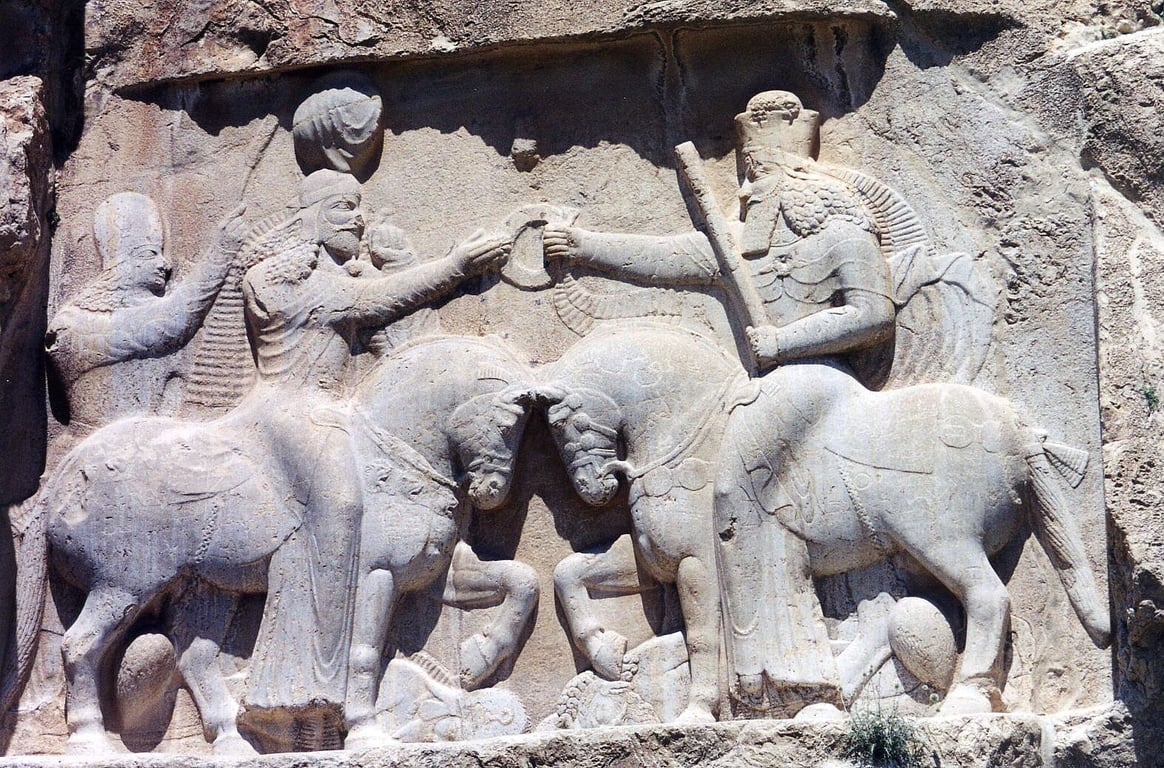
The insignia of the sovereigns were first served to represent the sovereign authority. The Avesta term for “insignia” was the same as for “royal power”, xšaθra. They then served to enhance the sovereign power and splendour, so that the realm and work of the sovereign seemed wonderful (Av. abda-) and excellent (Av. fraša-). The Persian kings had in their hands a stick which stood for the king’s power to guide and punish (right hand) and a flower of water lily (left hand); these two resemble the aštrā and suβrā of Yima.
The insignia imperii of the Persian kings were the robe, crown, shoes, parasol, throne, royal seal, bow, shield, wheel, etc. These insignia were passed on through generations symbolizing the transmission of power. For example, the new Persian king wore during the royal initiation the robe of Cyrus the Elder. On the south door of the central building of Persepolis we find an Achaemenian king under his parasol so that the sun could not directly shine on him.
…
The regalia of royalty — an exampleThe Shepherd King
Royal power is, above all, the power of protection in its two aspects, the human aspect, i.e. the power of the sovereign, and the divine aspect, i.e. the Fortune of the king. Old Persian xšāyaθiya- (Pers. šāh ≈ Av. xšaya-) rather evokes the power of the sovereign, and baga (Pers. bay) his splendor and prestige. The function of protecting men and herds and thus ensuring the guard of the kingdom is only ensured when these two aspects of power are found in the person of the king, i.e. the king who possesses Fortune (Av. xvarənah-, Pers. farr).
…
Ardašēr ī Pābagan and the Royal and Priestly Functions
Ardašēr, while continuing to proclaim the intimate relationship between royal power (Av. xšaθra-) and the action of religion (Av. daēnā-), expressed by the Pārsīg words hamzahag ‘coming from the same birth’ and hamnāf ‘from the same umbilical cord’, had to redefine this relationship in the face of the underground cults and hidden and secretive doctrines of all kinds that were spreading in Ērānšahr and beyond.
Aryan royalty was the instrument for the realization of a harmonious society; it therefore needed a vision of the world that was on a par with it. The Aryan ruler, although was not a priest-king at all, but did not allow the clergy to set up on their own account, and subordinated them to the State.
The model of the danger that threatened the kingdom, for the ancients, was the brigand-warrior (Av. mairya-) who devastated countries, destroyed cities, and left behind only misery, diseases, and ruins – like, for example, Alexander. The modern brigand shows himself in the religious aspect; he recruits from the dregs of the people, and reaps success from the wretched, the declassed, and the intriguing men. The slowly fanned fire of vengeance begins to penetrate the minds of the masses to finally ravage the structure of society and the State. The weakening of xšaθra as a ‘royal power’ and the decline of the feeling of belonging to xšaθra as a ‘kingdom’ and/or ‘homeland’ will result from the triumph of this communism before its time – hatred of sovereigns, the great and the strong, exaltation of the poor, the small and the weak.
After Ardašēr, the Persian kingdom experienced several brutal encounters with the “new” religions and royal power, until the day it was trampled and put to death by the mercenaries of an Arab bandit-prophet.
The Sovereign and the Subjects
Among the various relationships between a sovereign and a person subject to his authority, first and foremost, the relationship between father and child is the ethical representation par excellence of sovereignty. This relationship represents the golden age, the reign of Yima among the Perso-Aryans, and the reign of Rāma among the Indo-Aryans. “The conduct of a king,” says Rāmāyaṇa, “who without guarding his people as a father his son, collects customary taxes, is the most unjust and unbecoming.” It is this same relationship, according to the Mahābhārata, the prerequisite for the happiness of creatures in the world.
The Pārsīg book Ēvēn-nāmag had enumerated the different relationships concerning the different reigns until the end of the Kavis. Tha‘âlibî quotes this sentence from it:
“[In the Book of Rules] it is also said that: The benevolence of Yima towards his subjects was like that of a father towards his child; Dahāka treated his subjects as a woman his rival; Θraētaona was for his subjects like a brother towards his brothers; Fraŋrasyan was for his subjects like an enemy (against) an enemy; and Vištāspa was for his subjects like a (schoolmaster) towards children.’’
Āδar Kēvān gives the same list, and he adds:
‘‘The conduct of Husrō ī Kavādān (Χοσρόης I, sixth century) towards his subjects was like that of a partner towards another partner; the other (Sassanian) kings followed him. But after the fall of the Persian kings, the behavior of most of our governors is like that of the victor towards the vanquished, or rather that of the oppressor towards the oppressed.’’
….
 Made with Bullet